A journalist trades himself for a dead stranger, and the camera — slowly, over seven minutes — decides it is more interested in the empty square than in either of them
A Dossier on The Passenger (Michelangelo Antonioni, 1975)
A man is stuck in the desert. His Land Rover won’t move. The sand won’t talk to him. He has come to Chad to make a documentary about rebels fighting a civil war, and the rebels have not appeared, and his guide has abandoned him, and the landscape extends in every direction with the absolute indifference of something that was here before humans arrived and will be here after they leave.
He screams at the sky. The sky does not respond.
This is how Antonioni introduces David Locke, and it is the last honest thing the film allows him. From this moment forward, Locke will stop being himself — literally, deliberately, and with a calm that is more frightening than any panic. He will walk into a dead man’s room, find the body, and decide, without drama, without visible anguish, to become him.
The desert in the opening minutes of The Passenger belongs to the same geological lineage as Hanging Rock. Both are landscapes that precede and outlast the human dramas played upon them. Peter Weir’s rock swallowed three girls and a teacher and offered no explanation; Antonioni’s Sahara simply waits until the man screaming at it exhausts himself. But where Hanging Rock’s indifference was vertical — the rock towering above, time moving downward into deep strata — the desert’s indifference is horizontal. It goes on. It goes on. There is no edge to reach, no summit to attain. There is only more of the same, in every direction, forever.
It is the perfect setting for a man who has run out of reasons to be himself.
Robertson is dead in the next room. Heart attack, apparently. He and Locke had talked the night before — two men in a nowhere hotel, drinking, comparing notes on exhaustion. Robertson sold arms to the rebels Locke was trying to interview. They looked somewhat alike. They had neighbouring rooms.
Locke switches their passport photos. He takes Robertson’s diary, his appointments, his identity. He reports his own death and walks out of the hotel as someone else.
There is no moment of crisis. No anguished soliloquy. No visible tipping point. Bobby Dupea, five years earlier, had at least given us the diner scene — a man raging against the constraints of a world that refused to serve him what he wanted. Llewyn Davis was trapped in a loop he couldn’t see, circling back to the same bar, the same beating, the same failure. Both men were prisoners of themselves, but they fought — Dupea by running, Davis by enduring.
Locke doesn’t fight. He simply steps sideways. He slides out of his own life the way you might leave a room without closing the door, and walks into another man’s life with no more ceremony than checking into a hotel. The self-mythology thread that has run through this project from the beginning — Bobby’s performance of the rebel who doesn’t care, Llewyn’s performance of the artist who deserves better, the Writer in Stalker performing his cynicism as if it were wisdom — arrives here at its logical terminus. Locke doesn’t mythologise himself. He erases himself. He doesn’t construct a more flattering story; he abandons story altogether and borrows someone else’s plot.
And the borrowed plot, it turns out, is fatal.
Robertson’s diary is full of appointments. Locke keeps them. He meets men in hotel lobbies. He receives money. He is given instructions. Slowly, without ever quite being told, we understand that Robertson was an arms dealer — that the appointments are with rebel contacts, that the money is for weapons, that the identity Locke has stepped into is not an escape but a corridor leading somewhere very specific.
This is the film’s central mechanism, and it operates with the quiet precision of a trap: Locke wanted to be no one, and instead he has become someone more consequential than he ever was. He wanted to shed responsibility, and instead he has inherited a dead man’s obligations — obligations that carry the weight of other people’s wars, other people’s deaths.
Antonioni said he never thought about meaning — that he had nothing to say, but perhaps something to show. When an interviewer asked him to explain The Passenger in words, he replied that if he could do the same thing with words, he would be a writer and not a film director. This was not false modesty. It was a precise description of what his cinema does: it shows you a man walking through spaces that are larger than his problems, and it asks you to feel the disproportion.
The disproportion is the point. Locke moves through Barcelona, through Munich, through the south of Spain, and in every location Antonioni’s camera is drawn away from him — toward architecture, toward landscape, toward the geometry of empty plazas and crumbling walls. The camera is interested in Locke, but it is more interested in the spaces Locke moves through. It treats him the way the desert treated him in the opening scene: as a temporary presence in an enduring world.
Then there is the Girl.
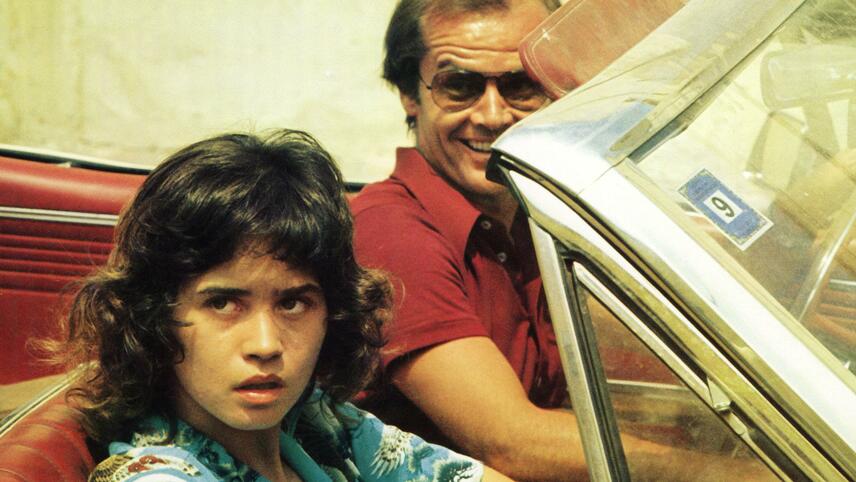
She has no name. She appears in Barcelona, reading on a bench in front of Gaudí’s architecture. She is young, spontaneous, unattached. She asks no questions that require honest answers. When Locke tells her he used to be someone else but traded him in, she responds with her location: Well, I’m in Barcelona.
It is a perfect exchange — two people declining to know each other, agreeing instead to share space and motion. She becomes his companion not because she understands him but because she doesn’t need to. She is, as the film’s title suggests, a passenger. But so is he. They are both passengers in Robertson’s life, following a dead man’s itinerary toward a destination neither of them chose.
The Girl asks Locke what he is running from. He tells her to turn her back to the front seat. It is the only direct question she asks, and the only one he refuses to answer, and the refusal is more honest than any answer would have been. Because Locke is not running from anything specific. He is running from the condition of being David Locke — from what he describes, in a rare moment of candour, as having run out of everything. His wife, his house, his adopted child, his successful career — everything except a few bad habits he couldn’t get rid of.
Those bad habits are the film’s quiet thesis. You can change your name, your passport, your continent. You can walk into a dead man’s life and keep his appointments and spend his money. But the habits — the way you hold a cigarette, the way you fall silent when someone looks at you too long, the way you translate every situation into the same old codes — these travel with you. They are not David Locke’s habits or Robertson’s habits. They are the habits of being a person, and no identity swap can shed them.
Locke tells the Girl a story about a blind man who had an operation and regained his sight. At first the man was elated — faces, colours, landscapes, all of it new and overwhelming. But then everything changed. The world was much poorer than he had imagined. No one had told him how much dirt there was. How much ugliness. He noticed ugliness everywhere. He became afraid. He retreated into darkness. He never left his room. After three years, he killed himself.
It is the most important speech in the film, and Antonioni places it not as a confession but as an anecdote — something Locke offers casually, as if it were about someone else entirely. But of course it is about him. Locke was a journalist. His profession was seeing — looking at the world and reporting what he found. And what he found was that the looking itself was a prison: People will believe what I write. And why? Because it conforms to their expectations — and of mine, as well — which is worse.
The ethics of looking, again. In Caché, Georges refused to see what France had done. In The Zone of Interest, the Höss family trained their eyes to see only the garden. In Persona, Elisabet harvested what she saw in Alma’s confessions. But Locke’s relationship to looking is different from all of these. He is not refusing to see, or curating what he sees, or predating upon what he sees. He is exhausted by seeing. He has looked at the world professionally for so long that the act of observation has become indistinguishable from the act of lying.
This is what a witch doctor tells him early in the film, in a scene that reverberates long after it passes. Locke is interviewing a man for his documentary when the man turns the camera around to face Locke and says: Your questions are much more revealing about yourself than my answers would be about me. The camera, reversed, becomes a mirror. The journalist is exposed as the subject. The observer is observed.
Antonioni described his own role in the film as “the journalist behind the journalist” — someone who added other dimensions to what Locke considered reality. He was not interested in Locke’s escape as a plot. He was interested in the impossibility of escape as a condition.
And then, the final shot.
Seven minutes. One unbroken take. Eleven days to film.
Locke lies on a bed in a shabby hotel room in a Spanish village. The camera faces the window. Iron bars. Beyond them, a dusty square. A driving school car circling. A dog. Dust.
The camera begins to move forward. Slowly — so slowly you might not notice at first — it glides toward the window. It reaches the bars. And then, impossibly, it passes through them.
Outside, the square continues its life. The Girl walks at a distance. A car arrives with people searching for Locke. The camera, now free of the room, circles the square in a wide arc, taking its time, observing the dust and the dog and the driving school car with the same unhurried attention it gave to Locke. Then it turns back toward the hotel. It looks through the window from the outside. The bars are now closed. Locke is dead on the bed.
His wife arrives. She is asked if she knew the man. She says: I never knew him.
The camera passed through the bars. This is the fact that haunts the film. The bars that contained Locke — the iron grid of identity, obligation, habit, selfhood — could not contain the camera. The camera simply moved through them, the way Locke wanted to move through his own life and could not. The camera achieved the escape that the man could not achieve.
Ebert, who initially disliked the film but returned to it thirty years later with the reverence of a man who had finally understood what he’d been looking at, noted that the driving school car in the square was perhaps the film’s most devastating detail. Robertson is dead. Locke is dead. And outside, someone is learning first gear, second gear, clutch, brake. The world continues its small educations. Neither death interrupts anything.
The landscapes that don’t care — Hanging Rock’s ancient stone, Stalker’s Zone that offered everything and gave nothing, the wall in The Zone of Interest that separated the garden from the crematorium — find their most radical expression here. The Spanish square does not care that a man has died in the hotel. The camera, having passed through the bars, discovers what Locke could not: that the world on the other side of identity is not freedom. It is simply the world, continuing without you, as if you had never been.
There is a conversation early in the film, recorded on Locke’s tape deck, that plays back like a ghost speaking:
Locke says: Wouldn’t it be better if we could just forget old places. Forget everything that happens. Just throw it all away, day by day.
Robertson replies: Unfortunately, the world doesn’t work that way.
Locke says: But it doesn’t work the other way either — and that’s the problem.
Both men are right. And the problem — the irreducible, unfixable problem — is that there is no third option. You cannot shed yourself, and you cannot bear yourself. You are stuck between two impossibilities, and the space between them is the space the film inhabits for its entire running time.
Elisabet Vogler tried silence. The Stalker’s visitors tried the Room. Chow Mo-wan tried a whispered secret buried in a stone wall at Angkor Wat. Bobby Dupea tried driving away. All of them were looking for the third option — the door that opens onto something other than yourself or the unbearable world that made you. None of them found it.
Locke tried the most radical version: he tried to become someone else entirely. And what he discovered is what Antonioni spent his career showing: that the self is not a costume you can change. It is the body wearing the costume. It travels with you into every borrowed life, every false passport, every new name. The bad habits you cannot get rid of are not habits at all. They are you.
The camera passes through the bars. You don’t.
“I don’t have anything to say but perhaps something to show. There’s a difference.” — Michelangelo Antonioni, Film Comment interview, 1975
“People disappear every day.” “Every time they leave the room.” — The Girl and David Locke