When a woman stops performing, the woman watching her begins to vanish — and the film watching them both starts to come apart
A Dossier on Persona (Ingmar Bergman, 1966)
THE MOUTH
A woman stops speaking. Not gradually, not with a stammer or a trailing off. In the middle of performing Electra on stage — a role about grief that has curdled into something ungovernable — Elisabet Vogler simply stops. She looks at the audience. She looks, perhaps, through them. And then she is silent.
The doctors find nothing wrong. Her body works. Her vocal cords are intact. She could speak if she chose to. She does not choose to.
Bergman does not explain this. The film’s doctor offers a hypothesis that is more like a poem than a diagnosis: the hopeless dream of being, not seeming. At every waking moment, alert. The gulf between what you are with others and what you are alone. She describes Elisabet’s silence as a decision, not a breakdown — a woman who has realised that every inflection is a lie, every gesture a falsehood, every smile a grimace, and who has concluded that the only honest act remaining is to stop.
This is where the unease begins, and it never lifts.
Because the film does not treat Elisabet’s silence as a problem to be solved. It treats it as a question that contaminates everything around it. If she is right — if speech is performance and performance is dishonesty — then what is Alma doing every time she opens her mouth? What are we doing every time we accept the roles we’ve been given?
In Franco’s Spain, a country stopped speaking, and a child named Ana walked into the silence looking for answers that would never come. In Francoist silence, the muteness was imposed from outside — a nation’s throat closed by fear. But Elisabet’s silence comes from within. She is not forbidden to speak. She has decided that speech itself is the problem.
This is a more radical proposition. Ana’s Spain suppressed truth by force. Elisabet suggests that truth cannot survive the act of being spoken at all.
THE EARS
Into this silence walks Alma.
She is young, competent, recently engaged, recently qualified. She believes in her life the way a person believes in furniture — it is solid, it is there, it serves its purpose. She tells the doctor as much. She will marry Karl-Henrik. They will have children. It is all decided, all inside her. Nothing to ponder. She says this with a confidence that the film regards with something very close to tenderness, because it knows what is about to happen.
They are sent to a cottage by the sea. Elisabet will recover. Alma will care for her. The arrangement seems simple.
But silence is not passive. Silence is a vacuum, and Alma rushes in to fill it.
She talks. She talks about her life, her fiancé, her ideas about art. She talks about how she admires artists, how she believes art is important — especially for people in difficulties. And then, one evening, with the rain and the wine and the dark, she talks about something she has never told anyone.
A day on a beach. Two boys. Another woman’s body. Her own body responding with an abandon that terrified her. An orgasm so overwhelming it seemed to belong to someone else. A pregnancy. An abortion. The knowledge, buried but never quite deep enough, that she has been performing normalcy over a chaos she has never resolved.
She pours all of this into Elisabet’s silence. And Elisabet receives it — her face in close-up, watching, absorbing, offering nothing back.
Roger Ebert, returning to the film decades after first reviewing it, observed that the most real experience Alma has ever had was that moment on the beach, and that most of what we call “ourselves” is not direct experience of the world at all, but a kind of mental broadcast assembled from other people’s expectations.
He was right, and the film knows it before he does. Alma’s confession is the moment she becomes real — and it destroys her, because once you’ve been real in front of someone who refuses to reciprocate, you can never go back to performing.
Bobby Dupea fled from this exact reckoning. He drove away. Llewyn Davis circled it endlessly without arriving. But Alma walks straight into it. She gives herself to Elisabet’s silence completely, and the silence takes her apart.
THE EYES
Here is what Elisabet does with what she receives: she writes a letter.
She writes to her doctor about Alma. She describes the nurse’s confessions with clinical amusement — it is fun studying her, she writes. She mentions the orgy. She mentions the abortion. She treats the most devastating revelation of Alma’s life as material.
And Alma reads the letter.
This is the pivot. Not because it is a betrayal — though it is — but because it reveals that Elisabet’s silence was never honesty. It was strategy. She stopped performing on stage, but she never stopped performing. She simply found a new audience: a single person, in a cottage, by the sea, who was foolish enough to believe that silence meant safety.
The ethics of looking have haunted this project from the beginning. In Caché, Georges Auteuil refused to see what his country had done, and the film refused to let him look away. In In the Mood for Love, Chow Mo-wan and Su Li-zhen watched each other with an intensity that was its own form of contact, a gaze that substituted for the touch they would not allow themselves. In The Zone of Interest, the Höss family lived beside a death camp and trained their eyes to see only the garden.
But Persona adds something none of those films quite reach. Elisabet does not merely look. She harvests. Her silence is not withdrawal; it is a method of extraction. She creates a space in which another person feels compelled to expose herself, and then she collects what is exposed. The vampire metaphor that critics have applied to Persona is not a metaphor at all. It is the film’s diagnosis of what one person can do to another simply by being quiet and attentive.
And yet — and this is the part that keeps the unease alive — can you entirely condemn her? Is what Elisabet does to Alma fundamentally different from what any artist does? What a filmmaker does? What a writer does, sitting across from someone who has agreed to talk?
Bergman never answers this. He can’t, because he is doing it too. The camera itself is Elisabet — silent, watchful, taking everything in, giving nothing back. Sven Nykvist’s close-ups of Andersson’s face as she confesses are among the most beautiful and most merciless images in cinema. They are acts of extraordinary intimacy and extraordinary predation simultaneously, and there is no clean line between the two.
THE SKIN
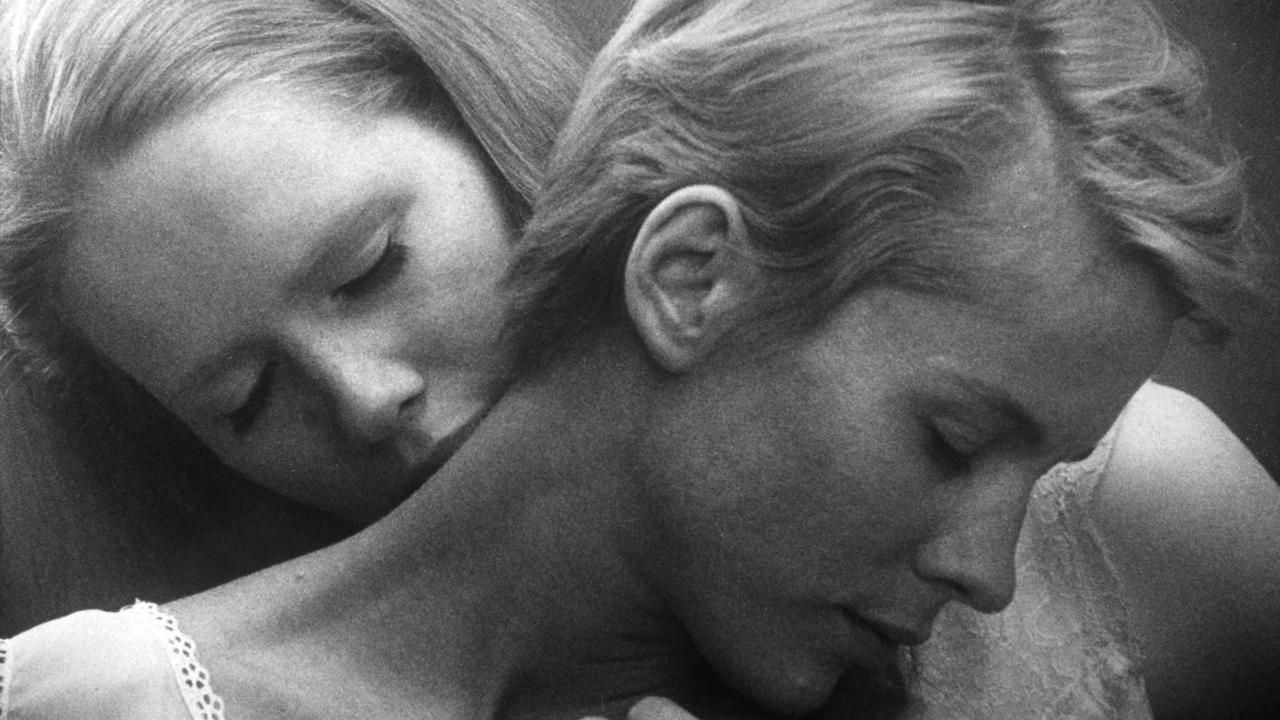
Then the faces merge.
It is the most written-about image in the history of film criticism, and it earns every word. Alma delivers a monologue about Elisabet’s relationship with her son — about the pregnancy she didn’t want, the child she tried to destroy, the motherhood she performs without feeling. Bergman shoots the speech twice: once watching Alma speak, once watching Elisabet listen. Then he takes half of each woman’s face and joins them into a single composite.
The image is uncanny because it works. The two faces fit. The join is visible but the resulting face is coherent, and there is a sickening moment where you cannot remember which half belongs to whom.
Susan Sontag called Persona a desperate duel of identities, but also the duel between two mythical parts of a single self — the corrupted person who acts and the ingenuous soul who founders in contact with corruption. Persona and Alma. Mask and soul. She was not just describing the film; she was describing the architecture of selfhood itself, and the terrifying possibility that the mask and the soul are not separable — that you cannot remove one without destroying the other.
This is the image that Mulholland Drive would spend thirty-five years trying to reach. Betty and Rita, blonde and brunette, the dreamer and the dreamed — Lynch’s film operates in the same territory, but where Lynch allows the dream to sustain itself for most of the running time before the box opens and identity collapses, Bergman makes the collapse the film’s central event. He puts it right in the middle. He shows you the composite face and then keeps going.
And what he shows after is worse: Alma screaming, I’m not like you. I don’t feel like you. I’m not Elisabet Vogler. You are Elisabet Vogler. I’m just here to help you. The words of a person who is no longer certain they are true.
THE CRACK
Midway through the film, the image burns.
The celluloid seems to catch fire in the projector gate. The picture warps, melts, goes white. Then darkness. Then fragments: the same disconnected images from the prologue — the nail, the spider, the dead. Then the film restarts.
Projectionists at the 1966 premiere stopped the screening, convinced the print had been damaged. The cans had to be labelled with warnings: The film does not actually catch fire.
But of course it does. Not the celluloid — the fiction. Bergman is showing you the moment when the story can no longer contain what it is trying to hold. The friction between these two women has become too much for the medium. The film itself breaks under the pressure.
This is the gesture that separates Persona from every other film about identity. It is not content to explore the dissolution of self within the story. It dissolves itself. It turns the camera around. It shows you the crew filming the scene you are watching. It reminds you that what you have been treating as reality is light projected through a strip of plastic, and that your emotional investment in these two women is itself a kind of performance — you in the dark, pretending that shadows on a wall are people.
In Stalker, the Zone offered each visitor what they truly desired, and the terror was that no one dared enter the Room to receive it. But Bergman’s gesture is more vertiginous. He is not offering you a room you’re afraid to enter. He is showing you that the room you thought you were already inside — the room of the film, the room of narrative — was never really there. You have been sitting in the dark, watching light move. The Room in Stalker at least had a door. Persona has no walls at all.
Bergman himself said it plainly. He felt that with Persona, working in total freedom, he had touched wordless secrets that only cinema could discover. Not wordless secrets that cinema could express — that cinema could discover. The medium was not the vehicle. It was the investigation.
THE MIRROR
And so we arrive at the question the film leaves behind.
Not what is Persona about? — that question is a trap, and the film knows it. Bergman cautioned against the urge to demystify, telling a Swedish interviewer in 1966 that each person should experience it the way they feel. Ullmann, half a century later, was even more direct: Persona is not to be explained.
Not who is Elisabet and who is Alma? — that question collapses the moment you ask it, because the film has shown you that the boundary between them is permeable, perhaps illusory, perhaps nonexistent.
The question is this: What is left when you stop performing?
Elisabet stops performing and the answer appears to be: nothing. Or something worse than nothing — a silence that feeds on other people. Alma tries to stop performing — is forced to stop, really, by the demolition of her carefully constructed self — and the answer appears to be: a scream, a denial, a desperate reassertion of a self she is no longer sure she possesses.
Neither answer is reassuring.
The boy in the prologue — that child in the hospital or morgue who reaches toward the blurred image of a woman’s face on a screen — has been read as Elisabet’s unwanted son, as a stand-in for the viewer, as cinema itself in its infancy. He reaches, and what he touches is not a person but a projection. He reaches for a mother’s face and finds light on glass.
This child joins a lineage that runs through the body of this project like a nerve. Ana in The Spirit of the Beehive, asking questions no one will answer. The Stalker’s daughter, moving a glass with her mind in a kitchen where faith has been replaced by exhaustion. The Höss children in The Zone of Interest, playing in a garden fertilised by ash. Children who witness what adults have agreed not to see. Children who reach for something real and find only the performance of reality.
But the boy in Persona reaches for something even less substantial than the lies those other children were given. He reaches for an image. He reaches for cinema itself — for the medium that promises to show us real faces and instead shows us light shaped by someone else’s decisions.
Bergman understood this. He understood that his own art was a form of the very deception Elisabet was trying to escape. He made a film about the impossibility of authenticity, and in doing so created something that feels more authentic than almost anything else in cinema. That paradox is the engine of Persona’s unease, and no amount of critical analysis will ever resolve it, because the paradox is not a flaw. It is the point.
The film begins with a projector starting up. It ends with a projector shutting down. In between, two women try to be real, and fail, and in their failure Bergman discovers something that only the cinema can discover — something he could not name, because naming it would be another performance, another mask, another lie.
He left the discovery wordless. The silence is the finding.
“I feel that with Persona — and later, Cries and Whispers — I had gone as far as I could go. And that in these two instances, when working in total freedom, I touched wordless secrets that only the cinema can discover.” — Ingmar Bergman, Images: My Life in Film
“Each person should experience it the way they feel.” — Ingmar Bergman, Swedish television interview, 1966
“It’s not me, you know?” — Liv Ullmann, on Persona, 2024