It is raining.
Three men sit beneath a ruined gate. The gate is enormous, crumbling, a relic of something that was once grand. The rain falls in sheets. The men have nowhere to go. They have time. And one of them says he does not understand what happened.
This is the frame. This is where Akira Kurosawa places us: in a ruin, in a storm, listening to people try to make sense of an event that resists sense. Everything that follows, the four testimonies, the contradictions, the forest and the murder and the beautiful wife and the bandit and the samurai, is told from this position. From the gate. From the rain. From the wreckage.
Rashomon is the most influential film ever made about the unreliability of narrative, and it has been analyzed for seven decades as a film about truth. About subjectivity. About the impossibility of knowing what really happened.
All of that is right. None of it is the point.
The point is not in the forest, where the stories compete. The point is at the gate, where the stories end and a man picks up a child.
The Event
A samurai is dead. His wife has been assaulted. A bandit named Tajōmaru has been captured.
These are the only facts that are not in dispute. Everything else, the how, the why, the sequence, the motivation, the moral meaning, shifts depending on who is telling.
Kurosawa presents four versions of the same event:
Tajōmaru, the bandit, tells a story in which he is a magnificent and dangerous warrior. He tricked the samurai, tied him up, and took the wife. The wife, overwhelmed by his virility, begged him to fight her husband for her honor. The two men dueled. It was spectacular. Tajōmaru won.
The wife, Masako, tells a different story. She was assaulted. Her husband looked at her afterward with cold contempt. The contempt was worse than the assault. She begged him to kill her. He would not. She fainted, and when she woke, the dagger was in his chest. She may have done it. She does not know.
The samurai, speaking through a medium, tells a third version. His wife, after the assault, asked the bandit to kill him. The bandit, disgusted, turned to the samurai and asked whether he should let her go or kill her. The wife fled. The bandit left. The samurai, alone, took the dagger and killed himself.
The woodcutter, the fourth witness, the man who found the body, tells the version he claims he saw. The wife manipulated both men into fighting. The fight was clumsy, fearful, pathetic. Two men stumbling through the underbrush, terrified, neither wanting to die. Tajōmaru eventually won, but it was nothing like the heroic duel he described.
Four versions. Each internally consistent. Each contradicting the others on essential points. Each serving the teller’s need to be a particular kind of person in the story.
The Need
This is what most analyses of Rashomon identify and then fail to pursue far enough: the stories are not simply inaccurate. They are shaped by need.
Tajōmaru needs to be a great warrior. His story turns the assault into a romance and the murder into an epic duel because Tajōmaru’s identity depends on being a figure of dangerous charisma. A clumsy fight in the bushes, the version the woodcutter describes, is not a story Tajōmaru can live inside. He needs the duel.
The wife needs to be a victim. Not because she is performing victimhood, but because the alternative, that she had agency, that she made choices, that her actions contributed to her husband’s death, is a story her culture and her self-image cannot accommodate. She needs the faint. She needs the gap in memory. She needs the uncertainty.
The samurai needs to be noble. A warrior who was tied up and whose wife was taken cannot be a figure of honor, so the samurai’s story reframes the event: his death was a suicide, a choice, a dignified response to his wife’s betrayal. He needs the dagger in his own hands. He needs the death to be his.
The woodcutter needs to be uninvolved. He says he merely witnessed. But the commoner at the gate notices that the dagger is missing from the woodcutter’s account, and suggests the woodcutter stole it. The woodcutter, the man who positions himself as the objective observer, the witness with no stake, may have been the most compromised of all.
Four needs. Four stories. And Kurosawa does not rank them. He does not shoot one version with more authority than the others. He does not use lighting or framing or music to signal which account is closest to the truth. He gives each version the same visual treatment, the same narrative weight, the same cinematic respect.
This is the most important formal choice in the film, and it is the one that makes Rashomon something beyond a clever exercise in perspectivism. Kurosawa is not saying: one of these is true and the rest are lies. He is saying: each of these is the truth as experienced by the person who needs it to be true. And the need is not a distortion of the truth. It is the mechanism by which truth is produced, always, in every account, including yours.
The Forest
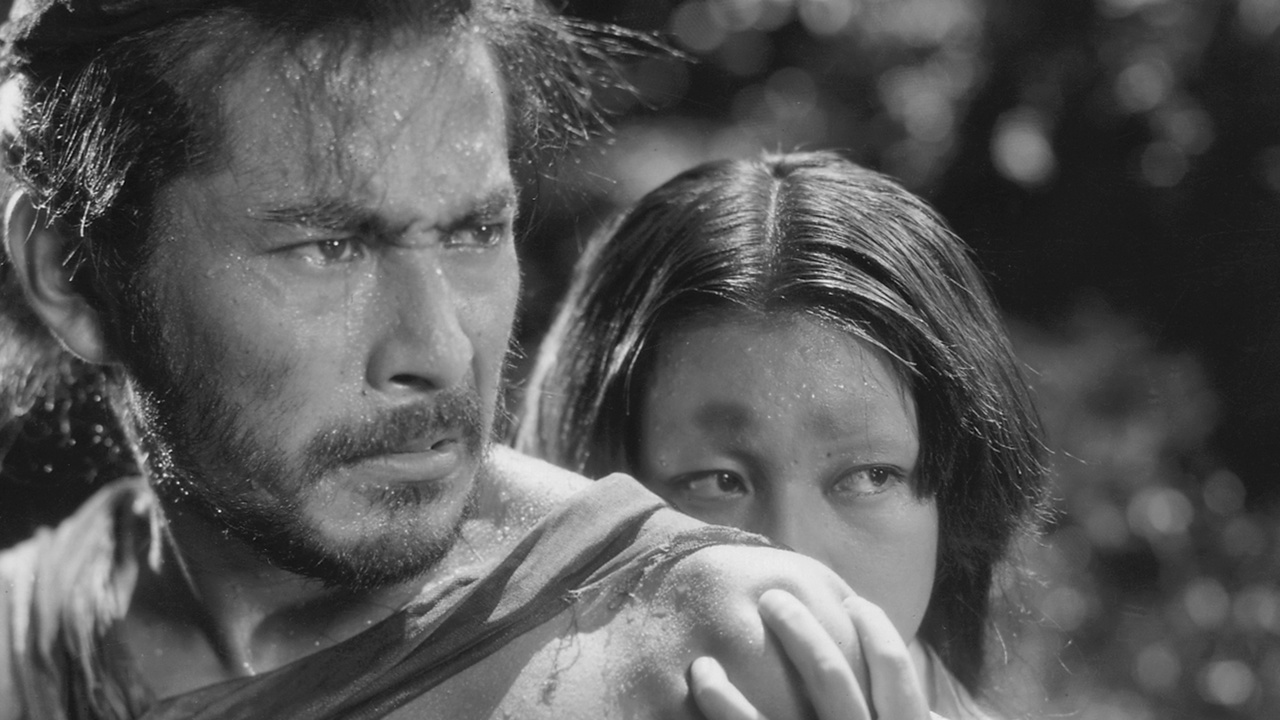
Kurosawa films the forest scenes in direct sunlight.
This seems like a small detail. It is the key to the film’s visual argument.
The forest is bright. The light comes through the canopy in patterns that shift and dapple, so that the faces of the actors are never evenly lit. Light and shadow move across them constantly, as though the truth itself is flickering, never settling, illuminating one thing and obscuring another in the same instant.
This is the opposite of the noir lighting that governs films like Chinatown and Mulholland Drive, where darkness conceals and the detective moves from shadow toward revelation. In Rashomon, the light is abundant. There is no shadow to blame. The truth is not hidden in darkness. It is hidden in brightness, in the excess of light, in the way that too much illumination can be as blinding as too little.
The forest is beautiful. The event that occurs inside it is ugly. And the beauty and the ugliness occupy the same space without resolving, the way the four stories occupy the same event without resolving.
Kurosawa understood something that Western cinema would take decades to articulate: that the setting of a story is never neutral, that the light you film in is an argument about what kind of knowledge is possible, and that a forest full of light is the perfect setting for a story about blindness, because blindness in full daylight is the kind of blindness that cannot be cured by turning on a lamp.
You can see everything in the forest. You can see nothing true.
The Gate
Now come back to the gate.
The three men, the woodcutter, the priest, and the commoner, have been sitting in the rain throughout the testimonies. The priest is shattered. The commoner is cynical. The woodcutter is defensive.
The commoner is the film’s most unsettling figure, because he is the audience’s surrogate and he knows it. He listens to each story and responds with a shrug. Of course people lie. Of course everyone is self-serving. Of course the truth is unavailable. This is not a revelation. This is the human condition. What else did you expect?
The commoner’s cynicism is the trap Kurosawa sets for the audience, and it is the trap this series has been circling since No Country for Old Men. After enough stories fail, after enough narratives prove unreliable, after enough investigations lead to nothing, the temptation is to conclude that nothing means anything. That stories are always lies. That truth is always inaccessible. That the only honest position is the commoner’s shrug.
This is the position No Country arrived at. Sheriff Bell’s retirement. The coin toss. The waking up. The kitchen table.
Rashomon takes you to that same position. It sits you in the rain with the commoner and lets his cynicism wash over you. And then it does the thing that No Country did not do.
It gives you the baby.
The Baby
A sound. Crying. From somewhere in the ruined gate. The three men find a baby, abandoned, wrapped in cloth.
The commoner takes the baby’s clothing. He will sell it. When the woodcutter protests, the commoner confronts him: you stole the dagger. You’re no better. You’re no different. We’re all thieves. We all take what we can. The commoner’s philosophy is complete and consistent and irrefutable, and it is the philosophy that the four testimonies seem to support.
The commoner leaves. The priest holds the baby. The woodcutter reaches for it.
The priest recoils. Another theft? Another self-serving act?
The woodcutter says he has six children. One more won’t make a difference.
He takes the baby. He walks into the rain. The priest watches him go.
This is the ending of Rashomon, and it is the ending this series has been walking toward for forty-one films.
Not because it resolves the question of truth. It does not. The four testimonies remain contradictory. The murder remains unsolved. The human capacity for self-serving narrative remains intact. Nothing about the baby changes the epistemological problem the film has posed.
But the baby changes the question.
The question was: what is true? The baby answers: it doesn’t matter. Not because truth is unimportant, but because the baby is crying and the rain is falling and someone has to act. Not narrate. Not testify. Not construct a version of events that serves their self-image. Act. Pick up the child. Walk into the rain. Do the thing that exists below narrative, beneath testimony, before the story starts.
The woodcutter is not a hero. He may have stolen the dagger. His testimony may be as self-serving as the others. He is not a reliable narrator. He is not a good man in any uncomplicated sense.
He picks up the baby anyway.
And Kurosawa argues, through this gesture, that the act is not less valuable because the actor is compromised. That the good deed does not require a good person. That the thing which exists after every story has been told and none of them are true is not nothing. It is the crying child. It is the specific, irreducible demand of a human being who needs something, right now, in the rain, regardless of whose version of events is correct.
After Narrative
This is where Rashomon meets the arc of Cycle Three and offers something none of the previous films could.
The cycle began with Mulholland Drive, a film about a story that collapses. It moved through stories that succeed toxically (Taxi Driver), stories provided by institutions (The Shining), stories that complete but change nothing (Chinatown), stories that become obsolete (No Country), stories that are sold (Network), stories that are traps (Oldboy).
Then the turn. Stories that resist (Pan’s Labyrinth). Stories that transform the listener (The Lives of Others). The mutual gaze that creates a shared story (Portrait of a Lady on Fire). The ghost of the unlived story that walks beside the lived one (Past Lives).
Rashomon arrives after all of this and asks: what if you set the stories down?
Not reject them. Not debunk them. Not cynically dismiss them the way the commoner does. But set them down the way you set down a tool that has done its work. The testimonies were told. They were heard. They were found wanting. And now there is a baby.
Kurosawa does not propose that narrative is useless. The four testimonies reveal something real about each teller: their needs, their self-image, their relationship to violence and desire and honor. The stories are not empty. They are just not sufficient. They cannot reach the thing that the baby’s cry reaches, which is the pre-narrative demand: I am here. I need something. What will you do?
The woodcutter’s answer is not a story. It is a gesture. He reaches for the child. He takes it. He walks.
The rain does not stop. The gate remains in ruins. The truth remains unavailable. And a man carries a baby into the world because the baby is there and the baby needs carrying.
This is not hope in any triumphant sense. It is not a redemption arc. It is not a narrative of restoration. It is the smallest possible unit of meaning: one person, one need, one act.
And after forty-one films of stories that trap and stories that free and stories that haunt and stories that collapse, the smallest possible unit of meaning turns out to be enough.
1950
One more thing about context.
Rashomon was released in 1950. Japan was five years past Hiroshima and Nagasaki. The country was under American occupation. The national narrative, the story Japan had told itself about its identity, its military destiny, its divine emperor, had been comprehensively destroyed. Not revised. Destroyed. The way a gate is destroyed.
Kurosawa made a film about the unreliability of stories in a country whose foundational story had just been proven not merely wrong but catastrophically wrong, and millions of people had died inside that story, and the ruins were still standing, and the rain was still falling.
The baby in the gate is not an allegory. But it is informed by the knowledge that Kurosawa and every person in his audience carried: that the grand narratives had failed, that the institutional stories had produced annihilation, and that the question of what remained was not academic. It was existential.
What remained was the gate. What remained was the rain. What remained was the person next to you and the question of whether you would act.
Kurosawa’s answer is the woodcutter’s answer: you pick up the child. Not because you are good. Not because the story tells you to. Because the child is there.
Where This Leads Us
Rashomon sets the stories down and finds the act. It arrives at the place beneath narrative where something still holds.
But there is a film that takes narrative’s self-awareness to a different extreme. Not the solemn deconstruction of Rashomon but something stranger, louder, more playful, and, in its way, more frightening. A film in which the characters have seen the same movies you have. In which they know the rules. In which the rules are not subtext but dialogue, spoken aloud, tested in real time, and following the rules is the only thing that might save your life.
If Rashomon asks what remains when the stories fail, this next film asks what happens when the story knows it’s a story. When the genre watches itself. When the audience is not just implicated but cast.
The phone is ringing. The voice on the other end wants to know: what’s your favorite scary movie?