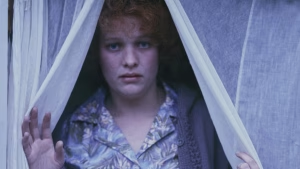
An Angel at My Table corrects the world’s misreading of Janet Frame by reading her from the outside. The correction is magnificent. The reading has its own blind spot.
“I was baffled by my fuzzy hair and the attention it drew, and the urgency with which people advised that I have it ‘straightened’, as if it posed a threat.”
Janet Frame wrote this in her autobiography — the three volumes that are the film’s source and soul. She was describing the same hair the film makes its primary visual language for her inner life: the cloud of unruly red that crowns all three actresses playing Frame at different ages, the most expensive item in the production budget, lit in the film’s iconic image like a lightbulb against the southern New Zealand sky. In Campion’s telling, the hair means Frame’s vitality. It means her fire. In the hospital sequences, when the color drains from it, you feel her extinction. When it blazes again on the other side, you feel her survival.
In Frame’s own account, the hair made her feel baffled. People wanted to straighten it. She found the urgency with which they said so bewildering, as though the hair were doing something to them rather than simply growing.
The film’s doctors read Janet’s shyness and strangeness as schizophrenia. The film reads Janet’s hair as her soul. Both gestures translate an interior into an exterior sign. One is catastrophic. One is beautiful. The difference in consequence is total; the difference in method is smaller than the film can see.
An Angel at My Table, directed by Jane Campion and released in 1990, was made first as a three-part television miniseries — three episodes, covering Frame’s life in installments across a combined 158 minutes — before critics received it with such force at Venice that it was released theatrically as a single film. It follows Janet Frame (played as a child by Alexia Keogh, as a teenager by Karen Fergusson, and as a young adult by Kerry Fox) from her impoverished but literate childhood in rural New Zealand, through the university years that precipitated a breakdown, through eight years in psychiatric institutions where she received over two hundred electroshock treatments and came within days of a lobotomy that was cancelled only because a literary prize arrived in time, and through her emergence as one of New Zealand’s most significant writers. Roger Ebert gave it four stars and wrote that it “tells its story calmly and with great attention to human detail,” and that he found himself “drawn in with a rare intensity.” He was right about the calmness. He was right about the intensity. He did not ask whether the calmness was also the film’s limit.
| Director | Jane Campion |
|---|---|
| Year | 1990 |
| Runtime | 158 minutes |
| Cast | Kerry Fox, Alexia Keogh, Karen Fergusson, Iris Churn, K. J. Wilson |
| Awards | Grand Special Jury Prize, Venice 1990; International Critics’ Award, Toronto 1990 |
| Streaming | Criterion Channel, Max |
The previous review in this sequence asked what Campion knew about silence before she made it beautiful in The Piano. An Angel at My Table is the answer: she knew it could be damage. She knew that the world would read a woman’s stillness as pathology, that the space a person needs to write could be diagnosed as deterioration, that the particular kind of attention Frame brought to language would look, to people who did not understand it, like absence of mind. She made a film that corrects this with extraordinary dignity. The correction is real. It is also made, necessarily, from the outside of what it is correcting.
“The film gives Frame her life back. It cannot give her her prose. And the prose is what makes the life matter — not as suffering survived, but as the specific way a mind moved through the world and translated it into language unlike anyone else’s. The hair you can film. The sentences you cannot.”
Frame was not simply a woman who survived psychiatric abuse and became a writer. She was a writer whose prose is unlike any other: strange, lyrical, deliberately vertiginous, aware of language as a system that both traps and releases. Her novel Faces in the Water — written during her institutionalization, about institutionalization — is not a document of suffering but an act of formal strangeness, a book that uses the fractured consciousness of the ward to dismantle the sentence itself. You do not need to have read it to watch the film. But the film, which is based on Frame’s autobiography rather than her fiction, has no mechanism to show you what the writing actually does. We see Kerry Fox at a typewriter. We are told the books are brilliant. We watch a literary prize arrive in the mail and stop a lobotomy. The film is faithful to every fact of Frame’s life and formally incapable of rendering the quality of her intelligence.
This is the difference between the film’s subject and the film’s source. The autobiographies Campion adapted are Frame telling her own story in her own voice. The film is Campion telling Frame’s story in Campion’s visual language. The translation involves a necessary loss that the film, which is so committed to restoring what was taken from Frame, cannot fully acknowledge: that what was taken from her was eight years in which she would have been writing, and what she had to fight her way back to was not life in general but the specific freedom to make sentences that no one had made before.
The episodic television structure reveals this more clearly than a more densely constructed film might. Because the form watches Janet from outside across decades — childhood, adolescence, young adulthood, Europe, return — it accumulates the facts of her life without inhabiting the quality of her consciousness. The three actresses are extraordinary, each picking up the thread of Frame’s shyness and private intensity from the other with uncanny continuity. But they are giving us Frame observed, Frame at a distance, Frame in landscape. Campion’s camera, so attuned in The Piano three years later to what an interior life sounds like from the inside — Ada’s music as her actual voice — here watches Frame from the respectful, loving distance of a biographer.
The film to place alongside this one is Paterson, Jim Jarmusch’s 2016 film about a bus driver who writes poems, already reviewed on this blog, where the central blind spot was that Paterson’s poetic genius was borrowed from the celebrated Ron Padgett and then presented as the spontaneous expression of a humble and unrecognised man. The films are mirror images of the same problem. Jarmusch needed to show poetic genius and could not generate it, so he borrowed real poems and attributed them to a fictional person. The result is a film that celebrates unrecognised creativity using the work of a recognised and decorated poet, and the gap between the film’s argument and its method is where the blind spot lives.
Campion had access to the real thing. Frame’s own prose was there, in three volumes, before the camera began. And the film still cannot give it to us — not because Campion was careless or disrespectful, but because prose does not translate to image the way music does, because the particular strangeness of Frame’s sentences cannot be represented by a woman sitting at a typewriter, because the camera is good at showing what happened to Frame and structurally incapable of showing what Frame did with what happened. The corrective biopic that gives a misread woman her dignity back is also, by its nature, another reading of her — one made with love rather than ignorance, but made from the outside nonetheless.
Frame herself understood this. She wrote about the difference between the mask and the face with the precision of someone who had watched others apply masks to her for years. “Temporary masks had their place,” she wrote. “Everyone was wearing them. But not masks cemented in place until the wearer could not breathe and was eventually suffocated.” The film does not cement anything. It wears its reading lightly, and it removes it at the end to show Frame at her typewriter in a caravan in her sister’s garden, a woman who found her way back to the work. The hair catches the light. The keys click. The film is finished.
What Frame wrote in that caravan, and what it does when you read it, remains beyond the frame.
If this stayed with you, watch these next:
The Piano (Jane Campion, 1993): the companion film reviewed in the previous post — the one that found a formal equivalent for a mute woman’s inner life and used it to make silence beautiful. Read beside An Angel at My Table, the two films are a single argument about whether a filmmaker can render an interior life from the outside, and what it costs when she can’t and what it costs when she can.
Paterson (Jim Jarmusch, 2016): reviewed earlier on this blog, and the mirror image of this film’s central problem. Where Campion had real genius available and could not film it, Jarmusch needed to invent genius and borrowed it from a real poet without naming him. Both films are about what happens when the camera meets a kind of creative intelligence it cannot directly show.
UnspokenCinema publishes every week. No ratings. No rankings. Just what films reveal without meaning to.