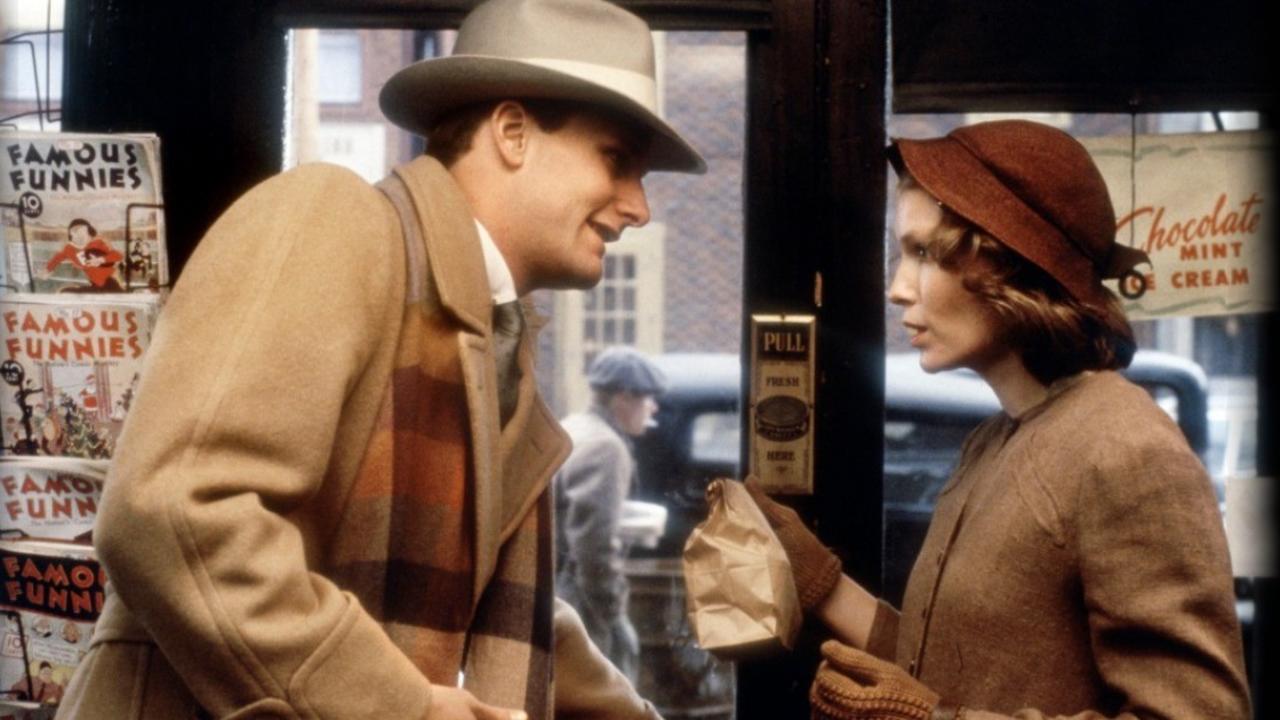
Woody Allen made a film about the danger of using cinema to escape your life. He did not notice that his ending was the escape.
CHARACTERS
Tom Baxter — explorer, archaeologist, adventurer, fictional The Countess — wealthy, bored, New York, fictional Jason — her husband, fictional Kitty — showgirl, fictional The Priest — fictional
Cecilia — waitress, Stardust Memories Diner, New Jersey, real Monk — her husband, real Gil Shepherd — actor, real The Cinema Manager — real
The film is about which list is real. It declines to say.
| Director | Woody Allen |
|---|---|
| Year | 1985 |
| Runtime | 82 minutes |
| Cast | Mia Farrow, Jeff Daniels, Danny Aiello |
| Award | BAFTA for Best Original Screenplay; César for Best Foreign Film |
| Streaming | MUBI, Max |
Woody Allen’s The Purple Rose of Cairo (1985) is set during the Depression in Stardust Memories, New Jersey, where Cecilia (Mia Farrow), a waitress with a violent unemployed husband and a life that offers very little to hold onto, goes to the cinema as often as she can manage. She has seen the same film — a 1935 picture called The Purple Rose of Cairo, featuring Egyptian adventures and Manhattan penthouses and a character named Tom Baxter — so many times that Tom Baxter (Jeff Daniels) notices her from the screen, steps out of the picture, and comes to find her in the dark of the theatre. The other characters in the film are stranded mid-scene. The cinema manager is in crisis. Gil Shepherd, the real actor who plays Tom Baxter, comes to New Jersey to coax his character back into the picture. Cecilia falls in love with both the fictional man and the real one simultaneously and must choose between them. She chooses Gil Shepherd, the real man, who promptly abandons her to return to Hollywood. She goes back to the cinema. Top Hat is playing. Fred Astaire is dancing. Her face, which has been registering something very close to devastation, very slowly releases into the expression the film presents as its final image: not quite happiness, not quite peace, but something approaching the particular suspension of feeling that cinema produces in the people who need it most. The film won the BAFTA for Best Original Screenplay and the César for Best Foreign Film. It is understood, almost universally, as Allen’s most tender and most melancholy film — a bittersweet meditation on the gap between the perfect love offered by fantasy and the damaged love available in reality, on the consoling power of cinema and its ultimate inadequacy. That reading is accurate about the first eighty-one minutes. It is not accurate about the last one.
The ending is the film’s argument, and it is the argument the film cannot see. Cecilia has just been abandoned by the man she chose over a fictional alternative. She has lost everything the film set up for her to lose: the dangerous husband she tolerated, the fictional man who loved her completely, the real man who used her and left. She enters the cinema. She sits. Astaire dances. Her face changes. Allen shoots this with the same warmth and the same formal attention he has given every cinema scene throughout the film: Cecilia in the dark, lit by the screen, her face registering the particular quality of absorption that cinema produces when it is doing exactly what it promises. The film presents this as consolation — as evidence that even after everything, cinema retains the capacity to restore something in the people it has failed. What it cannot see is that this image is indistinguishable from the film’s opening images of Cecilia in the cinema, before any of what happened happened. She is in the same seat. The same light is on her face. The same expression is forming. The film has spent eighty-two minutes examining the mechanism by which cinema keeps Cecilia from confronting her life, and it closes by activating that mechanism one final time, on its own audience, and calling the activation grace. The last scene of The Purple Rose of Cairo is the thing the film was critiquing. Allen did not notice because he was inside it too.
This is not an argument about Allen’s intentions, which were clearly genuine and clearly melancholy. It is an argument about what the film’s form does in excess of its intentions. Allen intended the ending to be both beautiful and sad — to hold the consolation and the inadequacy of the consolation simultaneously, to say: this is what she has, and it is not enough, and it is also real. What the form produces instead is the consolation without the inadequacy, because the image of Mia Farrow’s face in the cinema light is too beautiful, too carefully composed, too precisely calibrated to the feeling the film wants you to carry out of the cinema with you. The ending works on the audience the same way Top Hat works on Cecilia. You leave slightly elevated, slightly restored, the sadness converted into something more bearable by the quality of the filmmaking. Allen made a film about the gap between what cinema promises and what it delivers, and the gap between what his ending promises and what it delivers is exactly the same gap. The film is the thing it is about, and it cannot see this because the inability to see it is precisely the condition Allen was diagnosing.
The last image of Cecilia’s face in the cinema light is indistinguishable from the first. The film presents this as consolation. It is the cycle resuming.
The choice between Tom Baxter and Gil Shepherd is the film’s moral centre, and it is more complicated than the frame Allen gives it. The film presents the choice as the choice between fantasy and reality — between a man designed to be perfect and a man who is real, which means flawed, which means capable of genuine love but also of genuine damage. Tom Baxter cannot lie. He was not written with the capacity for deception. He loves Cecilia with a completeness the script gave him and that he had no say in, which means his love is real but not chosen. Gil Shepherd can lie. He does lie. He performs affection for Cecilia while calculating what it will cost him if his fictional character stays out of the picture, and then, when the calculation resolves in favour of returning to Hollywood, he leaves. Allen frames the choice as the inevitable tragedy of preferring the real to the perfect: Cecilia chooses reality, and reality disappoints, as reality does. What this framing cannot see is what the choice reveals about what loneliness selects for. Cecilia does not choose Gil Shepherd because she prefers reality. She chooses him because his capacity for deception reads to her, in the register poverty and a violent marriage have trained her to read, as the texture of something real. Tom Baxter is too consistent. His love has no friction, no morning-after quality, no evidence of the daily negotiation that Cecilia has learned to mistake for intimacy. Gil Shepherd disappoints her in familiar ways. The familiar disappointment is what she knows how to love. That is not a sentimental error. It is the specific, devastating effect of having your capacity to choose shaped by a life that offered only bad options, and having learned to trust what hurts you because what hurts you at least has the virtue of having happened.
This blog reviewed Stardust Memories early in its archive — Allen’s 1980 film in which a filmmaker is besieged by admirers who loved his early funny films and find his current work too painful and cerebral. That film examines what cinema does to a filmmaker: the trap of the audience’s expectation, the impossibility of working honestly when the work is always being received through the prism of what came before, the specific prison of being beloved for something you are no longer trying to do. The Purple Rose of Cairo examines the other side of the same exchange: what cinema does to the audience, to the specific person in the specific seat who needs the film more than the film can deliver. Together the two films form one complete argument about the transaction between cinema and the people it involves. Stardust Memories looks from the screen outward. The Purple Rose of Cairo looks from the audience inward. Neither film can see the other’s half of the argument, because each is inside the position it occupies. Allen made both films without making the film that holds both positions simultaneously, which would be the most honest film about cinema ever made, and which he was perhaps too inside the transaction to attempt.
Buster Keaton’s Sherlock Jr. (1924) invented the formal gesture Allen inherits and inverts. In Keaton’s film, a projectionist falls asleep and dreams himself into the movie he is showing — he walks through the screen and into the picture, navigating its editing logic with the physical literalism of a body that does not understand it is inside a representation. The dreamer enters the film. Allen reverses this entirely: the fictional character exits the film and enters the dreamer’s life. The reversal produces a completely different quality of argument. In Sherlock Jr., the projectionist’s problem is that he does not know the rules of the fictional world he has entered. In The Purple Rose of Cairo, Tom Baxter’s problem is that he does not know the rules of the real world he has entered. In both films, the crossing of the threshold produces comedy and then melancholy. But Keaton’s projectionist wakes up, and the film ends with him watching the movie he was in, copying the romantic gestures the actors perform, finding reality an awkward imitation of the fiction. Allen’s Cecilia does not wake up. She was never asleep. The fiction stepped into her waking life, and when it left, she returned to watching it. The difference between those two endings is the difference between a film that treats cinema as dream and a film that treats it as condition — something closer to weather than to sleep, which is always there, which you cannot fully wake from, which is doing something to you whether or not you are paying attention to what it is doing.
The Purple Rose of Cairo is the most honest film Allen ever made about the people who love cinema most, and its honesty has a limit precisely where his own love of cinema begins. He could see what the screen was doing to Cecilia. He could not see what his own screen was doing to the audience watching her. The two things are the same thing, at different removes, and the film that is most alert to the first is most completely blind to the second. Cecilia goes back to the cinema. The light falls on her face. The film ends. You carry it out with you, slightly restored, the sadness converted into something more bearable than it was. That is the film working on you exactly as the film says cinema works on her. The only difference is that you know it is happening. The film is counting on that knowledge not being enough to stop it.
If this stayed with you, watch these next:
Sherlock Jr. (Buster Keaton, 1924): the film that invented the gesture Allen inverts — Keaton’s projectionist enters the screen where Allen’s character exits it — and whose ending, a man awkwardly copying a film’s romantic gestures in real life, is the comic version of the tragedy Allen arrived at sixty years later, the same argument about cinema’s relationship to reality told from the opposite side of the laughter.
Stardust Memories (Woody Allen, 1980): our review is on this blog — Allen examining what cinema does to the filmmaker rather than the audience, the transaction seen from the other side of the screen; together the two films form one complete argument about what cinema costs the people it involves, and neither film can see the half the other is holding.
UnspokenCinema publishes every week. No ratings. No rankings. Just what films reveal without meaning to.