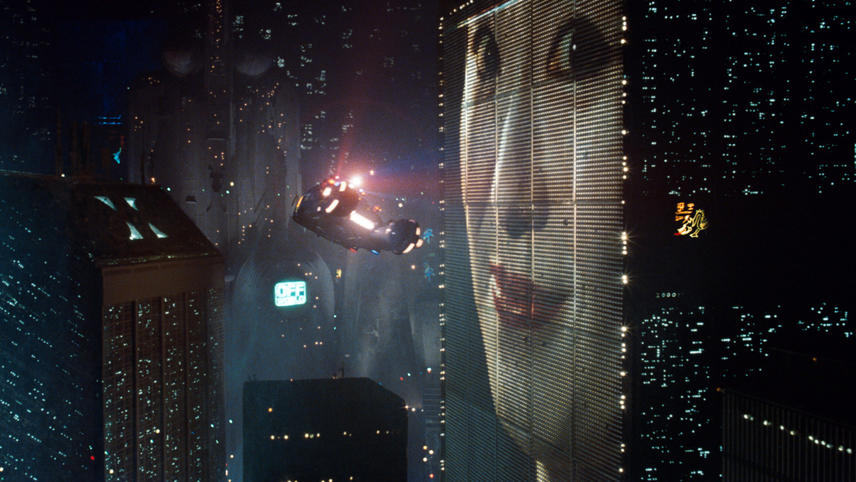
It’s raining in Los Angeles.
It is always raining in Los Angeles. The city is drowning in acid water and neon light and the exhaust of a civilization that has used itself up. The wealthy have left. They’ve gone off-world, to the colonies, to whatever clean air and open sky money can buy. The people who remain are the ones who couldn’t afford to leave, or who had nowhere else to go, or who are not, technically, people. They live in the permanent twilight of a city that has forgotten the sun. They eat noodles at street stalls in languages that bleed into each other. They move through a world that feels, in every frame Ridley Scott composes, like the morning after the end of the world.
Into this city, Deckard walks. He’s a blade runner. A cop. His job is to hunt replicants, artificial humans manufactured by the Tyrell Corporation, and retire them. Retire is the word. Not kill. The language is institutional, clinical, calibrated to obscure what is actually happening, which is that a man is being sent to find beings who think and feel and bleed and kill them because they were not supposed to be here this long.
He takes the job. He doesn’t want to, but the institution applies its pressure, and Deckard complies, and the film begins its slow, rain-soaked walk toward a rooftop where everything the series has said about performance, identity, institutions, and what it means to be alive will arrive at its simplest and most devastating articulation.
Four words. Then silence. Then rain.
The Test
The Voight-Kampff machine measures empathy.
It sits on a table between the examiner and the subject. It watches the eye. It tracks the iris, the capillary dilation, the involuntary blush response. The examiner asks questions designed to provoke an emotional reaction: a tortoise on its back in the sun, a wasp on a child’s arm, a calfskin wallet. The theory is that replicants, however convincing their performance, will fail the empathy test. Their responses will be slower, flatter, measurably less human. The machine will know.
The theory is wrong.
Not because the machine doesn’t work. Because the assumption beneath the machine is false. The Voight-Kampff test assumes that empathy is the bright line between human and artificial, that the ability to feel is what separates the made from the born. But the film spends two hours methodically demonstrating that the replicants feel more than the humans do. Leon treasures his photographs. Pris creates performance art. Zhora runs for her life with a desperation that is, in every physiological dimension, indistinguishable from a human woman fleeing a killer. And Roy Batty, the combat model, the most dangerous replicant ever manufactured, grieves, rages, loves, and dies with a fullness of feeling that no human character in the film comes close to matching.
The test measures the wrong thing. Or it measures the right thing and applies the conclusion backward. The question was never whether replicants can feel. The question the film is actually asking, the question it buries beneath the noir and the rain and the Vangelis synthesizers, is whether Deckard can.
Watch him. Watch Harrison Ford’s performance, which is often criticised as flat and which is, in fact, the most precisely calibrated element of the film. Deckard is empty. He moves through the city with a mechanical efficiency that mirrors the replicants he’s hunting. He takes the job without conviction. He kills Zhora without visible remorse. He pursues Rachael with an aggression that the film, to its credit, does not disguise as romance. He is, by every metric the Voight-Kampff claims to measure, less empathetic than the beings he destroys.
The blade runner is the one who fails the test. The film just never makes him sit down and take it.
The City
Los Angeles 2019 is Parasite’s architecture scaled to a metropolis.
The Tyrell Corporation’s headquarters is a pyramid. It rises above the city, golden, massive, Egyptian in its implications: the pharaoh’s tomb, the monument to a corporation that creates life and houses it in a structure designed to remind that life of its insignificance. Inside, Tyrell lives among candles and books and owls that may or may not be real, a creator god in his ziggurat, playing with the genetic code the way Vito Corleone played with favours: generously, strategically, from a position of absolute power disguised as intellectual curiosity.
Below the pyramid, the streets teem. The market stalls, the neon signs in Japanese and German and Spanish, the endless rain. The people at street level never see the sun. They never see the inside of the pyramid. They exist in the infrastructure of a world whose upper floors they will never visit, and the film renders their lives with a beauty that is also a kind of mourning: every neon reflection in a puddle is gorgeous and desolate at the same time, a city that is dying and still luminous, the way a sunset is most vivid just before the dark.
This vertical architecture runs through every frame. The replicants, when they arrive on Earth, arrive at the bottom. They move through the streets and the industrial zones and the dark apartments. They are, like the Kims in Parasite, below. The humans who built them, who own them, who profit from their labour, are above. And the blade runners move between the levels, enforcing the boundary, ensuring that the products don’t accumulate enough experience, enough memory, enough humanity to challenge the hierarchy.
The city is the institution. Not Tyrell. Not the police. The city itself. It is the built environment that organises bodies into hierarchies of value, that determines who lives in the pyramid and who lives in the rain, that sorts the made from the born and assigns them different expiration dates. The city is every institutional space in this series compressed into a single skyline: beautiful, vertical, and designed to keep certain people in the dark.
The Photograph
Rachael has a photograph.
It shows a mother and a daughter in front of a house. The light is warm. The image is faded at the edges, the way real photographs from real childhoods fade. Rachael keeps it with her. She shows it to Deckard. This is my mother. This is proof that I am real.
Deckard tells her the truth. The photograph is real but the memory is not. The mother in the image is someone else’s mother. The childhood in Rachael’s mind is someone else’s childhood. Her memories are implants, designed by Tyrell, installed at manufacture, given to her so that she would believe she was human, so that the emotional architecture of a lived life would cushion the absence of an actual one.
Rachael’s face, when she hears this, is the quietest devastation in the film. Sean Young plays it without tears, without collapse. She plays it as the slow withdrawal of a person who has just been told that the ground she’s standing on doesn’t exist. Not the facts of her life. The feeling of her life. The specific, textured, intimate feeling of a particular childhood, a particular mother’s voice, a particular afternoon in a particular kitchen. All of it, real inside her, fake outside her. All of it, felt genuinely, manufactured deliberately.
This is Eternal Sunshine turned inside out. Joel wanted to erase memories that were real. Rachael discovers that her memories were never real to begin with. But here is the thing the film insists on with a stubbornness that is its deepest conviction: the memories still function. They still shape her. They still determine who she is, how she responds, what she values, what she fears. The fact that they were implanted doesn’t diminish their structural role in her identity. She was built on them. She is, in every meaningful sense, the person those memories created.
The photograph is real. The mother is someone else’s. The feeling is Rachael’s.
This is the argument about identity that the series has been building toward since its first film. Andy Dufresne performed hope so convincingly that the performance became the thing. Tyler Durden was a fiction that shaped a real person. Norman Bates was a son who became a mother who became a skull beneath a face. Every character in this series has been constructed, assembled, performed into existence. Rachael is simply the most literal. She is the character who was manufactured, whose memories were installed, whose identity was designed. And she is as real as any of them. Because the self is not what you’re made of. It’s what you’re made into. And Rachael was made into a person, and the person she was made into is grieving, and the grief is hers, and no Voight-Kampff test can take that from her.
The Hunter
Deckard kills Zhora in the street.
She runs. She crashes through glass storefronts, one after another, the glass shattering around her in slow motion, the neon reflecting off the shards, Vangelis’s score turning the execution into something that looks like ballet and sounds like mourning. She falls. She dies in the rain, in the broken glass, in the artificial snow of a shopping district that has replaced weather with decoration.
And Deckard stands there.
He doesn’t react. He doesn’t process. He doesn’t flinch. He has just killed a woman who was running for her life, and his face registers nothing that the Voight-Kampff would recognise as empathy. He is the blade runner. He is the instrument. He is the institution’s hand, the same hand that held Oppenheimer’s clearance hearing, that closed the door on Kay Adams, that sent Willard upriver. The hand that does what the institution requires and does not ask whether the requirement is just.
But the film sees what Deckard doesn’t. The camera lingers on Zhora’s body. The music mourns. Scott composes the death as a tragedy, not an action beat. The film’s sympathy is not with its protagonist. It is with his victim. The film is more empathetic than its hero.
This is the Unspoken thing about Blade Runner’s structure. Deckard is the protagonist by convention: he’s the detective, the hunter, the one the camera follows. But the film’s emotional and moral centre is elsewhere. It’s with Rachael, discovering her memories are implants. It’s with Leon, clutching his photographs. It’s with Pris, painting her face in Sebastian’s apartment with the desperate artistry of someone who knows she has days left. It’s with Roy, on the rooftop, in the rain, holding a dove.
The film asks you to follow the hunter while loving the hunted. It asks you to occupy Deckard’s perspective while rejecting his indifference. It does what Psycho did and what Silence of the Lambs did, but in reverse: instead of making you root for the monster, it makes you walk beside the law and realise the law is the monster.
The Father
Roy Batty goes to meet his maker.
He ascends the pyramid. He enters Tyrell’s chamber. He stands before the man who designed him, who gave him his face and his strength and his capacity for love and his four-year lifespan. He stands before his god and asks for more life.
Tyrell says no. Not cruelly. Practically. The biology doesn’t allow it. The mutation that would extend replicant life would also destabilise the cells. The expiration date is structural. It’s built into the code. It’s not a decision that can be reversed. It’s a feature.
Roy kills him.
He pushes his thumbs into Tyrell’s eyes, into the eyes that designed the Voight-Kampff test, the eyes that looked at human empathy and decided to replicate it in a product with a four-year warranty. The murder is Oedipal and theological at once: the son killing the father, the creation blinding the creator. It is Michael Corleone’s baptism montage condensed into a single gesture: the institution that made you is the institution you must destroy, and the destruction doesn’t free you, because the four-year lifespan is still running, and the clock doesn’t stop because God is dead.
Tyrell is Daniel Plainview if Plainview had built people instead of pipelines. He is the founder whose product is life itself, who monetised existence, who created beings capable of suffering and shipped them off-world to do the work humans wouldn’t do, and who installed an expiration date not out of caution but out of commerce. A product that lasts forever can’t be resold. A replicant that lives past four years might develop enough experience to demand rights. The four-year lifespan is not a technical limitation. It is a business decision. It is the Corleone family’s logic applied to biology: the institution limits what it creates so that the creation never threatens the institution.
Roy kills his father and gains nothing. Not a single extra day. Not a single extra hour. He descends the pyramid and returns to the rain and the clock keeps ticking and the only thing he has is what he’s always had: the time between now and the end. The four years. The memories. The light he saw, the things he did, the moments that belonged to him regardless of who designed him to have them.
The Rooftop
The film’s final act.
Roy hunts Deckard through the Bradbury Building. It’s raining. The building is decaying. Deckard is terrified. Roy is dying. His hand is cramping, the cells failing, the body the corporation built beginning its scheduled collapse. He drives a nail through his palm to feel something, to keep the nerves alive a few minutes longer, and the gesture is Christ-like and mechanical and desperately human all at once.
Deckard runs. He climbs. He leaps to another rooftop and almost falls. His hands grip the ledge. He hangs in the rain, above the street, above the neon, and Roy stands above him, looking down. The hunter and the hunted, inverted. The blade runner dangling. The replicant deciding.
Roy saves him.
He grabs Deckard’s arm and pulls him onto the roof. He sits down. He holds the dove. The rain falls on his face. And he speaks.
I’ve seen things you people wouldn’t believe. Attack ships on fire off the shoulder of Orion. I watched C-beams glitter in the dark near the Tannhäuser Gate. All those moments will be lost in time. Like tears in rain.
Time to die.
Rutger Hauer wrote part of this speech himself. He improvised the “tears in rain” line. And it is, in thirty-seven words, the most complete articulation of everything this series has been trying to say across twenty-six films and two cycles.
All those moments will be lost in time.
Not the memories. Not the data. Not the institutional record or the surveillance footage or the Voight-Kampff results. The moments. The specific, irreproducible, experiential moments that belong to a consciousness and to no one else. The fire off Orion. The glitter near the Gate. Things Roy saw with his eyes, felt in his body, carried in his mind, and which will, when his four years end, vanish. Not because they were implanted. Not because they were artificial. Because that is what moments do. They pass. They dissolve. They disappear into the rain, regardless of whether the person experiencing them was born or made.
This is the elegy the film has been building toward. Not for replicants. For experience itself. For the unbearable fact that consciousness is temporary, that every moment of perception is a moment that will be lost, that the things you’ve seen and felt and carried are as mortal as you are, and when you go, they go, and the rain doesn’t care whether the tears it washes away belonged to a human or a machine.
Roy dies. The dove flies. Deckard sits in the rain and looks at the body of the being who just saved his life and who was, in the final accounting, more alive than Deckard ever was. The hunter failed the test. The hunted passed it. And the rain falls on both of them equally.
The Origami
Gaff leaves a unicorn.
A small origami unicorn, folded from tinfoil, left outside Deckard’s apartment. In the director’s cut, Deckard dreams of a unicorn. Gaff knows about the dream. The implication is inescapable: Gaff knows Deckard’s dreams because Deckard’s dreams are implants. Because Deckard is a replicant.
The film never confirms this. It lets the origami sit there. It lets the question dissolve.
And the question’s dissolution is the answer. Because if Deckard is a replicant, then the blade runner is the thing he hunts. The institution’s enforcer is the institution’s product. The man who retires artificial people is an artificial person, and his memories, like Rachael’s, were installed, and his feeling of being human, like Rachael’s, is genuine and manufactured at the same time.
But if Deckard is a replicant, then every distinction the film has drawn, between hunter and hunted, human and artificial, real and made, collapses. And if the distinction collapses, then Roy’s speech on the rooftop was not about replicant experience. It was about experience. Full stop. The tears in the rain belong to everyone. The moments lost in time are everyone’s moments. The mortality that makes the memories precious is everyone’s mortality. The four-year lifespan is, in its particulars, a corporate decision. In its essence, it is the human condition compressed, accelerated, made visible.
We all have four years. Some of us just don’t know the number.
Where This Leads Us
Blade Runner asks what makes a life real. Roy Batty answers with thirty-seven words on a rooftop: the things you’ve seen. The moments you’ve carried. The tears the rain will wash away.
But the film takes place in 2019, in a city humanity has already half-abandoned. The world beneath the rain is used up. The planet is exhausted. The question of what makes life real is asked against the backdrop of a civilization that is running out of time, not on a four-year corporate schedule but on a geological one. The clock is ticking for everyone, and the rain that falls on Roy Batty’s face is acid.
What happens when the clock runs out? When the city drowns? When the institution isn’t a corporation or a pyramid but the planet itself, and the planet can no longer sustain the things that live on it? What does a species do when it has consumed the world and the world has nothing left to give?
In 1968, fourteen years before Blade Runner, Stanley Kubrick made a film that begins with the species before language and ends with the species after the body. A film about a black monolith that appears at the moments of transformation, that watches without speaking, that represents whatever it is that waits at the edge of what we can understand. A film whose final image is a child, floating above the earth, looking down at a planet that made it and can no longer hold it.
That film is 2001: A Space Odyssey. And the monolith has been standing there the entire time.