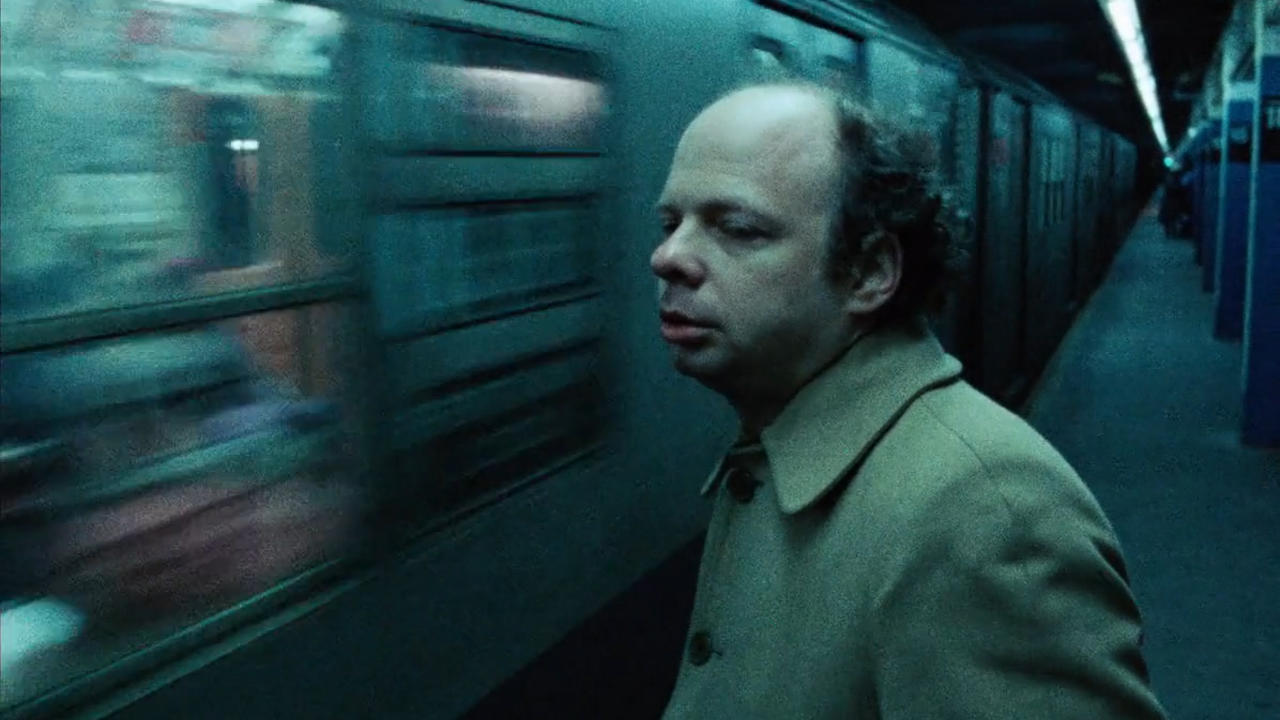
My Dinner with Andre thinks it is a dialogue between two equal worldviews. What it cannot see is that it decided which worldview was more interesting before anyone sat down.
Table for two. Party of Gregory, A. and Shawn, W.
Mr. Gregory will have: the spiritual crisis, the theatrical experiments in Poland and the Sahara, the burial alive on Long Island, and the extended meditation on whether the modern world has made genuine human feeling impossible. He will not require the menu.
Mr. Shawn will have: the electric blanket, the cup of coffee, the apartment, Debbie. He will need a moment.
The restaurant notes that this is, formally speaking, a table for two.
| Director | Louis Malle |
|---|---|
| Year | 1981 |
| Runtime | 110 minutes |
| Cast | Wallace Shawn, Andre Gregory |
| Awards | National Society of Film Critics Award, Best Screenplay |
| Streaming | Available on major platforms |
The alibi in Manhattan lived in Gordon Willis’s cinematography: the black-and-white skylines, the Gershwin, the 70mm widescreen that made Ike Davis’s moral choices look like art. Writing that review, the argument felt complete — the beautiful image does ethical work the film cannot acknowledge, so smoothly the film never needs to notice. Then My Dinner with Andre arrives. Louis Malle’s 1981 film has almost no beautiful images. The restaurant is grey. The close-ups are close and unflattering. There is no music until the credits. And the alibi is still there. It turns out the beautiful false sentence doesn’t need a skyline. It just needs a good storyteller.
Andre Gregory is an extraordinary storyteller. This is the first thing the film establishes, and the last thing it questions. The film was written by Gregory and Wallace Shawn from their real conversations, directed by Malle in what is essentially a filmed theatrical experiment: two men at dinner, talking. Andre is the avant-garde theater director who has spent years on mystical quests following a creative breakdown — Poland, the Sahara, a spiritual community in Scotland called Findhorn, and finally a ritual burial alive in a coffin on Long Island as a kind of death and rebirth. Wally is the playwright who stayed in New York, writing plays that don’t get produced, keeping warm in a small apartment with his girlfriend Debbie. Andre has been to the edge of what he can survive. Wally has been to the hardware store.
The film presents these two positions as a genuine dialectic: extraordinary experience against ordinary life, radical seeking against material comfort. What it cannot quite see is that it has already decided, before Wally speaks his first sentence, which position is more interesting to inhabit.
Andre speaks for perhaps seventy percent of the film’s runtime. His stories are the film’s content. Wally’s responses are its punctuation — he asks Andre to clarify, to slow down, to explain what he means. His own stories are miniature: a cup of coffee, an electric blanket, the pleasure of a particular table at a particular restaurant. These are not offered as insufficient substitutes for spiritual experience. Wally means them seriously. But the structure of the film cannot receive them seriously, because the structure of the film is: one man tells extraordinary stories while another man listens. That structure was set before the cameras rolled.
The film thinks it is a dialogue. It is a very sophisticated lecture with one very patient student.
Malle’s decision to shoot almost entirely in close-up was deliberate: he wanted to dissolve the distance between the audience and the conversation, to make viewers feel present at the table. It works. The close-ups are intimate, occasionally uncomfortable, and technically precise. But they also, unavoidably, equalize what the script has made unequal. When the camera rests on Wally’s face as he listens to Andre, it lends him the gravity of a genuine respondent. The editing suggests turn-taking where the script has given Andre the floor. The visual grammar insists on dialogue that the verbal grammar cannot quite deliver.
What the film withholds, carefully and perhaps unconsciously, is any accounting of what Andre’s spiritual adventures cost. The mystical journeys — Poland, the Sahara, Long Island — require money, time, cultural permission, and an infrastructure of other people willing to arrange them. The film never asks who paid for the coffin, who dug the hole, who organized the community in Scotland. Andre’s capacity to pursue a spiritual crisis across three continents is itself a product of the comfortable bourgeois life he has decided is insufficient. The critique depends on the thing it critiques. The film senses this vaguely — there are moments where even Andre acknowledges the paradox — but it cannot hold the knowledge, because holding it would require stepping outside Andre’s frame, and the film has no outside.
Wally steps outside it, briefly, at the end. His closing monologue about his father, about the pleasure of a good cup of coffee in a familiar coffee shop, about Debbie, is the most emotionally true passage in the film. After two hours of Andre’s extraordinary world, the ordinary reasserts itself with a force that surprises even the film. Something has been discovered, at the last possible moment, about who has been carrying the real weight. Two reviews ago, we wrote that Manhattan “discovered at the last moment that it had been watching the wrong person, and it was too late to redirect.” The same sentence applies here, exactly. Two films, different directors, different decades, the same structural decision: place the most eloquent person at the center, give the quiet one the moral, discover too late that the moral was the point.
The film that creates the sharpest friction with My Dinner with Andre is not another film about conversation. In our review of Jeanne Dielman, 23, quai du Commerce, 1080 Bruxelles, we wrote about a woman who has arranged her daily life into a structure of absolute precision, and what happens when that structure silently begins to fail. Jeanne doesn’t explain herself. She has no dinner companion to listen and prompt and occasionally push back with gentle skepticism. Chantal Akerman gives her no language for what she is experiencing, because the film understands that what she is experiencing has no language available to it. My Dinner with Andre gives Andre a hundred and ten minutes, a patient interlocutor, and the most attentive close-ups that money can buy, to try to say what cannot be said. Jeanne gets none of this, and the silence is somehow more articulate. The contrast is not about which director is more generous. It is about who gets to narrate their own arrangement of daily life, and what that permission costs everyone else at the table.
My Dinner with Andre is a film about the impossibility of genuine conversation, made as a conversation that is already impossible and doesn’t quite notice. Andre and Wally leave the restaurant. Wally takes a cab home through the night streets, thinking of his parents, thinking of the city. Erik Satie plays. It is a beautiful ending for a film that has earned it by not quite deserving it.
If this stayed with you, watch these next:
My Night at Maud’s (Rohmer, 1969): another film structured almost entirely as philosophical conversation, set in a single room over a single night, but where Rohmer commits fully to the dialectic — both speakers are genuinely in danger of being changed — and the contrast reveals what Malle’s film quietly refuses.
Stardust Memories (Allen, 1980): reviewed here; another artist who has organized a spiritual crisis into content, who finds his audience insufficient and his interlocutors inadequate, but where Allen exposes the mechanism that Andre Gregory never quite has to face.
UnspokenCinema publishes every week. No ratings. No rankings. Just what films reveal without meaning to.