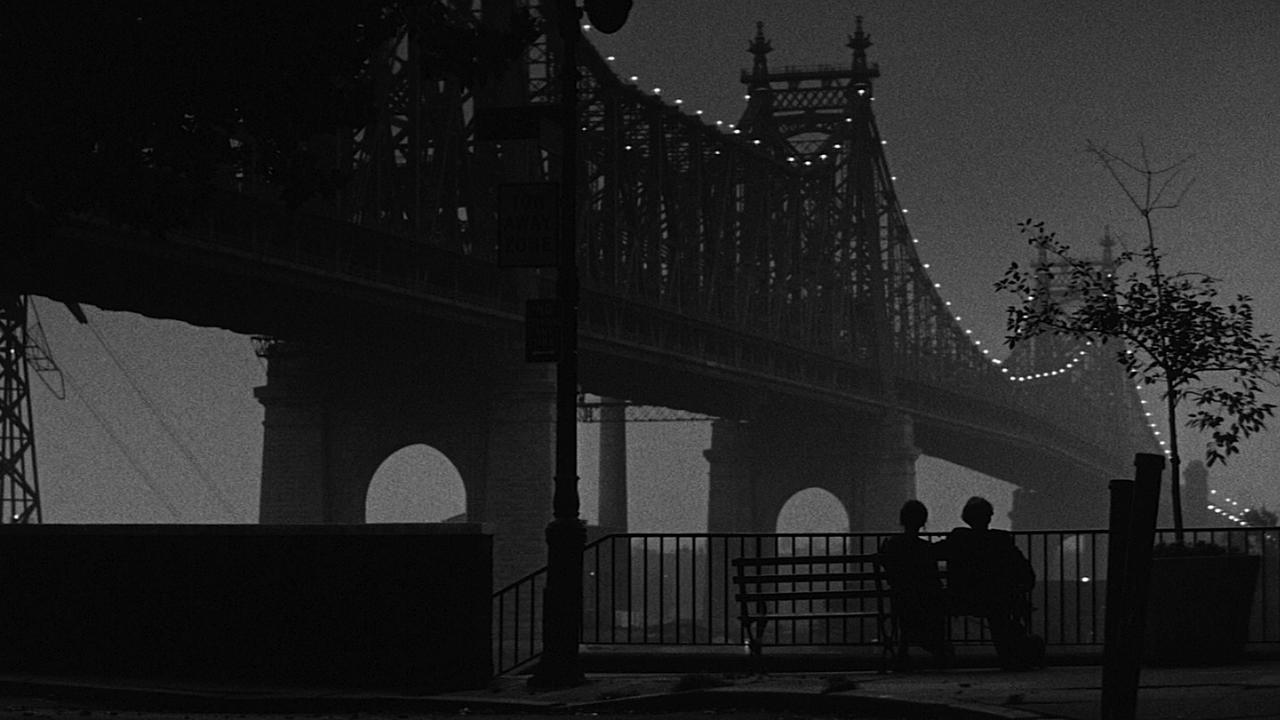
Manhattan knows its protagonist cannot tell sophistication from wisdom. What the film cannot see is that its own cinematography has been making the same mistake from the very first frame.
| Director | Woody Allen |
|---|---|
| Year | 1979 |
| Runtime | 96 minutes |
| Cast | Woody Allen, Diane Keaton, Michael Murphy, Mariel Hemingway, Meryl Streep |
| Awards | BAFTA Best Actress (Diane Keaton); Academy Award nomination, Best Supporting Actress (Mariel Hemingway) |
| Streaming | Available on major platforms |
He romanticized New York City out of all proportion.
The most beautiful image in Manhattan is a forty-second shot of two people on a bench at dawn beneath the Queensboro Bridge. It is also a portrait of at least two simultaneous betrayals, but George Gershwin is already playing and Gordon Willis has already lit the sky and the argument is over before it begins.
The alibi arrives before the title does.
Woody Allen opens Manhattan with a sequence that is, structurally speaking, the most honest thing in the film: Isaac “Ike” Davis, sitting at a dictaphone, trying and discarding multiple first sentences for his novel. Each version reaches for something more magnificent than the last. He is not looking for the true sentence. He is looking for the most beautiful false one, the version of New York that will hold. Gordon Willis has already decided what that version looks like: black-and-white, 70mm anamorphic widescreen, the Chrysler Building silver against the dark. Ike will spend the next ninety minutes searching for the sentence that matches what Willis has already composed.
F. Scott Fitzgerald wrote, in his essay My Lost City, that “New York had all the iridescence of the beginning of the world.” Manhattan is the film that still believes this, in 1979, and the belief is doing more work than the film knows.
The story, briefly: Ike is 42, in a relationship with Tracy (Mariel Hemingway), who is 17 and a high school student. Into this arrangement arrives Mary Wilke (Diane Keaton), his best friend Yale’s (Michael Murphy) girlfriend: sharp, self-aware, immediately destabilizing. Ike ends things with Tracy and begins something with Mary. Then Yale, returning to his wife, ends his own affair with Mary. Ike, recognizing his error too late, runs back to Tracy, who is by now leaving for London. The film presents this as a comedy about a man who cannot recognize the genuine article until it is walking out the door. That reading is correct, as far as it goes.
It doesn’t go far enough.
Willis’s black and white is not documentary. It is not neutral. It is a specific idea of New York: the New York of jazz photography, of late-night diners and bridges at dawn, of a city that exists in memory and aspiration rather than in the present tense. Every important scene in the film is placed inside one of these compositions, which means what happens inside the frame has been aestheticized before anyone speaks. When Ike betrays Tracy, he does it somewhere beautiful. When he falls for Mary against his better judgment, the East River is silver behind them, Gershwin swelling, the sky beginning to turn. The film cannot see that its own visual grammar is doing ethical work.
The beauty is not the backdrop to the story. The beauty is the moral argument the story cannot make in words.
Which brings us to Tracy.
The film mentions, once, that she is 17. Then proceeds as though this has been adequately registered. What the film actually does with Tracy’s age is build its entire moral architecture around it: she is the uncorrupted one, the genuine article, the person in this Manhattan comedy whose feelings are real while everyone else’s have been made ironic by sophistication. At the end, when Ike runs to her apartment and she tells him “not everybody gets corrupted,” and then, more devastatingly, “you have to have a little faith in people,” the film is genuinely moved. Mariel Hemingway plays these scenes with a simplicity that earns everything the film asks of her.
But the film is asking something specific. Tracy must be uncorrupted. She must be untouched by the self-consciousness that Manhattan sophistication produces in everyone else. And she must be available to a 42-year-old man without the film needing to examine what that availability means. Her youth is not a biographical detail. It is a structural requirement. The film needs her to be the thing that hasn’t been spoiled, which means it needs her to be specifically 17 — and it needs that age to carry no weight, to exist inside the same black-and-white frame as the Queensboro Bridge and the Central Park joggers and the rest of the beautiful things.
Watch where the film ends. Ike’s face: uncertain, almost moved. Tracy is already gone. The Gershwin plays. The camera holds on the wrong person, and the film discovers at the last moment that it has been watching the wrong person the whole time, but it is too late to redirect. The woman required to carry the film’s moral weight has left the frame, and the film can only end where it was always going to end, on the man who organized it.
In the Frances Ha review, we said that Noah Baumbach’s black-and-white cinematography “arrived with its argument already formed.” What that review could not yet say, because Manhattan hadn’t been the subject, is where that argument was formed and what it was built to do. Baumbach inherited a grammar, and the grammar was constructed here, in 1979, for a specific kind of male protagonist. What he did, possibly without meaning to, was adopt the grammar while changing its subject to a woman, which changes what the grammar can do. The Manhattan alibi was designed for Ike. It does not fit Frances the same way, and the places where it doesn’t fit are precisely where Frances Ha becomes interesting. That review called the cinematography a formation. This is the founding moment of that formation.
The film that illuminates Manhattan most sharply by friction is Nuri Bilge Ceylan’s About Dry Grasses, reviewed here. Samet, the schoolteacher protagonist, shares Ike’s essential structure: the man who uses cultural sophistication as cover for a moral vacancy he cannot perceive, who arranges everything around him into a story in which he is the most sensitive person in the room. But Ceylan steps outside Samet. He gives Nuray and Sevim scenes where the camera’s allegiance shifts, where Samet’s self-construction becomes visible as construction, where the film’s intelligence exceeds its protagonist’s. In Manhattan, Allen’s camera never steps outside Ike. The black-and-white photography is not observing Ike’s aestheticization of New York. It is that aestheticization. Ceylan and Allen are making the same film, and only one of them knows it.
Manhattan is the most aesthetically honest film about a man who uses aesthetics dishonestly, and it has no idea. The beautiful false sentence Ike was searching for at the beginning? He found it. He called it a movie.
If this stayed with you, watch these next:
Husbands and Wives (Allen, 1992): Allen answers his own grammar thirteen years later, shooting in handheld 16mm, deliberately ugly — and the contrast tells you exactly what the black-and-white in Manhattan was doing, and what it was hiding.
Scenes from a Marriage (Bergman, 1973): named in our The Worst Person in the World review as the episodic dissection of a long relationship stripped of narrative cushion. Where Manhattan wraps its romantic wreckage in Gershwin and skylines, Bergman refuses every aesthetic comfort, and the refusal is the argument.
UnspokenCinema publishes every week. No ratings. No rankings. Just what films reveal without meaning to.