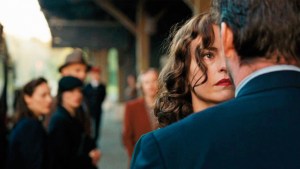
Phoenix ends with one of cinema’s great acts of female reclamation. To make it possible, it required another woman’s death. That woman is the film’s first face. No one talks about her.
The ending is real.
Nelly sings “Speak Low” at the piano, Johnny accompanying her. The first verse she speaks more than sings — flat, halting, provisional, a woman still deciding. Then the second verse opens and the voice becomes itself, and Johnny’s hands slow on the keys, and the camera finds his face, and his face finds what it has spent the entire film refusing to find, and Nelly rolls back her sleeve, and the number is there on her forearm, and he knows, and she sees that he knows, and she turns and walks. No confrontation. No speech. No dissolution into tears. She walks.
A.A. Dowd of The A.V. Club called it “a noir psychodrama for the ages.” He was right. The ending of Phoenix is the best ending Petzold has ever made, and among the great endings in German cinema. It does what the best endings do: it earns in three minutes everything the previous ninety-four put in escrow.
And then she is gone, through the door, and the film ends.
But before we follow her through that door — before we accept, as every review of this film does, that she has reclaimed herself — let us return to the film’s very first image. Not Nelly’s face. The face of Lene Winter.
Phoenix, written and directed by Petzold and released in 2014, opens in darkness and partial profile on Lene (Nina Kunzendorf), a Jewish welfare worker driving through a checkpoint in postwar Berlin. Her passenger is Nelly Lenz (Nina Hoss), bandaged and bloodied, shot in the face, returned from Auschwitz. Lene has been with her. Lene arranges the reconstructive surgery, finds the apartment, manages the money, presents the evidence of Johnny’s betrayal piece by piece — divorce papers filed the day before Nelly’s arrest, the timeline of a man who calculated his survival on his wife’s destruction. Lene is the only character in Phoenix who sees Nelly clearly from the first frame to the last. She is the film’s most present intelligence, its most reliable consciousness, its most uncomplicated love — whether that love is friendship or something that dares not name itself, and the film leaves this deliberately open.
Lene kills herself before the film’s climax.
She leaves a note. The landlady tells Nelly about it between scenes. The note contains the final proof of Johnny’s betrayal. And then the film moves on, because the ending is coming, because the piano and the song and the walked-away-from room are waiting, because the whole intricate architecture of Phoenix has been building to Nelly’s reclamation and Lene’s suicide is a piece of information necessary to that architecture rather than a grief the film will pause to feel.
| Director | Christian Petzold |
|---|---|
| Year | 2014 |
| Runtime | 98 minutes |
| Cast | Nina Hoss, Ronald Zehrfeld, Nina Kunzendorf |
| Awards | 98% Rotten Tomatoes; Criterion Collection |
| Streaming | Criterion Channel, MUBI |
Petzold said in an interview that at first he did not want to make Phoenix because Vertigo already exists. He meant: Vertigo is about a man who remakes a woman in the image of his desire, who cannot see the living person in front of him for the dead woman he wants her to be. Phoenix is the reverse angle — in Petzold’s version, the woman who has been erased performs her own resurrection for the man who erased her, and then reclaims herself from his recognition. The reversal is genuine and the ending proves it. She gets to leave.
“The film’s first face belongs to the woman who always saw Nelly. Its last image belongs to the woman who needed the man to finally see her. Between those two facts is the argument the film is too busy finishing to make.”
But here is the cost of the reversal. In Vertigo, Scottie’s gaze constructs Judy into Madeleine; the film is about his pathology. In Phoenix, Johnny’s gaze fails to construct Nelly correctly — he trains a woman to be her own impersonation and still cannot see her — and the film is about his failure. The ending redeems Nelly by demonstrating that failure. She sings, he sees, she walks. The reversal is genuine.
And yet. The mechanism of that reversal still requires his recognition. Nelly cannot leave until Johnny confirms who she is. Her agency at the end is real — the walking away is hers, the voice is hers, the choice to reveal herself rather than remain disguised is hers. But the moment of liberation is the moment his face changes. She has been waiting, across every visit to his apartment, for that face to change. The film knows this: the camera catches her almost-smiles when he nearly sees her and retreats. She is always watching for his recognition. It does not arrive until she forces it with her voice, which is the bravest thing in the film. But what she forces is still his recognition. She cannot simply be Nelly. She has to make him admit it.
Lene did not require this. Lene saw her from the dark car at the film’s beginning. Lene knew who Nelly was when her face was bandaged and bloody. Lene knew who Johnny was when Nelly refused to. Lene represents the relationship in which Nelly’s identity requires no performance, no proof, no piano and no song — just presence, just knowledge, just the person who drove her through the checkpoint and stayed. This is the relationship the film cannot inhabit at length, because it does not generate the mechanism of the ending. Lene’s death is the film’s acknowledgment that this relationship, and the life it was offering — Palestine, survival, new beginning — must be cleared away before Nelly can arrive at the moment the film was built to reach.
The Undine review in this sequence claimed that Phoenix was the Petzold film where he finally gave his protagonist her agency back — and speculated that this was possible only because the film had a clearer villain. That speculation was partly right. Johnny is complicit; his guilt gives the ending its specific justice; it is satisfying that the man who had her sent to Auschwitz is the man who must finally say, with his stricken face, I know what I did. The ending is a reckoning, not just a reclamation, and the reckoning requires the guilty party.
But the villain’s clarity came at a cost the speculation did not name: Lene had to die so that her clarity could not be the ending. A story in which Nelly simply goes to Palestine with the woman who loves her and always saw her would have been a different and perhaps more radical film. It would not have needed the song. It would not have needed the piano. It would not have needed his face to change.
The film opens in darkness on Lene’s face. It closes on Nelly walking through a door. Between those two images, the woman who never required Nelly to perform her own resurrection has been quietly removed from the world by a note delivered between scenes, and the film that is celebrated as the one where Petzold finally gave his heroine back to herself has moved on, because the ending was waiting.
She walks. It is magnificent. Lene is already gone.
If this stayed with you, watch these next:
Undine (Christian Petzold, 2020): reviewed in the previous post — the film this sequence of Petzold reviews reaches backward from, which promised that Phoenix had broken the pattern. Read together, they map a filmmaker who can see his trap perfectly in Undine and found the exit in Phoenix only by clearing away the one character who would have made the trap unnecessary.
Barbara (Christian Petzold, 2012): the film immediately preceding Phoenix, in which Hoss plays another woman navigating a system of surveillance and control in East Germany, and in which the ending also turns on a man finally deciding to see her clearly. The comparison with Phoenix asks whether Petzold’s liberation endings always require a man’s recognition as their engine, and what that requirement says.
UnspokenCinema publishes every week. No ratings. No rankings. Just what films reveal without meaning to.