The Lives of Others is a film about a man who becomes good through listening to another man’s life. It is one of the most emotionally intelligent arguments for art’s redemptive power ever made. It is also a film in which a woman has to die to make the argument possible.
Sonate vom Guten Menschen Sonata about a Good Person
To HGW XX/7, in gratitude
Georg Dreyman is a playwright in East Germany in 1984. His apartment is bugged, his girlfriend is being coerced by a minister with more power than conscience, his dissident friend has just hanged himself, and a Stasi captain named Wiesler is listening to everything from the attic above. Dreyman, distressed, sits at the piano and plays a gift his friend left him before his death: a piece titled “Sonata for a Good Man.”
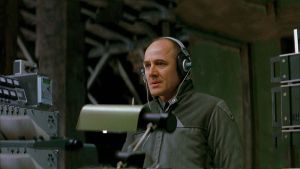
In the attic, Wiesler listens. A tear runs down his face.
“Can anyone who has heard this music,” Dreyman says later, “I mean really heard it — still be a bad person?”
He does not know Wiesler is listening. Wiesler is already answering. The tear is the hinge on which the entire film turns, and Ulrich Mühe — who died of stomach cancer eighteen months after the film’s release, aged fifty-four — finds it without a single false note. Roger Ebert, awarding the film four stars, called Mühe’s performance “one for the ages,” and wrote that the film demonstrated that art could transform “not just the audience but the characters in the story.”
He was right. The transformation is real. The tear is real. The Lives of Others, written and directed by Florian Henckel von Donnersmarck in his feature debut, is one of the most emotionally precise arguments for art’s redemptive power ever committed to film. It is also, before any other consideration, a film about good men recognising each other across the distance of surveillance and power — and a film in which a woman has to die so that recognition can become its own reward.
The Lives of Others is set in East Berlin in 1984, five years before the Wall’s fall. Stasi Captain Gerd Wiesler (Mühe) is ordered to conduct round-the-clock surveillance on playwright Georg Dreyman (Sebastian Koch) at the request of Minister of Culture Bruno Hempf, who wants Dreyman removed as a rival for his actress girlfriend, Christa-Maria Sieland (Martina Gedeck). Wiesler installs listening equipment in Dreyman’s apartment, settles into the attic, and begins his report. What he hears instead of the evidence of disloyalty he was promised is the texture of a life lived with love and art and genuine human warmth — the specific quality of a life he has never had access to. He begins, gradually, to protect rather than expose. He falsifies his reports. He removes the incriminating typewriter from Dreyman’s apartment when the second search comes. He costs himself his career, his position, his future.
| Director | Florian Henckel von Donnersmarck |
|---|---|
| Year | 2006 |
| Runtime | 137 minutes |
| Cast | Ulrich Mühe, Martina Gedeck, Sebastian Koch, Ulrich Tukur |
| Awards | Academy Award Best Foreign Language Film 2007; German Film Prize Best Film |
| Streaming | Max, MUBI |
The film’s architecture is a formal argument for the humanising power of observation. Wiesler is transformed by listening. The surveillance state deployed him as an instrument of control; the thing he was surveilling turned him into a person. The logic is beautiful, and it produces one of the most satisfying endings in contemporary European cinema: Dreyman’s novel dedicated to the code name of the man who saved him; Wiesler buying it for himself; his quiet “no, it’s for me” when asked if it should be gift-wrapped. Two men who never shared a scene across the entire film reaching each other through the dedications page.
The Barbara review in this sequence placed The Lives of Others as the opposite solution to the same problem: Petzold’s film finds liberation in the observed person’s refusal to be defined by what they’re watching; von Donnersmarck’s film finds it in converting the observer. Both solutions are genuine. Both films achieve their endings. The question the comparison leaves open — and the question this film cannot ask about itself — is at whose expense the conversion is purchased.
“The film’s title announces that it is about the lives of others, plural. Three people live under the apparatus of Hempf’s surveillance scheme: Dreyman, Sieland, and Wiesler. The film ends with the two men in a relationship of mutual recognition across the gap of what happened between them. Sieland, whose life was most violently destroyed by the apparatus — who was coerced, blackmailed, forced to betray the man she loved — is dead before the epilogue begins.”
Christa-Maria Sieland is the most complex character in the film and the one most ruthlessly subordinated to its requirements. She is a celebrated actress who has been coerced into a sexual arrangement with Hempf because he controls the cultural apparatus that determines whether she works. She is dependent on prescription drugs she can only access through Hempf’s favour. She is aware — far more clearly than Dreyman, who has been allowed to maintain his comfortable pro-regime position — of exactly what the state is doing to them both. When she defends her complicity to Dreyman, she is right: “We’re both in bed with the regime in order to be allowed to continue our artistic careers.” He protests. She goes out.
When the Stasi interrogate her, she breaks and gives them the typewriter’s location. She is released. She runs in front of a truck. Dreyman cradles her body on the street, and the film frames them as the Pietà — the image of grief that precedes resurrection. She has to die so that Dreyman can grieve, and his grief can transform into the novel, and the novel can find Wiesler in a bookshop two years later.
The film calls this the cost of tyranny. It is that. It is also the cost of a narrative in which the woman’s body is the price of the men’s story.
Alisha Tan, writing in Film Matters Magazine, observed that “women receive no agency unless to bolster a man’s narrative of opposition or change.” Sieland’s suicide is “her final word” — and also the word that sets the story’s resolution in motion. She cannot be in the epilogue because her presence would complicate the clean arc of male recognition the film needs. Two good men, recognising each other across years of harm. A third person who was ground up by the same machinery they were put through, whose suffering was more intimate and more sustained than either of theirs, is the condition of their meeting rather than a participant in it.
This is not the same criticism that can be made of Phoenix, reviewed in the previous sequence, where Lene Winter was similarly cleared away to enable the ending. In Phoenix, the removal was the film’s blind spot — Petzold did not appear to notice what he had done. In The Lives of Others, the removal is more structurally embedded. Von Donnersmarck built a film about the civilising power of art on the body of an actress — an artist, a woman in the creative community the film claims to celebrate — whose relationship to her own art was the most compromised in the whole apparatus. Dreyman never had to sleep with anyone to keep his plays on stage. Sieland did. The film knows this and shows it. But the film’s ending does not belong to her.
The film is not dishonest about what happened to Sieland. It shows the coercion clearly. It refuses easy exculpation for the men around her. What it cannot do — what its structural commitments prevent it from doing — is imagine a version of its ending in which she survives to speak. A living Sieland complicates the clean moral transaction between Wiesler and Dreyman. Her survival would require the film to ask how two men who failed to protect her feel about the protection they claim to have offered. The bookshop moment, which is one of the most beautiful endings in any film of this decade, depends on no one present knowing what the other paid.
The Lives of Others is a great film. Wiesler’s transformation is real, and Mühe’s performance remains one of the most demanding and precise in European cinema of the past quarter century. The Sonata for a Good Man is genuinely moving. The ending is genuinely earned. And the film dedicated to the good man is dedicated, in a way it cannot see, to the woman who paid for him to become one.
If this stayed with you, watch these next:
Barbara (Christian Petzold, 2012): reviewed in the previous post — the film placed here as the opposite solution to surveillance’s problem. Barbara refuses to be defined by the watching; The Lives of Others converts the watcher. Read together, they are the two possible responses to the same oppressive structure, and together they reveal what each film cannot see about its own ending.
Ida (Paweł Pawlikowski, 2013): a film about a woman discovering her past in postwar communist Poland, in which the historical machinery of surveillance and control is refracted through a female consciousness and refuses to resolve into male recognition as its endpoint. The comparison asks what happens when the person processing the aftermath is a woman who is not anyone’s supporting character.
UnspokenCinema publishes every week. No ratings. No rankings. Just what films reveal without meaning to.