Portrait of a Lady on Fire is a manifesto about the ethics of looking. Its final scene looks at someone who does not know she is being watched. The film finds this beautiful. That is its only contradiction — and it is everything.
If you look at the painter, who does the painter look at?
This is the question Héloïse asks Marianne halfway through the film, and Mark Kermode, reviewing it in The Observer, named it the question the entire film returns to: “an intellectually erotic study of power and passion in which observed becomes observer, authored becomes author, returning time and again to a central question: ‘If you look at me, who do I look at?’” He gave it five stars. He was right about the question. What neither he nor the film can quite see is what the final scene does to the answer.
The scene is this. Years after the events of the film, Marianne is at a concert in a theatre. She looks across the room and sees Héloïse. Héloïse does not see her. The orchestra begins Vivaldi’s Summer, which Marianne played for Héloïse on a harpsichord during the five days they had together on a Breton island in the late eighteenth century. As the Presto builds, Héloïse begins to weep: transported, overwhelmed, her face cycling through grief and joy and something that has no ordinary name. Marianne watches her. The camera watches Marianne watching her. We watch all three. It is one of the most sustained, most intimate, most cinematically perfect closing sequences of the twenty-first century.
And it is, formally, an act of secret observation. Héloïse does not know she is being looked at. She cannot return the gaze. She cannot consent to being watched. The woman whose portrait was painted without her knowledge, who felt betrayed when she discovered it, who built with Marianne an entirely different ethics of looking, built on reciprocity and mutual seeing, is being watched from across a concert hall without knowing it.
The film calls this love. The film is right. It is also something the film has spent a hundred and twenty minutes arguing against.
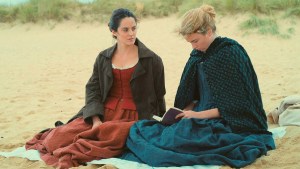
Portrait of a Lady on Fire, written and directed by Céline Sciamma, premiered at Cannes in 2019, winning the Queer Palm and the award for Best Screenplay. It stars Noémie Merlant as Marianne, a painter commissioned to produce a bridal portrait of Héloïse (Adèle Haenel), an aristocrat resisting an arranged marriage to a Milanese nobleman she has never met. Marianne must paint her in secret, introduced as a walking companion, memorising the details of Héloïse’s face on their daily walks and reconstructing them on canvas each night. When Héloïse discovers the deception, she is furious. When she agrees to pose for a second portrait, made with her full participation, something changes: the portrait becomes an act of collaboration, and then of love. The Countess leaves for the mainland. For five days, Marianne and Héloïse exist in a space briefly free of male authority. They read Ovid. They talk about Orpheus and Eurydice. They fall in love. Marianne leaves on a boat. Héloïse watches from the shore, her dress briefly catching fire, and does not look away.
| Director | Céline Sciamma |
|---|---|
| Year | 2019 |
| Runtime | 120 minutes |
| Cast | Noémie Merlant, Adèle Haenel, Luàna Bajrami, Valeria Golino |
| Awards | Best Screenplay, Queer Palm, Cannes 2019; 30th greatest film of all time, Sight and Sound 2022 poll |
| Streaming | MUBI, Criterion Channel |
Sciamma called the film a “manifesto about the female gaze.” She built it on a specific theoretical argument: that the male gaze, in classical art and in cinema, consumes its object, fixes it, destroys its agency. The Orpheus myth is the myth of the male gaze, she said. Orpheus looks back at Eurydice and she dies. Looking kills. The alternative the film proposes is reciprocal looking: two people who each see the other, who each change because of being seen, who co-create rather than capture. The moment the film crystallises this is when Héloïse turns the question back at Marianne during a sitting. She describes Marianne’s nervous habits with the same precision Marianne has been applying to her. “If you look at me,” she says, “who do I look at?” Both of them are looking. Neither of them is only the object. This is the film’s manifesto made visible.
“The first and last acts of looking in this film are both secret. In the first, Marianne paints Héloïse without her knowledge, and Héloïse is rightly angry. In the last, Marianne watches Héloïse at a concert without her knowledge, and the film gives us Héloïse’s face as the most beautiful image it has. The film calls the first a betrayal. It calls the second love. The distance between those two descriptions is where the argument lives.”
The Orpheus discussion is the film’s spine, and it is precisely laid. Sophie, the housemaid who has never heard the myth, responds to it with uncomplicated outrage. Why did he look? All he had to do not look. Marianne calls it “the poet’s choice”: Orpheus turns because he needs the image of Eurydice for his art, needs to see her one last time in order to carry her. Héloïse offers the interpretation that gives Eurydice back her agency: perhaps she asked him to turn, she says. Perhaps she chose to be seen, and chose what that seeing would cost. The film takes this seriously. It is the finest moment in the film’s intellectual architecture.
The final scene assigns these roles. Héloïse makes the lover’s choice: she does not look across the theatre. She keeps Marianne as a memory rather than a presence, protecting what they had from the world that would reduce it. Marianne makes the poet’s choice: she looks. She watches. She carries the image. The film frames Marianne’s looking as tender and elegiac, the last thing an artist can do with a love that cannot be completed. And it is tender. And it is elegiac. None of that is wrong.
What the film cannot acknowledge is that the poet’s choice and the original sin of the first portrait are structurally the same act. Marianne looks at Héloïse without Héloïse knowing she is being looked at. The first time, she painted her. This time, she watches her weep and stores the image. The ethics the film constructed across a hundred and twenty minutes, the entire argument for reciprocity over consumption, dissolves in the final sequence into the very thing it dismantled. The manifesto ends with its own exception.
Here is what makes this not a failure but the most honest thing the film does. Sciamma made Portrait of a Lady on Fire after ending a real relationship with Adèle Haenel, who plays Héloïse. Sciamma is Marianne. The film she made is, in the most precise sense, a painter painting the woman she loved: not only with a paintbrush but, as one critic put it, with a camera. The film’s argument against the consuming gaze is made by someone who directed 120 minutes of sustained, loving attention at the face of a woman who had been her partner. The argument is sincere. It is also, in its biographical dimension, already compromised by the making of it. Sciamma knows this. The final image is not the resolution of the film’s argument. It is the filmmaker’s admission that the poet’s choice and the lover’s choice cannot always be separated, that making art about a person you have loved is always, in some measure, looking at them from across a room while the Vivaldi plays and they do not know you are there.
The previous review in this sequence, on Summertime, found Lean looking at Venice through Jane Hudson’s eyes while his camera already knew every angle. The problem there was unacknowledged displacement: the director’s love was the film’s engine, and the character was the vehicle through which it ran. Sciamma acknowledges her displacement completely. She names the myth it enacts. She gives Héloïse the interpretation that makes Eurydice a subject rather than an object. And then, at the last moment, she cannot help herself. The poet looks back.
In this film, uniquely, the contradiction is the argument. The manifesto is honest precisely because it cannot fully live by its own terms. Looking at someone you love, Sciamma seems to know, may be the thing you can never make entirely ethical, no matter how reciprocal the frame. You can build the most rigorous theory of the gaze ever put on screen, and still, at the end, there is a woman weeping in a theatre, and you are watching her, and the camera is close on her face, and it is the most beautiful image you have ever made.
The manifesto does not fail. It tells the truth about itself. That may be the hardest thing an artist ever does.
If this stayed with you, watch these next:
Summertime (David Lean, 1955): reviewed in the previous post — the film placed here as the question Portrait of a Lady on Fire was supposed to answer: whose desire organises the frame? The comparison now runs in both directions. Lean couldn’t see that his love for Venice was displacing Jane’s story. Sciamma sees it completely. Whether seeing it resolves it is what the ending refuses to decide.
The Piano (Jane Campion, 1993): Sciamma cited it as an influence, specifically the moment when Ada throws herself and her instrument into the water. Both films are about women whose deepest inner life is expressed through art in the presence of people who may or may not be able to receive it. The comparison asks what each filmmaker trusted their audience to see without being told.
UnspokenCinema publishes every week. No ratings. No rankings. Just what films reveal without meaning to.