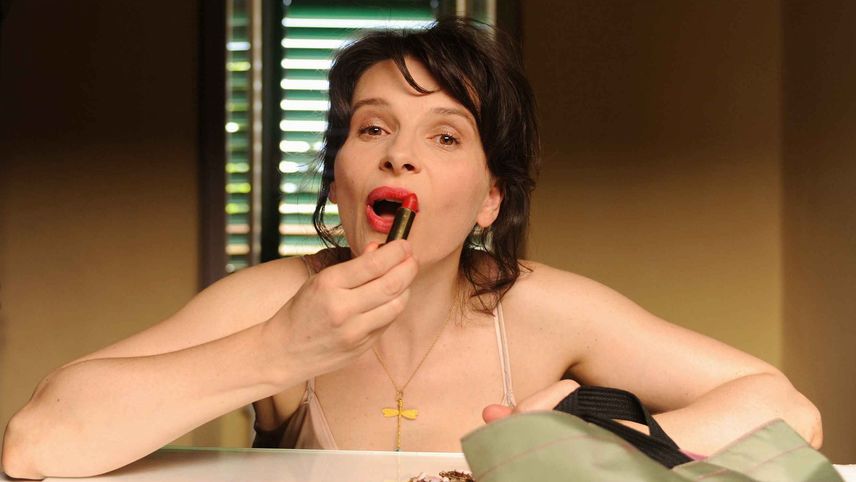
Kiarostami’s film asks whether a copy can have the same value as the original. What it cannot see is that it has been asking this question about one person’s life more than the other’s.
CERTIFICATE OF AUTHENTICATION
Object under examination: a marriage. Provenance: disputed. One party attests: Tuscany, one afternoon, two strangers. The other attests: fifteen years, a son, a room in a hotel in Lucignano where the mirror is in the same position it has always been.
Condition: the copy is indistinguishable from the original. This is either a triumph of reproduction or evidence that the original was never what one party believed it to be.
Authentication status: INCONCLUSIVE
Note from the examiner: the difficulty is not technical. The object does not wish to be authenticated. One party does not mind. The other minds considerably. The certificate cannot account for the asymmetry.
| Director | Abbas Kiarostami |
|---|---|
| Year | 2010 |
| Runtime | 106 minutes |
| Cast | Juliette Binoche, William Shimell |
| Awards | Best Actress, Cannes Film Festival (Binoche); Palm d’Or nomination |
| Streaming | Available on major platforms |
The Husbands and Wives review promised that Certified Copy was a film “where the woman’s experience of the dynamic is allowed to reorganise the entire film.” That was written as an invitation. Arriving now as the subject, the claim holds in one sense and requires complicating in another. Juliette Binoche’s performance does reorganise the film’s emotional center: there is no question about whose face the camera loves, whose interiority the film is tracking, whose experience of the afternoon costs something real. But the film’s philosophical structure, the argument about originals and copies that James presents at his lecture and that the film embeds in their relationship, is arranged so that one person can hold it lightly and the other cannot put it down.
Abbas Kiarostami made Certified Copy in 2010 as his first film outside Iran, shot in Tuscany with a French actress and a British opera singer. James Miller (William Shimell) is an English author who has written a book arguing that copies of artworks have equal value to their originals: a reproduction of the Mona Lisa, lived with daily, loved, is as real in its effect as the thing in the Louvre. He gives a lecture in a small Tuscan town. Afterward, an unnamed French woman (Binoche) drives him through the countryside to show him a painting, and somewhere between the car and a café, something shifts. A waiter’s wife addresses them as a couple. James does not correct her. The woman does not correct her. By the time they reach the village of Lucignano, they are behaving as though they have been married for fifteen years: they know each other’s habits, their disappointments, the particular way the other’s silence accumulates. Whether this is performance or memory, the film refuses to say. It refuses all the way to the last frame.
This refusal is Kiarostami’s great formal achievement, and also, quietly, the place where his film cannot see itself clearly.
The ambiguity is constructed to feel philosophical and shared: two people, equal in the film’s moral attention, holding an open question together. James’s book argues that the copy’s value is identical to the original’s, and the film seems to offer the couple’s uncertain status as a live demonstration of his thesis. If the afternoon is real, then it is a real marriage. If it is performed, then the performance has the same emotional weight as the real thing. Either way, the value is equivalent. James’s argument holds.
But watch what the ambiguity costs each of them. James inhabits it as an intellectual position throughout. His face is curious, occasionally irritated, sometimes tender, but never exposed. He is a man who has written a book about the equal value of the copy, and when the film places him inside a copy of a marriage, he responds the way a man would respond who has already worked out his position on the question. The woman responds as someone for whom the question is not theoretical. In the hotel mirror, she puts on earrings. She touches her reflection. The gesture is so private that the film feels briefly like it has looked at something it should not. She is not demonstrating the thesis. She is living inside it, and the living is not the same as the demonstration.
Kiarostami built a film about the equal value of originals and copies and placed two people inside the argument. One of them is inside the argument philosophically. The other is inside it the way you are inside a marriage.
The formal ancestor is Roberto Rossellini’s Viaggio in Italia (1954), which Kiarostami has acknowledged directly: a couple driving through southern Italy, a marriage dissolving in the light of ancient things, two performances of marital unhappiness so unguarded that audiences initially thought they were watching a documentary. Rossellini’s camera observes the couple from the outside, holding them at the distance of a patient witness. Neither George nor Katherine is given more of the camera’s attention. The marriage’s failure belongs to both of them in equal measure. Kiarostami inherits the landscape, the premise, and the formal walk-through-history structure, but his camera makes a different choice: it presses into Binoche’s face. The close-ups are hers. The interiority is hers. The film says the ambiguity is philosophical and shared. The cinematography says it has already decided whose film this is.
This is not a criticism of the cinematography. Binoche’s face in Certified Copy is one of the great sustained performances in recent cinema: she shifts registers within single takes, moving from playful to grieving to furious to something that has no name but reads, unmistakably, as the specific exhaustion of a woman who has been arguing the same argument for a very long time. The camera is right to press into it. What the film cannot see is that pressing into it also means the philosophical ambiguity has been quietly resolved by the camera even as the script insists on maintaining it. By the end, we are not uncertain about whose experience the film has taken seriously. We are only uncertain about what to call it.
The film in this archive that creates the sharpest friction is our review of Last Year at Marienbad, Resnais’s 1961 film where a man narrates a woman’s past to her and the film makes his narration the organizing grammar of the work. In Marienbad, the ambiguity belongs to X’s voice: he insists on a version of events, the camera enforces it, A’s resistance is present but cannot restructure the film’s reality. In Certified Copy, the ambiguity is distributed more honestly: the film genuinely refuses to adjudicate. But the woman’s experience of that refusal is not the same as James’s. Resnais gives the man the architecture. Kiarostami gives the man the philosophy and the woman the feeling, and presents this as equality. It is closer to equality than Marienbad manages. It is not quite there.
In Lucignano, they stand before a famous copy of a painting of a couple, and a local woman tells them it is good luck for newlyweds to visit it. They accept the story. On the walk back down the hill, something has settled between them, though what has settled is not clear and the film does not say. The light is golden. The village is old. They have been, for an afternoon, whatever the afternoon required. The certificate of authentication remains inconclusive. One of them is more inconclusive than the other.
If this stayed with you, watch these next:
Viaggio in Italia (Rossellini, 1954): Kiarostami’s direct ancestor, the couple driving through the ancient world, but where the camera observes from outside and refuses to press into either face — and the contrast reveals exactly what Kiarostami added, and what he could not let go of.
The Green Ray (Rohmer, 1986): named in our Pauline at the Beach watch-next, a film about a woman alone in summer who cannot make the ambiguity of her own desires resolve — and where Rohmer finally allows the cost to land without cushion.
UnspokenCinema publishes every week. No ratings. No rankings. Just what films reveal without meaning to.