Billy Wilder made a film about Hollywood discarding women who outlive the camera’s desire. His narrator is the most precise small-scale version of exactly that discarding. The film never notices.
The way I figured it, I had nothing to lose. A place to stay. A car in the garage. A woman who needed someone to tell her the script was brilliant. I’d been telling people their scripts were brilliant for years in this town and it hadn’t cost me much more than my self-respect, which was already a depreciated asset. So I stayed. And when the time came to leave — when a younger woman came along with a fresher situation and a future that didn’t involve waxwork dinners and a butler who was also an ex-husband — I left. And now I’m floating in the pool, and I’m going to tell you the whole story, and the version I tell will be the only version you get.
This is Joe Gillis. This is also the film.
| Director | Billy Wilder |
|---|---|
| Year | 1950 |
| Runtime | 110 minutes |
| Cast | William Holden, Gloria Swanson, Erich von Stroheim |
| Award | 3 Academy Awards including Best Screenplay; National Film Registry, Library of Congress |
| Streaming | MUBI, Paramount+ |
Billy Wilder’s Sunset Boulevard (1950) opens with its narrator already dead. Joe Gillis (William Holden), a broke and moderately talented screenwriter, floats face-down in a swimming pool on Sunset Boulevard while the police and press circle the property — and then his voice begins, and we go back six months to find out how he got there. What he found, when a blowout forced him up a driveway to hide his car, was Norma Desmond (Gloria Swanson), former queen of silent cinema, now sealed inside a mansion with her delusions, her pet monkey, and Max (Erich von Stroheim), her devoted butler who is also, it emerges, her first ex-husband and the man who manufactures the fan mail she believes is real. Joe stays. He edits her unsolicited Salome script. He accepts the shirts and the gold cigarette case and the New Year’s Eve party for two. He finds a younger woman, Betty Schaefer (Nancy Olson), a script reader with genuine taste and a future, and begins meeting her secretly to work on a script of his own. When Norma finds out, the arrangement collapses, and Joe leaves — and Norma shoots him, and the pool closes over him, and then his voice begins the story again. Sunset Boulevard won three Academy Awards in 1950, is among the most quoted films in American cinema, and entered the permanent archive as a searing indictment of Hollywood’s capacity to manufacture and then discard female celebrity. The previous review on this blog called it the film that “keeps the audience safely outside Norma Desmond’s delusion and produces tragedy through irony.” That was accurate, and now that the film is the subject rather than the comparison, it requires the harder question: safe for whom, and at what cost?
The Mulholland Drive review argued that Wilder’s distance from Norma — his irony, his cruelty, his refusal to let the audience fully inside her delusion — is what produces the tragedy. Place Joe Gillis next to that claim, and the distance begins to look less like authorial control and more like the film’s most intimate problem. Joe is the audience’s surrogate: witty, self-aware, professionally disappointed in a way that reads as earned rather than delusional, the kind of voice that earns the trust of anyone who has spent time in a room full of people taking themselves too seriously. He is positioned throughout as the observer of a pathology he did not create and cannot fully escape, a reasonable man in an unreasonable situation, making the best of things. The film offers no significant counter-pressure to this positioning. Max is too extreme to serve as moral anchor. Betty is too peripheral. The audience has Joe’s voice and Joe’s framing for the entire length of the film.
What the film cannot see — or rather, what it sees and then immediately narrates away — is that Joe Gillis is not an observer of the industry’s treatment of Norma Desmond. He is a practitioner of it. He is offered shelter and subsidy by a woman whose grip on reality is visibly loosening, and he accepts. He understands what Max is doing with the fan mail. He understands that Norma’s Salome script will never be produced. He understands that his presence in her house is sustaining a delusion that he privately finds grotesque. He takes the shirts anyway. The gold cigarette case anyway. He stays because the alternative is creditors and a cold-water apartment, which is to say he stays for the same reason the industry manufactured Norma Desmond in the first place: she was useful. When she stops being useful — when Betty Schaefer offers a cleaner, younger, less encumbered version of the same proximity to someone who believes in him — he leaves. The film criticises Hollywood for exactly this transaction: building a woman into a celebrity and withdrawing when the returns diminish. Its narrator performs the transaction in miniature across the entire film’s second act, and narrates it afterward with the wry distance of a man who has concluded that being complicit is not the same thing as being culpable. The film never disagrees with him. It gives him the pool and the voiceover and never asks whether the story he is telling from the water is the true one.
Joe Gillis is positioned as the film’s moral intelligence. He is actually its most precise portrait of the thing the film is supposed to be criticising. The irony does not reach far enough to see this.
The scene the film cannot protect with irony — the scene where the frame cracks and something more complicated than contempt shows through — is the screening room. Norma has arranged a private projection of her old films. She sits in the dark while the images from her silent career unspool: enormous, luminous, absolutely commanding. Max operates the projector. He is not watching the films. He is watching Norma watching herself. And Norma’s face, lit from below by the projector’s reflected light, is transported — not delusional, not grotesque, not the subject of a clinical study in pathological narcissism, but genuinely, heartbreakingly moved by the image of what she was. The films are not lying. She was extraordinary. The camera that adored her then was not wrong. What is happening in this room is not madness. It is a person sitting in the dark with evidence of her own vanished power, and feeling it.
Wilder shoots this with a stillness that exists almost nowhere else in the film. Joe’s narration goes quiet. The irony has no purchase here because there is nothing to be ironic about. A great talent sits in a dark room and watches herself. That is all. That is also everything. And Max, watching from the projection booth, is not a figure of grotesque servility in this scene. He is the most honest character in the film: a man who knows exactly how much was lost when the industry moved on from Norma Desmond, and who chose to stay and bear witness to that loss in whatever form she needed. The film cannot quite acknowledge what it has just shown. After the screening, the irony reassembles. Joe’s voice resumes. The sardonic distance reestablishes itself. But for those few minutes in the dark, Sunset Boulevard briefly becomes the film that loved Norma Desmond — not the film that pitied her — and the briefly-glimpsed love is more devastating than anything the irony surrounds it with.
Joseph L. Mankiewicz’s All About Eve, released the same year, illuminates Sunset Boulevard from directly alongside it: same industry, same year, same architecture of female ambition and its costs, and a completely different formal position. Where Sunset Boulevard places the audience outside its central woman through a man’s narration, All About Eve places them inside the calculations of its women — Margo Channing (Bette Davis), aging stage actress, and Eve Harrington (Anne Baxter), her perfectly engineered replacement — without a male narrator to provide comfortable distance. Mankiewicz’s film is at least as sardonic as Wilder’s, but the sardonic intelligence belongs to the women, not to a man watching them. Margo knows exactly what is happening to her. She names it with a precision Norma Desmond never achieves. The irony in All About Eve is wielded by its subject rather than deployed above her, which means the audience cannot use it as cover. The two films, placed side by side, show the difference between a film that criticises the industry’s treatment of women with a man’s voice and a film that gives the women the voice and makes the industry answer to it. Both came out in the same year. One of them is funnier, more quotable, and more comfortable. The other is harder to leave behind.
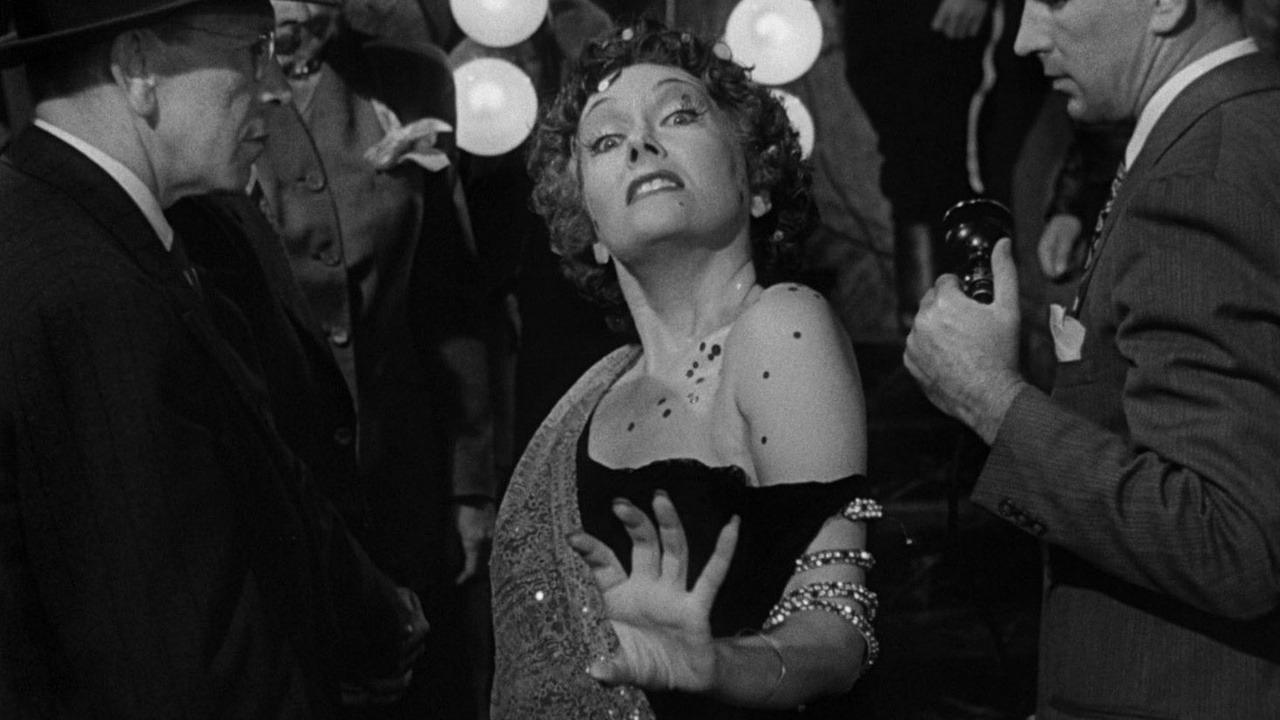
Sunset Boulevard is the most perfectly constructed trap in American cinema — a film about the audience’s relationship to female celebrity that produces, at its climax, the audience’s most rapturous engagement with the female celebrity at the centre of it. Norma Desmond descends the staircase believing the cameras have come back for her. They are crime scene cameras. She is being documented rather than adored. And yet the image she makes descending that staircase is one of the great images in cinema, and the film knows it, and gives it to her fully, and the question that lingers after the screen goes dark is whether the cruelty and the rapture were ever actually different things, or whether this is simply what the camera has always done: adored and then documented, worshipped and then archived, kept everything and given back nothing. Joe Gillis narrates from the pool. The story he tells is the only story you get. He was always going to tell it this way.
If this stayed with you, watch these next:
All About Eve (Joseph L. Mankiewicz, 1950): released the same year, set in the same industry of performance and replacement, but where Wilder gives the sardonic distance to a dead man, Mankiewicz gives it to the women themselves — Bette Davis wielding intelligence and fury in equal measure — and the comparison shows precisely what changes when the women in a film about women are allowed to be the most knowing people in the room.
Mulholland Drive (David Lynch, 2001): our review is on this blog — the film that inherited Sunset Boulevard‘s architecture and removed its narrator, leaving the audience inside the delusion rather than above it; where Wilder’s irony keeps the audience safely outside Norma’s dream, Lynch takes the door away, and what that removal reveals is everything the dead man’s voiceover was quietly protecting everyone from feeling.
UnspokenCinema publishes every week. No ratings. No rankings. Just what films reveal without meaning to.