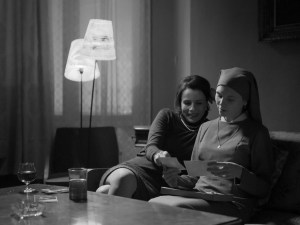
Ida keeps its characters pinned in the bottom third of the frame, with the weight of Polish sky above them. The framing is the film’s argument: history presses down and does not lift. But the film’s final image gives Ida the frame back. Watch what she walks toward.
Frame 1. Anna, a novitiate nun, at the edge of a table in the convent. The table fills the lower half of the screen. Her head is in the bottom third. Above her: pale wall, empty air, silence. The world she inhabits takes up perhaps a quarter of the visible image. The rest is what presses down on it.
Frame 2. Wanda in her car. Cigarette. Dark coat. The road and the winter fields occupy the upper two-thirds of the frame. Wanda is in the bottom, and she drives as if underneath something.
Frame 3. The two women in a small roadside hotel. They face each other across a table in the lower quarter of the image. The ceiling and wall above them are vast. Two women carrying decades of unspeakable history, and the frame makes visible what they cannot speak: the enormous weight of what happened is literally above their heads.
Frame 14. (The final frame.) Ida walks down a road, away from us, toward the convent. She occupies the center of the image now. The sky is still there, but she is moving into it rather than pressed under it. She has made her choice.
The question the film cannot ask is whether a choice made after someone else’s death is still a choice.
A.O. Scott of The New York Times called Ida “a compact masterpiece” that managed to “contain a cosmos of guilt, violence and pain” without stating any of it directly. He was precisely right about the compression — the film is eighty-one minutes and says nothing it does not have to say, shows nothing it does not have to show. Silence does more work here than dialogue. The Academy ratio (1.37:1, almost square) compresses the world laterally and forces what cannot be compressed vertically — the enormous empty space above the characters’ heads — to carry the film’s argument about what happened to them and to their country.
Ida, written and directed by Paweł Pawlikowski and released in 2013, is set in Poland in 1962, seventeen years after the war and while the country is still living inside the Stalinist structures that replaced one form of erasure with another. Anna (Agata Trzebuchowska), an eighteen-year-old orphan raised by nuns, is told before taking her vows that she must first visit her only living relative: her mother’s sister, Wanda Gruz (Agata Kulesza), a former communist state prosecutor whose Jewish family was murdered during the German occupation. Wanda tells Anna her real name is Ida, that her parents were killed not by Germans but by the Polish farmer who was hiding them — Feliks Skiba — who then buried them in the forest and took their farm. The two women drive into the winter countryside to find the graves and the truth. Wanda drinks heavily, sleeps with men she does not want to keep, prosecuted people in show trials that sent innocents to death. She is the film’s most alive and most damaged person, and Agata Kulesza’s performance is the best in either of these women’s careers.
| Director | Paweł Pawlikowski |
|---|---|
| Year | 2013 |
| Runtime | 81 minutes |
| Cast | Agata Trzebuchowska, Agata Kulesza, Dawid Ogrodnik |
| Awards | Academy Award Best Foreign Language Film 2015; BAFTA Best Film Not in the English Language |
| Streaming | Criterion Channel, MUBI |
The framing has been analysed exhaustively since the film’s release, and every reading arrives at the same conclusion: the characters placed in the bottom of the frame are crushed by history, by grief, by the weight of what Poland did and what was done to it. Łukasz Żal, who completed the film’s cinematography after the original DP fell ill and left, has described the Academy ratio as creating “a balance between the actors and the environment,” enabling a composition that speaks “about what is just beyond the frame.” The framing is about what cannot be seen — the dead, the disappeared, the buried — pressing down on the visible world from outside it. The characters carry what cannot be framed. The sky above them is the absence.
This is correct. This is also half the film’s argument.
“The film was named, in the previous post in this sequence, as the answer to the question the German surveillance films kept failing to answer: a woman processing historical aftermath without being anyone’s supporting character. Wanda is in the film. She is not supporting anyone. She dies. And when she dies, the only other path the film had given Ida closes. The road Ida walks at the end was always going toward the convent. Wanda’s death is what removes the question of whether it needed to go elsewhere.”
The Lives of Others review ended by naming Ida as the film that refuses to resolve into male recognition and imagines a female consciousness at the centre of historical reckoning. That framing was correct in one sense: Ida and Wanda are both the film’s center of gravity, and no male character organises the story. There is no Dreyman, no Wiesler. There is no man whose goodness is the ending’s reward.
But the pattern this sequence of reviews has been tracking — woman dies, clearing the space for another character’s resolution — does not require a man to be its beneficiary. Wanda jumps from her apartment window. The film cuts to Ida at the burial, then at Wanda’s apartment, then trying on Wanda’s clothes and stilettos, then sleeping with the jazz musician Lis, then leaving Lis in the morning without waking him, and walking down that road. The ending is framed as Ida’s choosing. The sequence is: death, trial, rejection, return. But the trial — the brief experiment with the life Wanda was pressing her toward, or that the world outside the convent offered — happens after Wanda is gone, in Wanda’s apartment, wearing Wanda’s clothes. Ida does not try living; she tries on its props. And she leaves them behind.
The framing in the film’s penultimate sequences, when Ida is in Wanda’s apartment, is different from the film’s established grammar. The characters are no longer pinned in the bottom third. Things fill the frame differently — the clutter of Wanda’s life, the textures of a world lived messily rather than devotionally. And then Ida leaves it all, and the final frame — the road, the convent, the figure walking into the sky — returns to the film’s original grammar. The sky presses down again. The choice is framed as liberation. The composition suggests something more ambiguous.
The film Pawlikowski made is not dishonest about Wanda. Her suicide is not a sacrifice that serves Ida’s story — it is a woman who cannot survive what she has remembered, who falls as the weight of what she did and what was done to her becomes indistinguishable. She is a more complex and more tragic figure than anyone the German films in this sequence managed with their female characters. She is not a plot device. She is a catastrophe the film regards with full attention.
What the film cannot see is that her death remains structurally necessary. Wanda alive would not let Ida return to the convent without consequence. Wanda alive is the road not taken, requiring constant renegotiation. Wanda dead allows Ida to make a choice that has no remaining argument against it. The last person who might have said “but you don’t have to go back” is silent. The sky fills back in.
The film that kept its characters in the bottom third of every frame, the film whose most consistent visual argument is that history cannot be escaped only borne, ends with its protagonist choosing to walk back under it. Whether that walk is faith or exhaustion or genuinely free choice, the film’s own framing cannot say. The space above Ida’s head is still there, enormous, the sky of 1962 Poland where the dead cannot be recovered and the living must carry what they know. She walks into it. The film ends on that frame. It does not ask what it means that she chose this road only after the person who offered her another one was buried in the same ground as her parents.
If this stayed with you, watch these next:
Cold War (Paweł Pawlikowski, 2018): Pawlikowski’s follow-up, which returns to the Academy ratio and black-and-white photography and a Poland that cannot hold its people — but focuses on a love story across decades and borders, asking whether devotion across political rupture is love or compulsion. The formal comparison with Ida is exact: same frame, different kind of sky.
A Separation (Asghar Farhadi, 2011): a film that also refuses resolution, in which every character’s moral position is simultaneously defensible and compromised, and in which the ending — a daughter choosing between her parents — refuses to show us the choice. The comparison asks what it means for a film to end on the threshold of a decision rather than on its aftermath.
UnspokenCinema publishes every week. No ratings. No rankings. Just what films reveal without meaning to.