The Ledger
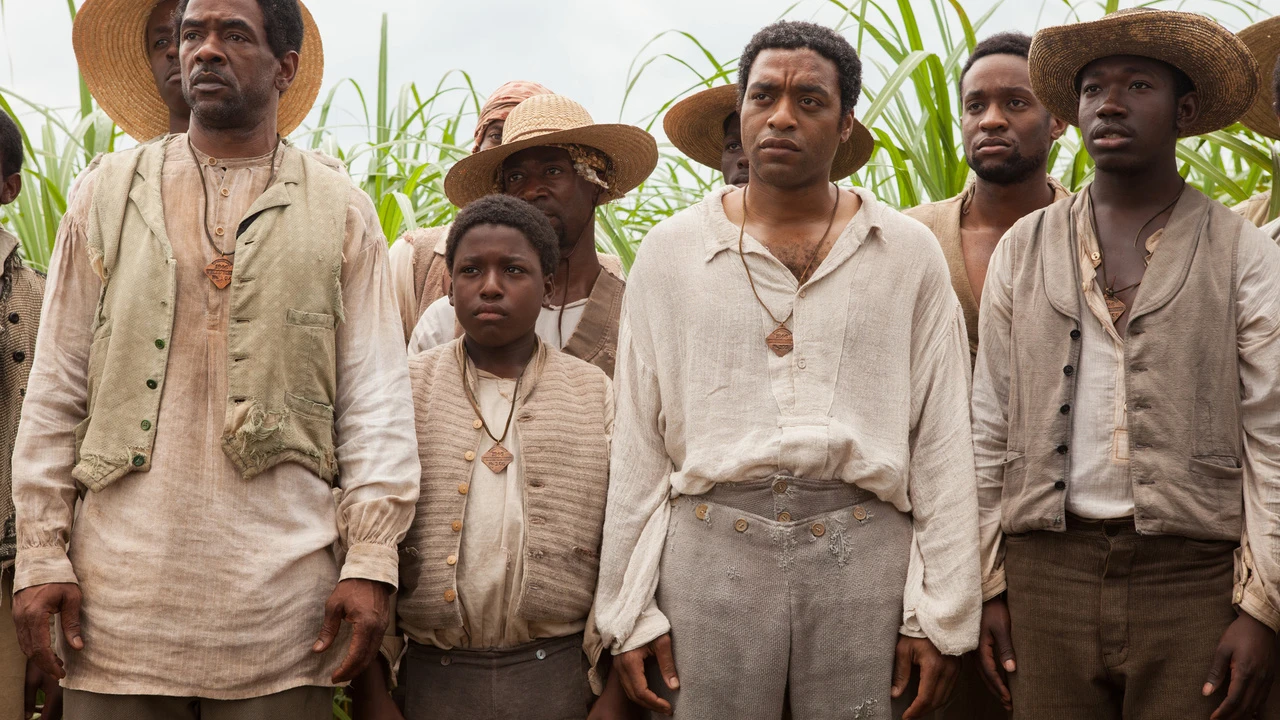
Solomon Northup is not a character who grows. He does not learn. He does not transform. He does not discover inner resources he did not know he had. He arrives in the first scene of 12 Years a Slave as a complete human being. A husband. A father. A violinist. A free man living in Saratoga Springs, New York, in 1841. He is literate. He is dignified. He wears a good suit. He is already everything the film will spend its next two hours taking from him.
This is the thing most people miss when they talk about this film. They call it a story of endurance. They call it a story of survival. But survival implies a threat to existence, and that is not what slavery does to Solomon Northup. It does something worse. It keeps him alive while removing, one by one, every category that made his life legible. His name. His history. His family. His skill. His standing. His right to look another person in the eye.
Steve McQueen understands this. He is not making a film about a man who survives slavery. He is making a film about subtraction.
The Name
They rename him Platt.
It happens fast. Too fast for the audience to metabolize. One moment he is Solomon Northup, and the next he is told that he is not, and the telling is enforced with a paddle. The scene is not about pain. Every film about slavery shows pain. This scene is about something more surgical. It is about the moment when a human being is required to participate in his own erasure. Solomon does not simply lose his name. He is required to answer to a different one. He must perform the subtraction.
You saw this same mechanism in Spirited Away, where Chihiro’s name was taken by the bathhouse and the forgetting began immediately. But Chihiro was a child in a fantasy, and the stakes, while real within the film, carried the safety net of metaphor. Solomon has no metaphor. His name is taken in a room, by men, with witnesses and paperwork. The institution does not need magic. It has commerce.
What the Violin Knows
There is a scene early in the film where Solomon plays his violin. He plays well. He plays with the ease of a man who has played all his life, for whom music is not an accomplishment but a fluency. The film lets you hear it, and in that hearing, it establishes something crucial: this is a man with an interior life so developed, so practiced, that it can produce beauty without effort.
Then the violin becomes something else.
On Edwin Epps’s plantation, Solomon is asked to play. Forced to play. He plays while enslaved people dance after a day of picking cotton, and the music that once belonged to him now belongs to the system. His skill is not destroyed. It is repurposed. The institution does not break what it can use. It redirects.
This is the algebra of the ledger. The film does not show Solomon losing his ability. It shows his ability being conscripted. The man is still present inside the musician. But the musician now serves the plantation. The interior life continues, and the continuation is the cruelty, because it means Solomon can feel every degree of the distance between what the music meant and what it now does.
The Long Take
McQueen holds shots longer than you want him to.
This is not an aesthetic choice. It is a moral one.
The most discussed sequence in the film is the hanging scene. Solomon is strung up by the neck from a tree, his toes barely touching the mud, for what feels like an eternity. The camera does not cut away. It does not offer a reaction shot. It does not give you another character’s horror as a proxy for your own. It simply watches a man balance on his toes in the mud while behind him, in the background, other enslaved people walk by. Children play. The plantation continues.
The length of the shot is the argument. McQueen is not showing you that slavery was cruel. You already knew that. He is showing you that cruelty was ordinary. The children playing in the background are not heartless. They have simply learned what Solomon is learning: that a body hanging from a tree is not an event. It is a feature of the landscape.
In Come and See, Klimov used the sustained gaze for a different but related purpose: to collapse the distance between witness and participant. Florya’s face became a document of exposure. But McQueen’s long take does something worse than exposure. It asks you to stay in a moment that has no narrative momentum. Nothing is being built. Nothing is being resolved. A man is dying slowly in the foreground and the world has not paused.
You want to look away. The film will not let you. And in your discomfort, you become the thing McQueen is actually filming: a person who would prefer not to see.
Epps
Michael Fassbender’s Edwin Epps is the most dangerous kind of villain. He is not evil in the cinematic sense. He is not calculating. He is not cold. He is passionate. He is religious. He is, in his own understanding of himself, a man in love.
He is in love with Patsey.
The word “love” here is doing something the film refuses to correct. Epps calls it love. He acts as if it is love. He is possessive and jealous and tormented and violent in the specific pattern that American culture has often mislabeled as romantic intensity. He rapes Patsey and then weeps. He beats her and then cannot sleep. He quotes scripture to justify ownership and reads tenderness into domination.
McQueen never gives Epps a moment of self-awareness. He never allows Epps to see what he is. This is not a failure of characterization. It is the characterization. Epps is a man whose entire moral vocabulary has been provided by an institution that calls ownership love and labor grace and violence correction. He is fluent in a language where every word means the opposite of what it costs.
Think about what The Godfather showed you: an institution that consumed Michael Corleone by promoting him. Epps is the version of that principle applied to the body of another person. He does not consume himself. He consumes Patsey. And he calls the consumption devotion.
Patsey
Lupita Nyong’o plays Patsey with a stillness that should not be possible under the circumstances the character endures. She is the plantation’s best cotton picker. She picks over five hundred pounds a day. She is raped by her owner. She is hated by her owner’s wife. She is denied soap. She is denied the right to be clean.
There is a moment where Patsey asks Solomon to kill her. She asks him quietly. She asks him as a favor. She asks him the way you would ask a friend to help you move something heavy. And the request is not performed as a dramatic peak. It is performed as arithmetic. Patsey has done the math. She has added up the days and the nights and the cotton and the weight of Epps in the dark, and the sum is a number she cannot carry any further.
Solomon refuses. He refuses not out of moral conviction but out of inability. He cannot do it. And in his inability, the film opens a gap between two kinds of suffering that most films about slavery refuse to acknowledge. Solomon suffers as a free man trapped in bondage. His suffering has a before and after. It has a shape. Patsey suffers as a person for whom there is no before. There is no Saratoga Springs. There is no violin. There is no life to which she might return. Her subtraction is not from a prior wholeness. It is her entirety.
The film never reconciles these two positions. It never asks you to rank them. It simply places them side by side and lets the gap do its work.
The Letter
Solomon’s escape depends on writing.
He must write a letter. He must find someone who will mail it. He must trust a white man with his literacy, which means trusting a white man with the most dangerous fact about his existence: that he is not what the institution says he is.
The first man he trusts betrays him. The scene is brief and devastating. Solomon burns the letter. The burning is not a metaphor. It is the destruction of evidence, and the evidence was his identity.
The second man, Bass, played by Brad Pitt, delivers the letter. The film has been criticized for making the savior a white man, and the criticism is not wrong. But McQueen does something interesting with the rescue. He films it without catharsis. Solomon’s family arrives. Papers are produced. He is declared free. He walks to the carriage.
And as he leaves, he looks back at Patsey.
That look is the longest line in the ledger. Solomon is restored. Everything that was subtracted from him will be, in some administrative sense, returned. His name. His family. His status. But Patsey remains. The ledger closes for Solomon and stays open for her. His freedom is not an answer. It is a demonstration that the system was never broken. It worked exactly as designed. It could subtract a person and then, if the paperwork was right, add him back. The capacity to do both is the horror.
What the Closing Title Cards Subtract
The film ends with title cards. They tell you that Solomon Northup was reunited with his family. They tell you he became an abolitionist. They tell you the date and circumstances of his death are unknown.
That last line is the final entry in the ledger. A man who was subtracted, restored, and then lost again, this time by history itself. The system that took his name and gave it back ultimately took him from the record altogether. We do not know where he is buried. We do not know how he died.
McQueen could have ended the film on the reunion. He could have ended on the embrace, on the tears, on the restoration. Every instinct of Hollywood construction says: end on the return. End on the wholeness.
Instead, he ends on a title card that says: we lost him again.
The ledger does not close. That is the argument. The ledger never closed. It is still open. Solomon’s story is not a historical curiosity. It is an ongoing subtraction that the country has never finished tallying. Every few years, someone opens the book and counts the names again, and the numbers do not add up, because you cannot return what was taken when the taking lasted centuries and the returning lasted an afternoon.
The Body Under History
This is what 12 Years a Slave brings to Cycle Four’s arc. After three films about the body as physical presence (The Wrestler‘s battered performer, Moonlight‘s armored tenderness, Crouching Tiger‘s bodies honest only in the air), we arrive at the body as property. The body that is owned. The body on which history writes its accounts.
Randy Robinson chose to give his body to the ring. Chiron chose to harden his body against the world. Li Mu Bai and Yu Shu Lien chose to deny their bodies what they wanted. Solomon Northup chose nothing. His body was taken. And the film insists that you understand the difference between a body that is damaged by its own choices and a body that is damaged by an institution that considers the damage an expense, files it, and moves on.
What the body carries. What history writes on it without asking.
The ledger stays open.
Where This Leads Us
There is a pianist in a ruined city who plays for no one, and then for the wrong person. The Pianist is not about the Holocaust the way you expect it to be. It is about a body that should have been subtracted, was not, and does not know why. Roman Polanski films survival not as triumph but as remainder. What is left when the ledger has taken everything and the body, inexplicably, persists.
Solomon knew why he survived. Władysław Szpilman never does.