The Transaction
Oskar Schindler is a war profiteer.
This needs to be said first, before the tears, before the speeches, before the girl in the red coat and the final scene at the grave, because Schindler’s List is a film that earns its emotion only if you understand what the emotion is built on. It is built on commerce. It is built on a man who understood, better than anyone around him, how systems work, how officials are bribed, how labor is valued, how a human being can be entered into a ledger as an expense or an asset. Oskar Schindler did not start by wanting to save anyone. He started by wanting to make money. And the film is honest enough, barely, to let that fact remain visible beneath everything that follows.
Steven Spielberg is often accused of sentimentality. The accusation is sometimes fair. But Schindler’s List is not a sentimental film. It is a transactional film. Nearly every scene involves a negotiation. Schindler negotiates with the German military for contracts. He negotiates with Itzhak Stern for labor. He negotiates with Amon Goeth for workers. He negotiates with officials for exemptions, for permits, for the right to keep his factory running. The film’s dramatic engine is not courage or compassion. It is leverage. Schindler saves lives because he understands that in a system that has assigned a price to human beings, the correct response is not moral outrage. It is purchasing power.
This is what most readings of the film get wrong. They treat Schindler’s transformation as a journey from indifference to empathy. But watch Liam Neeson’s performance closely. Schindler does not become empathetic. He becomes expensive. He spends more and more money. He bribes more and more officials. He risks more and more capital. The transformation is not interior. It is financial. The man does not change his nature. He changes his budget.
The Accountant
Ben Kingsley’s Itzhak Stern is the most important character in the film, and the film knows this, and Spielberg is smart enough to let Kingsley play it almost entirely in silence.
Stern is the man who makes the list. Not Schindler. Stern sits in an office and types names. He decides who goes on the list and who does not. He decides who lives. The film gives this power to an accountant, to a man whose instrument is a typewriter, whose language is numbers, whose survival depends on being indispensable to a man who is indispensable to the Germans. The chain of dependency is the architecture of rescue. Stern needs Schindler. Schindler needs the Germans. The Germans need the war. And somewhere at the bottom of this chain, a thousand people need their names to be typed onto a piece of paper.
There is a scene where Stern almost boards a train. He is rounded up, loaded into a cattle car, and Schindler arrives at the last moment, shouting, pulling rank, waving papers. Stern is removed from the train. The scene is filmed as a rescue, and it is a rescue, but it is also a demonstration of what rescue looks like inside a bureaucracy. It looks like paperwork. It looks like a man with the right signature arriving before the train departs. It looks like the system working in reverse for one person while it works as designed for everyone else on the train.
You saw this mechanism in 12 Years a Slave. Solomon Northup was pulled from a line by a man who had the right paperwork. The system that enslaved him was the same system that freed him. The capacity for both was not a contradiction. It was a feature. Schindler’s list operates on the same principle. The bureaucracy of death is also the bureaucracy of rescue. The same forms that send people to Auschwitz can, if filled out by the right hand with the right bribe, send them to a factory in Brünnlitz instead.
The Girl in Red
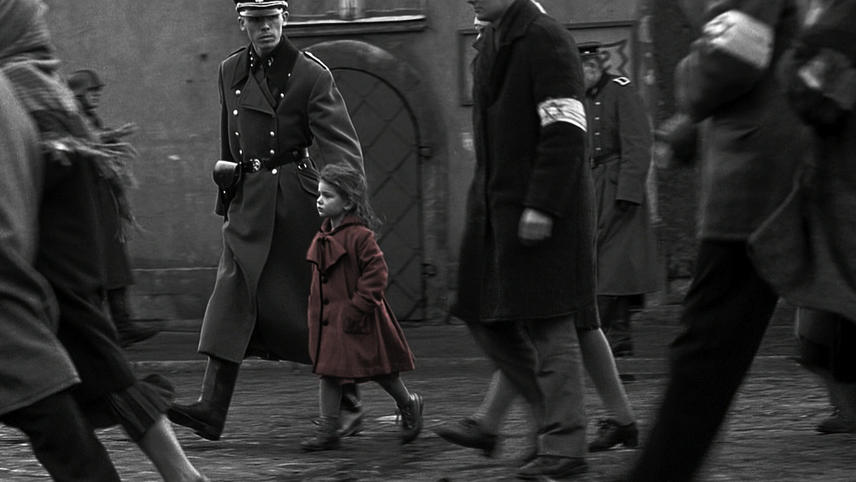
The red coat has been discussed so extensively that it has become a shorthand for the film itself, and that is unfortunate, because the shorthand misses what the image actually does.
A little girl walks through the liquidation of the Kraków Ghetto. The film is in black and white. She is in red. Schindler watches from a hill on horseback. He sees her. The audience sees her. She walks through the chaos, small and bright and apparently unnoticed by the soldiers, and she disappears into a building.
Later, Schindler sees the coat again. It is on a cart of bodies being taken to be burned.
The reading that has calcified around this image is that the girl represents the moment Schindler’s conscience awakens. He sees an individual. He sees a child. He can no longer look away. This reading is not wrong, but it is incomplete. Because the red coat does something more structural than emotional. It makes one person visible in a system designed to make people invisible. The girl is not important because she is a child. She is important because she is specific. She has a coat. She has a color. She has a trajectory through the frame that you can follow. And in a film where the machinery of death operates by turning people into numbers, into categories, into populations, the specificity of one red coat is an act of resistance against the arithmetic.
This is also what the list itself does. It makes people specific. It gives them names. It types those names onto paper. In a system that processes human beings as aggregate, the list is a technology of individuation. Each name on it is a red coat. Each name says: this one. Not the category. This one.
Goeth
Ralph Fiennes plays Amon Goeth as a man who has been given permission.
That is the horror. Not that Goeth is a monster. Not that he is insane. Not that he is uniquely evil. The horror is that he is ordinary, and the system has given him permission to do what ordinary men do when permission is granted. He shoots people from his balcony the way another man might shoot birds. He beats his maid because she is available to be beaten. He exercises power with the casualness of a man who has never had to justify the exercise, because the institution he serves considers the exercise routine.
Spielberg gives Goeth a scene with Schindler where Schindler tries to teach him mercy. Power is when you have every reason to kill and you don’t, Schindler tells him. Goeth tries it. He pardons a boy who has failed to clean his bathtub properly. He stands in front of a mirror and says, “I pardon you.” He practices mercy the way you practice a foreign phrase. Then he shoots the boy anyway.
The scene is the film’s clearest statement about what mercy means inside an institution that has no use for it. Goeth cannot be merciful. Not because he lacks the capacity. He demonstrates the capacity. He pardon the boy. He performs the gesture. But the gesture has no ground beneath it. The institution does not support mercy. It supports quotas. And when the gesture is finished, the institution reasserts itself, and the boy is dead, and Goeth is standing on his balcony with a rifle, and the sun is on his face.
Think about what The Godfather showed you. Michael Corleone was consumed by the institution through promotion. Goeth is consumed by the institution through permission. Michael became the thing the family needed him to be. Goeth became the thing the camp allowed him to be. The difference is cosmetic. The mechanism is identical.
The Shower
There is a scene at Auschwitz. The women from Schindler’s list have been sent there by mistake. They are taken to a room. They are told to undress. They enter a chamber. The showerheads are visible. The audience knows what showerheads in Auschwitz mean. The women know what they mean.
Water comes out.
This scene has been called exploitative. It has been called manipulative. It has been called the moment where Spielberg’s instinct for suspense overrides his responsibility to the subject. The criticism has merit. The scene engineers tension from the audience’s knowledge of the gas chambers. It uses the architecture of genocide as a plot device. It resolves with relief, and the relief feels obscene, because the relief applies only to these women, and the chambers functioned as designed for millions of others.
But there is something else in the scene that the criticism often overlooks. The women’s faces. Spielberg holds on them. Not on the showerheads. Not on the architecture. On the faces of women who believe they are about to die. And what you see in those faces is not dramatic terror. It is the specific quality of fear that belongs to people who have been processed. They have been stripped, numbered, sorted, moved through a system that has told them, at every step, that their bodies are not theirs. The fear is not of death. The fear is of confirmation. That the system means what it says. That the processing was not administrative. That it was final.
Water comes out, and they weep, and you weep, and the weeping is compromised, and Spielberg knows it is compromised, and he includes the scene anyway, because the compromise is part of what the film is about. You cannot make a film about the Holocaust that is not compromised. You cannot use the tools of cinema, suspense, identification, narrative, resolution, without those tools deforming the subject they are applied to. The shower scene is the moment where the deformation becomes visible, and you must decide whether visibility is honesty or exploitation.
The Speech
At the end of the war, Schindler addresses his workers. He tells them they are free. He tells the guards they can return to their families or be captured as war criminals. The workers give him a ring. It is made from a gold tooth. Inside it is inscribed a line from the Talmud: Whoever saves one life saves the world entire.
Schindler weeps. He looks at his car. He looks at his pin. He calculates. The car could have bought ten more people. The pin could have bought two. He did not do enough. He did not spend enough. He could have saved more.
This scene has been called the emotional peak of the film, and it is, and it is also the most revealing. Because Schindler’s breakdown is not about guilt. It is about arithmetic. He is still thinking in transactions. He is still calculating the price of a person. The car is worth ten lives. The pin is worth two. His grief is expressed in the language of the market because that is the only language he has. He did not become a saint. He became a buyer who ran out of money.
And here is where the film is braver than it is given credit for. It does not redeem Schindler by making him good. It redeems him by making him broke. He spent everything he had. Not because he was righteous. Because once you have learned the price of a person and you have the money to pay it, not paying becomes impossible. The knowledge is the trap. The list is the receipt.
The Graves
The final scene is in color. The real survivors, the actual people from Schindler’s list, walk to his grave in Jerusalem. They place stones. Beside each survivor walks the actor who played them. Fiction and fact share the frame.
Spielberg is doing something here that exceeds sentimentality. He is closing the transaction. The film began in commerce. It moved through bureaucracy, leverage, bribery, the reduction of human beings to line items and prices. And it ends with bodies. Real bodies. Bodies that are alive because their names were typed on a piece of paper by a man in an office at the instruction of a man who understood the system well enough to exploit it.
The stones on the grave are the final currency. Not money. Not gold. Not the teeth and jewelry that financed the list. Stones. The cheapest thing. The thing you find on the ground. The thing that costs nothing and means everything, because the people placing them are alive to place them, and that is the only transaction that mattered.
History’s Weight, Concluded
Schindler’s List closes the “history’s weight” arc of Cycle Four. Three films. Three relationships between the body and the institution that claims it.
12 Years a Slave: the ledger. A free man subtracted, line by line, and then restored by paperwork. The system that enslaved him was the system that freed him. The Pianist: the remainder. A man who fell through every system, rescue and death alike, and survived as an accident, a leftover, a body that persisted when the structures around it did not. Schindler’s List: the transaction. A man who learned the price of a person inside a system that had priced people for destruction, and paid it, and went broke, and wept over the arithmetic.
Three films. Three bodies under history. One was written into a ledger. One fell through the cracks. One was purchased from the machine.
What the body carries. What the institution costs. What the list remembers.
Where This Leads Us
There is a woman in Mexico City who mops the floor before anyone wakes up. She washes clothes on the roof while airplanes cross overhead. She carries the house on her back and the house does not notice. Alfonso Cuarón’s Roma is not about a family. It is about the body that holds the family together, the body no one sees, the body that works.
Schindler purchased bodies from history. Cleo gives hers away, daily, for wages the film never mentions.