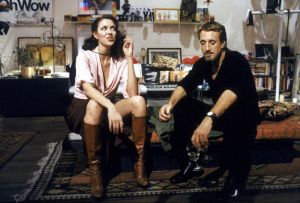
All That Jazz is ruthlessly honest about what Bob Fosse cost himself. The question it cannot bring itself to ask is what he cost the people he cast to play his damage.
Ann Reinking had to audition for the role of herself.
She was Bob Fosse’s girlfriend. The character of Kate Jagger, the dancer in an on-again off-again relationship with the womanizing choreographer Joe Gideon, was based on her, acknowledged by everyone involved. The real relationship had ended before production began. Fosse wanted her for the part anyway. And so Ann Reinking — who had just lived through the experience the film would dramatize — sat in a room and performed her own life back at the man who had put her through it, hoping he would decide she was right for the role.
He decided she was right for the role.
All That Jazz is one of the great films about a self-destructive artist, and one of the most genuinely original musicals in American cinema. Bob Fosse directed, choreographed, and co-wrote it as a semi-autobiographical portrait of Joe Gideon (Roy Scheider), a Broadway director and choreographer simultaneously editing a film, rehearsing a new show, consuming amphetamines and cigarettes at an industrial pace, sleeping with a rotating cast of women, and deteriorating toward a heart attack with the focused efficiency of a man who has decided to be excellent at everything, including his own destruction. It won the Palme d’Or at Cannes in 1980, four Academy Awards, and the permanent admiration of filmmakers including Stanley Kubrick, who called it the best film he had ever seen. The choreography is visionary. The editing is extraordinary. Roy Scheider gives the performance of his career.
The film knows all of this about itself and says so, loudly, with the jazz hands of a man greeting his own reflection every morning. That greeting — “It’s showtime, folks!” — is the film’s recurring motif, and its deepest tell.
| Director | Bob Fosse |
|---|---|
| Year | 1979 |
| Runtime | 123 minutes |
| Cast | Roy Scheider, Jessica Lange, Ann Reinking, Leland Palmer, Erzsébet Földi, Ben Vereen |
| Awards | Palme d’Or, Cannes 1980; four Academy Awards including Best Editing |
| Streaming | Max, Criterion Channel |
Joe Gideon cannot stop performing. Every morning, hungover and pharmacologically stabilized, he surveys himself in the bathroom mirror, puts on his glasses, and announces the day as if it is a show he is about to give. The mirror is important. Joe’s relationship with his own reflection is the most consistent relationship in the film. The women come and go. The daughter visits on weekends. The producers circle like creditors. But every morning, there is the mirror, and there is the performance that Joe delivers to it before he can face anything else.
“The film assembles the people Fosse most damaged and asks them to watch him die beautifully. They are moved. He is magnificent. The audience applauds. Somewhere in there, the reckoning he promised never quite arrives.”
What All That Jazz withholds is the cost of that performance as experienced by anyone other than Joe. The film is remarkably, almost bewilderingly honest about what Gideon’s self-destruction costs Gideon. It films the open-heart surgery in clinical detail. It lets Joe see his own failure as a father, his own compulsion, his own slow erasure of every relationship that might have saved him. The film does not excuse him. It does not romanticize the addiction or the womanizing. It watches him deteriorate with clear eyes.
But clarity about the protagonist is not the same thing as clarity about the people around him. Leland Palmer plays Audrey, the ex-wife based on Gwen Verdon, Fosse’s actual former wife, with whom he remained professionally entangled for years. Ann Reinking plays Kate, as discussed. A child actor plays the daughter. And the film places all three of these women — the ex-wife, the current girlfriend, the daughter — in scene after scene where their function is to respond to Joe: to worry about him, to confront him, to forgive him, to be hurt by him, to love him despite everything. They are fully drawn. They are not ciphers. The film gives them their own anger and grief.
What it does not give them is a perspective that the film ever fully inhabits. Joe’s interiority is everything. His hallucinations of the death figure Angelique (Jessica Lange) are given the film’s most beautiful sequences. His final production number, “Bye Bye Life,” gathers everyone he has loved into a spectacular closing act, a curtain call for a life performed at maximum wattage. Audrey is there. Kate is there. Michelle is there. They watch. They are moved. The film is moved by their being moved.
This is where the withholding lives. A man who has spent his entire adult life making women feel secondary to his work assembles those women in his mind as his dying audience, and the film frames this as his gift to them — the chance to witness how magnificently he goes. The closing number is extraordinary cinema. It is also the most complete version of “It’s showtime, folks!” in the entire film. Even death, for Joe Gideon, is a show he is giving someone else. The question All That Jazz cannot ask is whether the people in the audience wanted a show, or whether they wanted, at some point before the curtain fell, for him to simply stop performing and be present with them.
The film to place alongside it is 8½, already reviewed in these pages, and the comparison creates real friction. Fellini’s Guido Anselmi is also a director in crisis, also surrounded by women who reflect his various needs and failures, also unable to finish his work or leave his fantasies. But Guido’s women are invented, conjured from his own imagination, arranged and rearranged in the harem sequence according to his desires and guilts. They are projections. Joe’s women are real people who had to audition. Ann Reinking sat in a room and performed her own heartbreak for the man who caused it. Fellini aestheticized his damage into fantasy; Fosse hired his damage and paid it a salary. The distance between those two operations is the distance between a film that knows it is mythologizing and a film that believes casting the truth is the same as telling it.
All That Jazz is a masterpiece of self-examination that stops just short of the most difficult examination. Fosse looked at himself with extraordinary, almost brutal honesty, and made a film so dazzling in that honesty that it becomes very easy to mistake the looking for the reckoning. They are not the same thing. The mirror shows you everything. It forgives you nothing. But it also asks nothing of you, and Joe Gideon stands in front of it every morning and performs, and the film loves him for it, and so do we, and that is exactly what the film counts on.
It’s showtime, folks. It always is. That is the problem the film can name and the problem it cannot solve.
If this stayed with you, watch these next:
8½ (Federico Fellini, 1963): the film All That Jazz is most often compared to, and rightly, but our review argues the divergence is where the real argument lives — Fellini invented his women; Fosse cast his.
Cabaret (Bob Fosse, 1972): Fosse’s earlier film, in which Sally Bowles performs her way through a world that is ending around her without quite registering what the end will cost. A different kind of showmanship as evasion, and a darker one for being unconscious rather than deliberate.
UnspokenCinema publishes every week. No ratings. No rankings. Just what films reveal without meaning to.