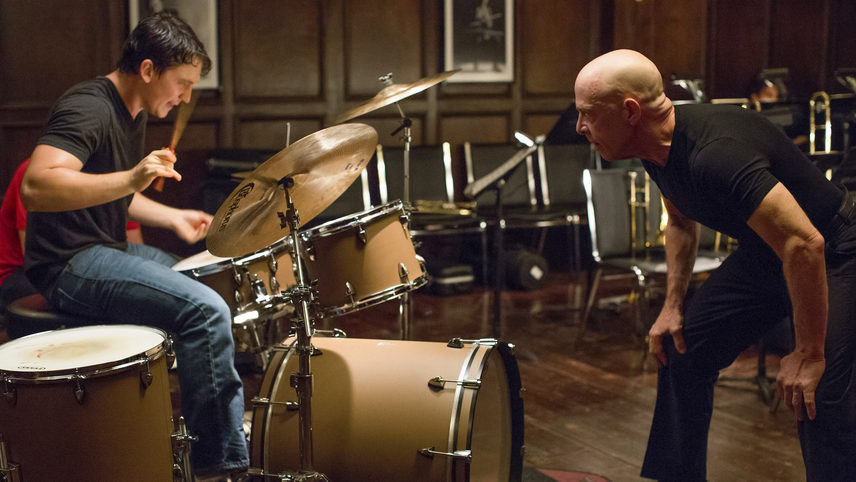
There is blood on the drum kit.
This is the image that Whiplash keeps returning to. Not metaphorical blood. Not symbolic blood. Real blood, from real hands, from a nineteen-year-old kid who has played until his skin split open and who dips his fingers in ice water and tapes them up and keeps playing, because the alternative is worse. The alternative is being ordinary.
The blood is important. Remember it. Because by the time the film reaches its final scene, that extraordinary, exhilarating, devastating final scene, you will have forgotten the blood. You will be so caught up in the rush of the drums and the sweat and the locked eyes between student and teacher that you will feel something dangerously close to triumph.
That feeling is the film’s trap.
And if you fall into it, the film has done to you exactly what Terence Fletcher does to Andrew Neiman.
The Seduction
Let’s be honest about something before we go any further.
Whiplash is one of the most viscerally thrilling films of the 21st century.
Damien Chazelle directs it like a boxing match. The editing is percussive. The camera moves with the urgency of a cornered animal. Tom Cross’s cuts land on beats, sometimes musical, sometimes physical, and the difference between the two dissolves until a drumstick hitting a cymbal and a hand hitting a face feel like the same gesture. The sound design is extraordinary. You don’t just hear the drums. You feel them in your sternum.
J.K. Simmons as Fletcher is a performance of such magnetic ferocity that it warps the entire film around it. He enters rooms and the air pressure changes. His whisper is more threatening than most actors’ screams. He is terrifying and charismatic in equal measure, and the film knows, with surgical precision, that the charisma is what makes the terror effective.
This is the seduction. The film seduces you with its craft, its energy, its relentless forward momentum, into a position where you are rooting for something you should be horrified by. And it does this not by accident but by design.
Chazelle has said in interviews that he wanted the audience to feel the rush of Andrew’s final solo, to feel the triumph, and then to walk out of the theater and slowly realize what they just cheered for.
Some audiences get there. Most don’t. Most leave Whiplash exhilarated, convinced they’ve watched a story about the price of greatness, about how the truly excellent must suffer, about how the hard teacher was right all along.
The film is smarter than its audience. That’s not a compliment to the film. It’s an indictment of how deep the myth runs.
Fletcher
Terence Fletcher teaches jazz at the Shaffer Conservatory, the best music school in the country. He conducts the top ensemble. He has produced professional musicians. He is, by every institutional metric, a success.
He is also an abuser.
Not a tough teacher. Not a demanding mentor. Not a drill sergeant with a heart of gold. An abuser. The film provides the evidence systematically, clearly, without ambiguity.
Fletcher throws a chair at Andrew’s head. He slaps Andrew across the face, repeatedly, in front of the ensemble. He screams obscenities. He uses homophobic slurs. He reduces students to tears and frames their tears as weakness. He manipulates through intermittent reinforcement, alternating between warmth and cruelty with the precision of a man who has studied which pattern produces the most dependency. He isolates his targets from support systems. He creates an environment where the abused compete for the abuser’s approval.
These are not pedagogical techniques. These are the behavioral signatures of domestic violence.
The film knows this. It knows this because it shows us Sean Casey, a former student of Fletcher’s who killed himself. The death is revealed late, almost casually, and the casualness is deliberate. Fletcher’s method has a body count. The film puts that body count on screen and then watches to see if the audience adjusts its assessment.
Most audiences don’t.
And this is the point. This is the exact point. Because the myth of the abusive genius, the belief that cruelty can be justified by the excellence it produces, is so deeply embedded in our cultural operating system that even a dead student doesn’t dislodge it. We hear about Sean Casey and we think: that’s sad, but Andrew is different. Andrew is stronger. Andrew can take it. Andrew will survive and become great.
We think this because Fletcher has already taught us to think it. The film has replicated Fletcher’s conditioning on the audience. We have been trained, over ninety minutes, to evaluate human beings by their capacity to endure abuse. And we don’t even notice.
“There Are No Two Words More Harmful Than ‘Good Job’”
This is Fletcher’s thesis statement. He delivers it in a bar, late in the film, after he has been fired and after Andrew has dropped out. He is calm. He is reflective. He tells the story of Charlie Parker, how Jo Jones threw a cymbal at Parker’s head during a bad performance, how Parker went home and practiced and practiced and came back and became the greatest saxophonist who ever lived.
“Imagine if Jones had just said, ‘Well, that’s okay, Charlie. Good job,’” Fletcher says. “Then Charlie Parker would never have become Bird.”
The speech is magnificent. Simmons delivers it with a quiet conviction that makes it sound not just plausible but profound. It sounds like wisdom. It sounds like truth.
It is a lie.
The historical record of the Jo Jones incident is disputed. What most accounts agree on is that Jones dropped a cymbal near Parker (not threw it at his head) to signal that his time was up. Parker was humiliated. He did go home and practice obsessively. He did become a genius.
But he also became a heroin addict. He died at thirty-four. The coroner estimated his age at fifty to sixty. His genius was inseparable from his self-destruction, and attributing that genius to a single act of humiliation, as though trauma were a manufacturing process for excellence, is a distortion so profound it functions as mythology.
Fletcher doesn’t tell Andrew about the heroin. He doesn’t tell Andrew about the death at thirty-four. He tells the version of the story that justifies his methods, the version where suffering is an input and greatness is the output, the version where the abuser is secretly the hero because without him the genius would never have emerged.
This is how abuse perpetuates itself. Not through force alone but through narrative. Through a story about how the pain was necessary, how the suffering had purpose, how the ones who didn’t survive simply weren’t strong enough. The survivors become evidence. The casualties become footnotes.
Fletcher believes his own story. That’s what makes him dangerous. A cynical abuser can be identified and removed. A true believer, a man who genuinely thinks he is serving art, serving history, serving the next Charlie Parker, is armored against every accusation. You can show him the dead student and he will mourn sincerely and then go back to throwing chairs, because in his cosmology the chairs are medicine and the death is a side effect and the music is worth it all.
Andrew Before Fletcher
Here is something the film buries that deserves to be exhumed.
Andrew Neiman, before Fletcher, is already damaged.
His mother left when he was young. The film never explains why. It simply presents the absence as a fact, a gap in Andrew’s architecture that he has filled with ambition. His father, played by Paul Reiser with a gentleness that the film treats almost as a disability, is a failed writer who teaches high school English. He loves Andrew. He supports Andrew. He is kind.
And Andrew is embarrassed by him.
Watch the dinner table scene. Andrew’s extended family gathers. His cousins talk about football, about college, about normal accomplishments in normal fields. Andrew’s father mentions his drumming, proudly, the way fathers do. And Andrew bristles. He doesn’t just bristle. He attacks. He ranks achievements. He implies that football is trivial. He suggests, with a contempt that has Fletcher’s fingerprints all over it, that his cousins’ ordinary lives are worth less than his pursuit of greatness.
This scene happens before Andrew’s worst experiences with Fletcher. Which means the contempt for ordinariness was already there. Fletcher didn’t plant it. He cultivated it. He found a boy who was already desperate to be extraordinary, who was already terrified of his father’s gentle, unambitious love, and he gave that desperation a shape, a direction, and a permission structure.
Fletcher didn’t break Andrew. Fletcher offered Andrew a reason to break himself.
This is the dynamic that makes Whiplash more disturbing than a simple abuse narrative. Because Andrew is not a passive victim. He is a willing participant. He chooses to return to Fletcher again and again. He chooses the practice room over the dinner table. He chooses the bleeding hands over the held hand. He is not being dragged toward destruction. He is running toward it.
And the film asks you: does the willingness make it better or worse?
Nicole, or: The Sacrifice Nobody Mourns
Andrew has a girlfriend. Her name is Nicole. She is played by Melissa Benoist with a warmth and openness that the film uses and discards with efficient cruelty.
Andrew breaks up with her in a scene that most audiences read as a tough but necessary choice. The artist sacrificing personal life for his work. The dedication scene. The “this is what greatness requires” scene.
Rewatch it.
Andrew doesn’t break up with Nicole because the relationship isn’t working. He breaks up with her because he has decided, preemptively, that she will become an obstacle. He tells her that her career (she’s studying to be a teacher) will make her resentful of his success. He tells her she will drag him down. He is not describing a problem that exists. He is describing a problem that Fletcher’s worldview predicts, and he is executing the solution before the problem can materialize.
He has internalized the doctrine. Human connection is weakness. Love is distraction. The only relationship that matters is the one between you and your instrument. Everything else is noise.
Nicole cries. Andrew watches her cry with a detachment that is more frightening than anger, because detachment means the amputation was clean. He has cut away a part of himself and felt nothing. He has performed the surgery Fletcher prescribed, and the patient survived, and the patient is worse.
The film lets this scene pass without comment. It does not punish Andrew for his cruelty. It does not reward him either. It simply shows you a young man dismantling his own humanity with the calm precision of a musician tuning his instrument, and it lets you decide whether this is discipline or destruction.
Most audiences decide it’s discipline.
That’s Fletcher’s victory, not Andrew’s.
The Setup
Fletcher is fired from Shaffer after Andrew reports his abuse. Andrew drops out of music. He works in a restaurant. Time passes.
Then Fletcher reappears. A bar. A conversation. The Charlie Parker speech. And an invitation: Fletcher is conducting a professional jazz band at the JVC Festival. He needs a drummer. Come play.
Andrew accepts.
What happens next is the film’s cruelest twist, and it is not a twist about plot. It is a twist about character.
Fletcher has lured Andrew to the festival to destroy him. He has given Andrew the wrong music. When Andrew sits down at the drum kit, in front of an audience of industry professionals, he discovers that he is playing a song the band hasn’t rehearsed. He is exposed. Humiliated. Publicly ruined.
Fletcher did this deliberately. As revenge for Andrew’s role in his firing. As a final act of control.
And this is the moment where the film asks its central question, not with dialogue but with the structure of its climax.
Andrew walks off stage. He sees his father. His father holds him. His father says they can go home.
Home. Ordinary life. The kind, gentle, unambitious life of a man who loves his son and doesn’t need his son to be great. The life that Andrew has been running from since the first frame of the film.
Andrew turns around. He walks back on stage. He sits down at the drums.
And he plays.
The Final Solo
What follows is four minutes of cinema that will rearrange your nervous system.
Andrew plays. He plays beyond the chart, beyond the arrangement, beyond anything Fletcher has planned. He plays with a ferocity and precision and abandon that transcends technique. The band follows. Fletcher, initially furious, begins to conduct. His fury transforms. His face changes. He begins to guide rather than control. He begins, for the first time in the film, to listen.
The solo builds. Andrew’s sticks blur. The sweat flies. Fletcher and Andrew lock eyes. There is a moment, a single held beat, where Fletcher gives the smallest nod. Not approval, exactly. Recognition. The recognition of a man who has finally found what he’s been looking for.
The screen cuts to black.
The audience erupts. In theaters, real audiences erupted. The scene is that powerful. The craft is that overwhelming. The visceral, physical, musical energy of the final solo is so immense that it bypasses analysis entirely and hits you in the body, in the blood, in the place where critical thinking goes quiet and pure sensation takes over.
This is the trap.
What You Just Cheered For
You cheered for a young man who has destroyed every human relationship in his life. Who has cut away love, family, friendship, and physical health in service of a single, obsessive pursuit. Who has been abused, manipulated, humiliated, and conditioned by a man who drove another student to suicide. Who returned to that man voluntarily, absorbed another betrayal, and responded not by walking away but by playing harder.
You cheered for the completion of Fletcher’s project.
Because that’s what the final solo is. It is not Andrew’s rebellion. It is not Andrew asserting himself against Fletcher’s control. Look at the scene again. Andrew plays beyond the chart, yes. He takes over, yes. But what does Fletcher do? Fletcher conducts. Fletcher guides. Fletcher smiles. Fletcher nods.
Fletcher gets exactly what he wanted.
He wanted a student who would endure anything. He wanted a musician who would bleed for the music. He wanted to push someone so far past their limits that what emerged was no longer a person but a player. Pure instrument. Pure function. The human being burned away, the artist remaining.
Andrew, in that final solo, is no longer a person. He is what Fletcher made him. And the exhilaration you feel watching it, the rush, the awe, is the same exhilaration Fletcher feels. You have been recruited into Fletcher’s worldview. You are watching a young man’s dehumanization and calling it art.
Nina Sayers said “I was perfect” and died. Andrew Neiman doesn’t say anything. He just plays. And the silence where his words should be is the loudest thing in the film.
The Myth That Won’t Die
Black Swan destroyed one body on one stage and asked: is perfection worth dying for? Whiplash doesn’t ask this question. It asks something worse.
Is perfection worth living for? Is it worth living as a person who has been hollowed out, whose capacity for love has been surgically removed, whose relationship to their own body is one of relentless punishment? Is it worth being the survivor who validates the method that produced the casualties?
Because Andrew will survive. Andrew will have a career. Andrew might even be great. And for the rest of his life, he will be the evidence Fletcher points to. The proof that the chairs and the slaps and the screaming and the tears and the dead student were all worth it. “I pushed him and he became Bird.” The story will be told. The myth will perpetuate. And the next student, the one who isn’t Andrew, the one who can’t take it, will be broken by a man who believes, sincerely and completely, that breaking is just the sound potential makes on its way to greatness.
Arthur Fleck was destroyed by systems that withdrew care. Andrew Neiman is destroyed by a system that calls destruction care. The Joker’s world was indifferent. Fletcher’s world is attentive, focused, precise in its cruelty, and utterly convinced of its own righteousness.
Indifference at least has the decency to look away. Fletcher never blinks.
What Chazelle Understood
Damien Chazelle was twenty-eight when he made Whiplash. He was a former jazz drummer. He has said that the film draws on his real experiences with demanding teachers, that the intensity is not invented but remembered.
And he understood something that most films about artistic ambition never grasp.
He understood that the audience is part of the problem.
Every music biopic, every artist’s journey, every “price of greatness” narrative follows the same arc: suffering, then triumph, then vindication. The suffering is the cost. The triumph is the payoff. And the audience, having witnessed both, leaves feeling that the equation balances. The pain was worth it. The art justifies the damage.
Chazelle builds that arc. He gives you the suffering. He gives you the triumph. He gives you the exhilarating, pulse-pounding, tear-inducing final solo that feels like vindication.
And then he cuts to black.
He doesn’t show you what comes after. He doesn’t show you Andrew at thirty-five, alone, estranged from his father, unable to maintain a relationship, playing in a room that has no one in it. He doesn’t show you the next student Fletcher breaks. He doesn’t show you the funeral he already showed you: Sean Casey’s, the one nobody in the audience remembers by the time the drums start.
He gives you the high and denies you the cost. Not because he doesn’t know the cost. Because he wants you to feel how easy it is to forget it. How willingly we trade a human being’s destruction for four minutes of transcendence.
How cheaply we can be bought.
Where This Leads Us
Fletcher smiled. Andrew played. The audience roared. The cost was invisible.
But what if the cost isn’t invisible? What if it’s the most visible thing in the world, broadcast to billions, replayed endlessly, dissected frame by frame, and still, somehow, nobody sees it for what it is? What if a man builds the most beautiful fantasy the world has ever seen, brick by brick, dream by dream, and the fantasy is so total, so immersive, so perfectly designed to make you feel like a child again, that you never notice the man inside the fantasy is drowning?
What if the greatest showman is also the loneliest man alive? And what if the show is so good that loneliness doesn’t matter, because the audience came for the show, not the man?
What if the curtain never falls because falling would mean looking at what’s behind it?