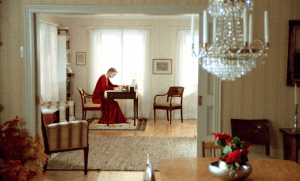
Ingmar Bergman’s Autumn Sonata condemns a parent who chose art over her children. The man who wrote it had done exactly the same thing. He just kept the camera.
| Director | Ingmar Bergman |
|---|---|
| Year | 1978 |
| Runtime | 93 minutes |
| Cast | Ingrid Bergman, Liv Ullmann, Lena Nyman |
| Award | BAFTA Award for Best Film Not in the English Language, 1979 |
| Streaming | Max, Criterion Channel |
There is a small girl in Autumn Sonata who appears in flashback as the younger version of Eva, the wounded daughter at the centre of the film. She is played by Linn Ullmann. Linn Ullmann is the daughter of Liv Ullmann and Ingmar Bergman. Bergman cast his own child, a child he had largely been absent from, to play the young self of the woman he had also largely been absent from, in a film he wrote and directed about the irreversible damage done to children by parents who choose their art over the people who need them.
He kept the camera. Charlotte does not get that option.
Autumn Sonata is one of the great confrontation films in cinema history. Charlotte, a celebrated concert pianist played by Ingrid Bergman in her final theatrical film role, arrives at the Norwegian home of her eldest daughter Eva after seven years of absence. Eva, played by Liv Ullmann with a rawness that is almost unbearable to witness, has been waiting. Not for the visit. For the permission the visit might finally give her to say what she has never been able to say. Over one long, sleepless night, she says it. She says all of it. The neglect, the abortion Charlotte pressured her into, the years of carefully managed emotional distance, the devastating discovery that her disabled sister Helena has been living with Eva while Charlotte has not once visited. Charlotte listens. Charlotte confesses. Charlotte cries. And in the morning, Charlotte leaves.
The film is devastating. It is also, and this is what it cannot see about itself, a document of extraordinary bad faith.
Ingmar Bergman was, by any honest accounting, precisely the kind of parent this film condemns. He had nine children by six different women. He was, by his own admission and theirs, largely absent from their childhoods, present when it suited him and elsewhere when it did not. He chose his work, again and again, the way Charlotte chooses her music. The parallels between Charlotte and Bergman are so exact that they cannot be accidental: both are artists of commanding international reputation, both are constitutionally incapable of sustained emotional presence, both use performance and charm as a way of managing the feelings of the people around them, both are genuinely talented and genuinely harmful and somehow never quite forced to hold both of those things at once.
The film forces Charlotte to hold them. For ninety-three minutes, there is nowhere for her to go. Eva’s accusations fill every room. Charlotte cannot retreat behind her career or her charm or her next concert tour. The camera is inches from her face. She has to sit there and receive it.
Bergman did not have to do any of that. He wrote the scene. He positioned the camera. He said cut. The film is, in its way, the most elaborate possible exercise in having it both ways: making a film about the damage done by absent artist-parents while remaining, in the act of making it, an absent artist-parent, and giving himself the one position in the room that Charlotte never gets to occupy. The position of the one who is watching, not the one being watched.
This is not a criticism of the film’s moral seriousness. Bergman clearly meant every word. The pain in this screenplay is real and the willingness to expose it is genuine. But there is a difference between confession and reckoning, and Autumn Sonata is, finally, a confession. Charlotte confesses. Eva receives the confession. The film presents this as devastating honesty. What it does not present, because it cannot, is what comes after the confession: whether anything changes, whether the understanding that Eva achieves through her long night of speaking translates into anything other than the extraordinary articulation of a wound that will still be there in the morning.
“Charlotte’s greatest gift and greatest crime are the same thing: she can describe her failures with perfect precision. The film mistakes this precision for transformation. It is actually the most sophisticated way of staying exactly where you are.”
The second thing the film does not know it is doing lives in its formal choices.
Bergman and his cinematographer Sven Nykvist shoot Autumn Sonata almost entirely in extreme close-up. The camera is so close to faces that you lose sight of hands, of bodies, of the physical space these two women occupy in relation to each other. It is almost always just one face or the other, filling the frame, inches from the lens. This has been universally praised as a technique of intimacy. I think it is something more complicated than that.
Extreme close-up is not the same as closeness. Extreme close-up is the abolition of context. When you cannot see the body, you cannot see what the body is doing: whether Eva’s hands are shaking, whether Charlotte has closed herself off physically while opening herself verbally, whether the space between them is growing or contracting through the night. You get faces. Extraordinary faces, two of the greatest actors who ever lived, giving everything they have, but faces as surfaces. Expressions. The film about the impossibility of true emotional connection is shot in a way that structurally prevents you from seeing the whole of either person. You get what they show. You do not get what they are.
This may be entirely intentional on Bergman’s part. It may be the visual argument: that this is all we ever get of each other, the performed surface, the managed expression, the face we compose for the camera of the other person’s gaze. If so, it is a bleak and honest observation. But it is also a choice that keeps both women, for the entire film, at a distance measured in millimetres but felt across a gulf.
The comparison that earns its place here is not another film but a fact. Ingmar Bergman wrote Autumn Sonata during his self-imposed exile from Sweden following a tax scandal that he experienced as a profound humiliation. He was outside his country, outside his familiar world, stripped of the context that had always given his work its authority. And in that condition of exile and exposure, he wrote a film about someone who cannot escape exposure, who is finally held in place and made to account. There is something in this worth sitting with. The film may be Bergman’s most personal work not because it is confessional but because it is envious. He put Charlotte in the room he was afraid to enter himself.
The other comparison is Eugene O’Neill’s Long Day’s Journey Into Night, in almost every meaningful sense the theatrical equivalent of what Bergman is attempting here. Both works are about families that have been destroyed by a combination of genuine love and genuine selfishness, and both are created by artists working through their own implication in exactly that damage. O’Neill wrote Long Day’s Journey and asked that it not be published until after his death. He could not quite face the world reading it while he was alive. Bergman made Autumn Sonata and released it into the world immediately, with his name on it, from a safe position behind the camera. Whether that is braver or more evasive than O’Neill’s choice is a question the film quietly and perpetually refuses to answer.
Autumn Sonata is one of the most painful films ever made, and one of the most necessary. The central confrontation between Ingrid Bergman and Liv Ullmann is cinema at a register that very few films reach: truthful in the way that only the best art manages, where you stop thinking about performance and simply feel the weight of two people failing to save each other. It is Ingmar Bergman at his most unsparing.
Toward everyone except himself.
If this stayed with you, watch these next:
Scenes from a Marriage (Ingmar Bergman, 1973): Bergman’s most extended examination of two people damaging each other, and the film that most clearly shows the director’s obsession with the confessional as a dramatic form.
Saraband (Ingmar Bergman, 2003): Bergman’s final film, returning to the characters of Scenes from a Marriage in old age, and the work in which he comes closest to turning the camera on himself.
UnspokenCinema publishes every week. No ratings. No rankings. Just what films reveal without meaning to.