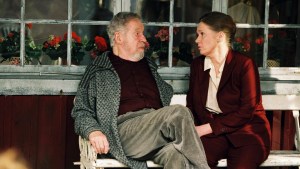
Ingmar Bergman’s Saraband is his most tender film. It is also the one where he finally arranged things so that no one could make him stay in the room.
In our review of Autumn Sonata, we noted that Bergman gave Charlotte nowhere to go. He put her in a chair, pointed the camera at her face, and let Eva speak. The whole moral architecture of that film rests on the idea that the absent artist-parent must finally be made to receive what her absence did. Charlotte sits. Charlotte listens. Charlotte has no exit.
Saraband, made twenty-five years later and the last film Bergman ever completed, contains a character who is unmistakably Bergman himself. Johan is wealthy, remote, intellectually domineering, a man who has spent his life arranging the world around his own needs and calling it something else. His son Henrik despises him with the focused, practiced hatred of someone who has been despising the same person for forty years. His granddaughter Karin is slowly being consumed by Henrik’s need for her. And Marianne, his ex-wife from Scenes from a Marriage, arrives after thirty years of absence to watch all of it from the outside.
What follows is Bergman at his most controlled, most formally beautiful, and most quietly self-protective. And the film does not know that last part about itself at all.
Johan does not have a scene like Charlotte’s. Henrik hates him openly and devastatingly, yes, and there are moments of confrontation between them that are genuinely painful. But watch carefully. Every time the confrontation between father and son threatens to become the scene it needs to be, something intervenes. Johan dismisses Henrik. Johan gives Karin money. Johan retreats to his side of the estate and closes the door. The accountability that Autumn Sonata made structurally unavoidable is, in Saraband, structurally managed. Bergman wrote Charlotte into a room with no exits. He wrote Johan with several, and Johan uses all of them.
This is the most revealing thing in the film, and the film does not see it.
| Director | Ingmar Bergman |
|---|---|
| Year | 2003 |
| Runtime | 107 minutes |
| Cast | Liv Ullmann, Erland Josephson, Börje Ahlstedt, Julia Dufvenius |
| Award | Swedish Film Institute Award for Best Film 2003 |
| Streaming | Max, Criterion Channel |
There is something else. Saraband is haunted throughout by Anna, Henrik’s dead wife and Karin’s dead mother. She appears only in photographs, specifically in a photograph of Bergman’s own late wife, Ingrid von Rosen, to whom the film is dedicated. Anna is described by every character who knew her in the same terms: warm, present, loving, the opposite of everything the men in this film are capable of being. She held Henrik together. She gave Karin something to grow toward. Her absence, two years before the film begins, is the wound that all the other wounds are bleeding from.
Anna is the film’s moral centre. And she is dead. She cannot speak.
Think about what this means in a film that is, on some level, Bergman’s reckoning with the damage of his own life. The one character who embodied everything he could not be, the one whose presence might have forced some accounting, has been removed before the film begins. She cannot accuse anyone. She cannot confirm or deny anything. She is perfect and inaccessible. Bergman has placed forgiveness in the one location where it cannot be given or refused: in the hands of someone no longer there to hold it.
Charlotte, in Autumn Sonata, had to sit in the room. Anna, in Saraband, does not have to sit anywhere. She is in a frame on the wall, absolutely beyond reach, as idealized and untouchable as Bergman needed her to be.
“Bergman spent his career putting people in rooms they could not leave. His last film is the one where he quietly, gracefully, found the door.”
And yet. And yet this is also, genuinely, the most tender film Bergman ever made. It is not a fraudulent tenderness. There is real grief in it, real acknowledgment of cost, real generosity toward people he might once have only examined. The scene where Johan, unable to sleep, climbs into bed with Marianne and simply asks her to hold him, without drama, without justification, is one of the most honestly pathetic moments in all of Bergman’s work. Pathetic in the precise sense: full of pathos, exposing a need so large and so long suppressed that the man can barely speak it. Johan does not deserve Marianne’s warmth. He has done nothing to earn it. And she gives it to him anyway. This is Bergman knowing, at eighty-four, that he did not deserve the care he received, and being honest enough to show that knowledge without resolving it.
Karin is the other thing the film does not know it is doing with such precision.
The film begins with Marianne looking at photographs of people from her past. It ends with Karin leaving. She takes the money Johan offers, she turns down her father’s suffocating love, she chooses Hamburg and her own future over the gravitational pull of a family that would consume her entirely if she let it. She is the only character in the film who has not already been defined by the damage. She is also the only one who escapes it.
Bergman’s final image, effectively, is not of his own generation but of the next one walking away from it. The filmmaker who spent forty years examining the impossibility of escape ends his last work with an escape. Not his. Someone younger’s. Someone who has not yet been fully made into what this family makes people. It is the most generous thing Bergman ever put on screen, and the most honest admission that the damage he spent his career documenting was not inevitable. That someone, given the right information and the means, could simply leave.
The comparison that earns its place is Wild Strawberries (1957), Bergman’s earlier meditation on an old man looking back across a life of emotional failure and recognising, perhaps too late, what it cost the people around him. Both films feature an aging man at the centre of concentric circles of damage. Both films use the presence of a younger woman, Karin in Saraband, Bibi Andersson’s Sara in Wild Strawberries, as a kind of grace note against the severity of everything else. But Wild Strawberries offers its old man a dream of reconciliation, a softening, a suggestion that clarity arrived in time to mean something. Saraband offers Johan nothing so consoling. Karin leaves. Henrik survives his suicide attempt but nothing changes between him and his father. Marianne goes home. Johan is alone in his house by the lake. The old man looks back and understands. Understanding, the film tells us, is not the same as being forgiven. And being forgiven, it whispers, was never quite the point anyway.
Saraband is a beautiful film and a quietly complicated farewell. Its tenderness is real. Its blind spot is real too: Bergman, who never gave Charlotte an exit, gave himself several here, and the film is too graceful to notice. But perhaps that is the right word for a man of eighty-four making his last work. Not dishonesty. Grace. The earned right, at the very end, to be a little gentler with yourself than the truth entirely permits.
The film that does not know it is doing this is still, in almost every other respect, extraordinary. The saraband from Bach’s Fifth Cello Suite plays through it like a slow, formal, unresolvable goodbye.
If this stayed with you, watch these next:
Scenes from a Marriage (Ingmar Bergman, 1973): the film Saraband is in quiet, decades-long conversation with, and the one that shows you who Johan and Marianne were when there was still something left to destroy.
Wild Strawberries (Ingmar Bergman, 1957): Bergman’s earlier meditation on an old man looking back, more consoling than Saraband and, for that reason, slightly less honest.
UnspokenCinema publishes every week. No ratings. No rankings. Just what films reveal without meaning to.