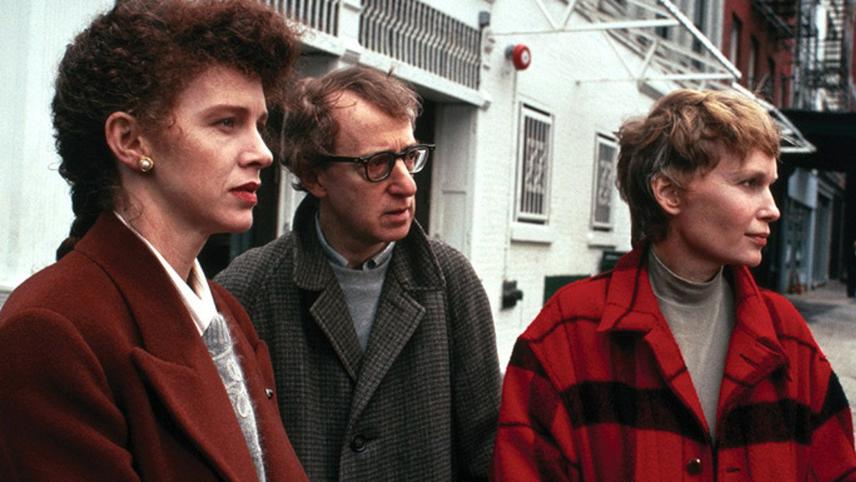
Woody Allen dismantled the beautiful false sentence of Manhattan and replaced it with a handheld camera. What Husbands and Wives cannot see is that the handheld camera is also a beautiful false sentence.
TRANSCRIPT EXCERPT — DOCUMENTARY INTERVIEW [recorded, date unspecified]
INTERVIEWER: [Were you honest in this film?]
GABE: I think so. I tried to be. The camera doesn’t lie — you can feel it, the roughness of it, nothing staged. That’s the whole idea.
INTERVIEWER: [And the girl? Rain?]
GABE: What about her?
INTERVIEWER: [She’s twenty-one. You’re—]
GABE: I didn’t do anything. That’s the point. I pulled back. I chose correctly.
INTERVIEWER: [The camera was honest about everything else.]
[pause]
GABE: The camera was where I pointed it.
| Director | Woody Allen |
|---|---|
| Year | 1992 |
| Runtime | 108 minutes |
| Cast | Woody Allen, Mia Farrow, Judy Davis, Sydney Pollack, Juliette Lewis, Liam Neeson |
| Awards | Academy Award nominations, Best Supporting Actress (Judy Davis), Best Original Screenplay |
| Streaming | Available on major platforms |
The Pauline at the Beach review ended on what felt like the thread’s most precise formulation: the problem with Rohmer’s films was never the voiceover, never the camera, never the narration. It was the architecture — the way each film arranges itself so the honest figure’s clarity cannot be fully costly. Removing Rohmer’s formal apparatus one piece at a time revealed that the apparatus was always symptomatic, never causal. The blind spot lives deeper than the method.
Then Husbands and Wives arrives with an entirely different architecture, and the same conclusion.
Woody Allen made Husbands and Wives in 1992 with handheld 16mm cameras, jump cuts, direct-to-camera interviews, deliberately rough and unstaged in every register the film could manage. In our Manhattan review, written earlier in this sequence, we noted that Allen would answer his own grammar thirteen years later: “the contrast tells you exactly what the black-and-white in Manhattan was doing, and what it was hiding.” That prediction was correct. Husbands and Wives is Allen’s formal confession: here is what the Gershwin and the Gordon Willis photography were covering for. The beautiful images were alibis. The handheld camera is the admission.
The film follows two couples disintegrating across one turbulent year. Jack and Sally (Sydney Pollack and Judy Davis) announce at a dinner party that they are separating, cheerfully, as though they have made a sensible administrative decision. This cheerfulness unravels almost immediately, and then everything unravels: Gabe (Allen) and Judy (Mia Farrow) discover that their stable marriage has been concealing a decade of accumulated distance. Everyone ends up somewhere they did not expect. The interviews — characters speaking directly to an unseen documentarian — punctuate the action throughout, lending each person equal testimony, equal weight, equal access to the film’s attention.
This formal democracy is the film’s most important claim and its deepest evasion.
Judy Davis gives the film’s most electrically alive performance as Sally: spiky, contradictory, furious at herself for wanting what she wants, honest in ways that cost her socially and emotionally in nearly every scene. The interviews let her say things the narrative cannot contain. Her face in close-up, slightly too close, the camera occasionally losing focus, is the film’s most honest image. She is also, structurally, the film’s most expensive character: she pays the highest price, recovers the least cleanly, and exits without the consolation the other characters receive. The democratic formal apparatus gives her equal testimony. The film’s emotional architecture gives her the bill.
Allen answered the alibi of Manhattan with the roughness of a handheld camera. He did not notice that he was pointing the handheld camera at the same story.
Watch Gabe with Rain (Juliette Lewis), his graduate student: twenty-one, startlingly intelligent, drawn to Gabe in a way the film presents as mutual recognition rather than a structural condition. Rain is the film’s most explicit echo of the Rohmer narrators’ problem: a young woman whose clarity and youth are required by the protagonist’s storyline. She must be wise enough to interest Gabe intellectually and young enough that his choice not to pursue her constitutes a moral achievement. The handheld camera shoots her with the same rough honesty it shoots everyone else, which creates the impression that the film is examining the situation rather than inhabiting it. But the examination always returns to Gabe’s interiority, his restraint, his ultimate choice of the correct life. Rain’s experience of any of this is not the subject.
Gabe pulls back. He makes the Rohmer wager and wins it. He writes a novel about a man who didn’t pull back, which means he converts the restraint into content — into the kind of artistic act that the Stardust Memories and 8½ reviews in this archive have traced, the male artist who organises his own moral near-miss into material. The handheld camera cannot photograph this conversion. It is too honest a tool for a film that is, at its center, performing honesty rather than achieving it.
The film that creates the sharpest friction is Scenes from a Marriage, Bergman’s 1973 dissection of a dissolving marriage, named in the watch-next of The Worst Person in the World and arriving here now as the subject it was promised to be. Bergman refuses every formal alibi: no handheld chaos, no jump cuts performing disorder, no documentary framing lending the appearance of equal testimony. Just two faces in close-up, in long takes, in rooms that grow more airless across six episodes, with no escape into the formal apparatus of honesty-as-style. What Allen’s camera performs, Bergman’s camera simply shows. The difference is not aesthetic preference. It is the difference between a film that says it cannot look away and a film that cannot look away. In Scenes from a Marriage, Marianne and Johan pay the full cost. In Husbands and Wives, the formal roughness absorbs some of it before it can land.
Husbands and Wives is the most honest film Allen ever made and not quite honest enough, which is, on reflection, the most honest thing about it. He pointed the camera at the thing he had been beautifying for thirty years and filmed it in all its chaos and damage and desire, and the film is genuinely harrowing in places and genuinely alive, and at the center of it Gabe makes the correct choice and gets to write the novel. The handheld camera recorded all of this without flinching. Nobody told it what it was recording.
If this stayed with you, watch these next:
Scenes from a Marriage (Bergman, 1973): the promise made in our The Worst Person in the World review, finally redeemed; Bergman removes every formal comfort that Allen’s camera offers and leaves two people with nothing between them and the bill.
Certified Copy (Kiarostami, 2010): another film about a couple whose relationship status is genuinely ambiguous, but where Kiarostami uses that ambiguity as the subject rather than the backdrop, and where the woman’s experience of the dynamic is allowed to reorganise the entire film.
UnspokenCinema publishes every week. No ratings. No rankings. Just what films reveal without meaning to.