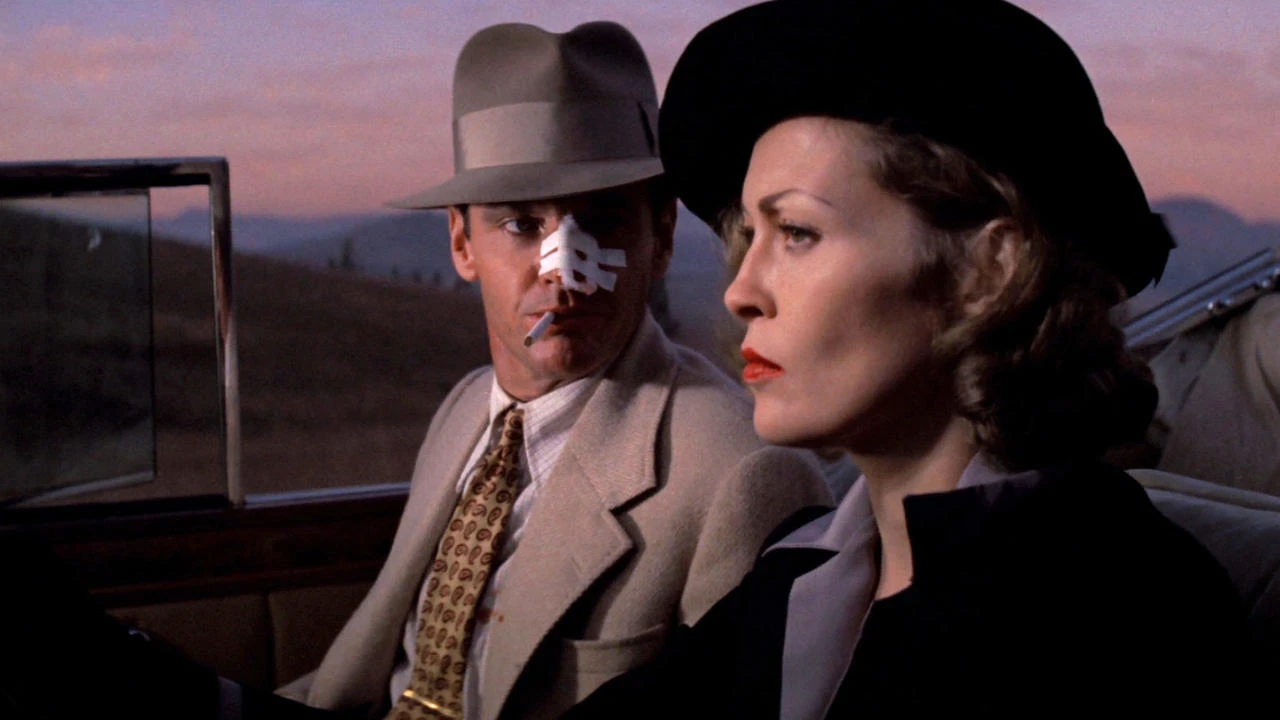
Jake Gittes is very good at his job.
This matters. This is the thing that makes Chinatown devastating rather than merely bleak. Jake is not a fool. He is not in over his head from the start. He is a sharp, experienced private investigator who reads people well, follows leads with precision, and constructs narratives from fragments the way a good detective should. He is, in the vocabulary of the genre he thinks he inhabits, the right man for the case.
He solves it. He figures out who is stealing the water, and why, and how it connects to the murder, and who is behind all of it. He puts the pieces together. He understands.
And it changes nothing.
This is Chinatown’s proposition, and it is one of the most radical arguments any American film has ever made. The detective story, from Sherlock Holmes onward, is built on a foundational promise: that knowledge is power, that understanding the crime is the first step toward justice, that the truth, once revealed, rearranges the world. Chinatown keeps every element of the detective story except that promise. Jake investigates. Jake discovers. Jake knows. And the man who did it goes home with the girl.
This is not a twist. It is a thesis. And the thesis is: the institution was here before you, and it will be here after you, and your knowing what it did is not a threat to it. It is barely an inconvenience.
The Water
Los Angeles should not exist.
This is the historical fact beneath everything in Chinatown, and Robert Towne’s screenplay is built on it with the care of an engineer building on a fault line. The city sits in a semi-arid basin. It does not have enough water. Everything Los Angeles became in the twentieth century, the sprawl, the industry, the dream factory, was made possible by water stolen from somewhere else.
The real history is the Owens Valley water grab of the early 1900s, in which agents of the city’s Department of Water and Power, working with private land speculators, diverted the Owens River and bought up the newly irrigable San Fernando Valley at deflated prices. It was legal. It was public. It ruined the Owens Valley. It built Los Angeles. Nobody went to prison.
Chinatown fictionalizes this history but keeps its essential architecture intact. Noah Cross, played by John Huston with the warm, patrician calm of a man who has never been told no, is engineering a water diversion scheme. He is dumping fresh water to manufacture a drought, driving down land prices in the Northwest Valley, buying the land through front names, and planning to annex the valley into Los Angeles so that when the water finally flows, it flows onto land he owns.
This is not a crime in the way the genre usually means. It is not a transgression against an otherwise functional system. It is the system. It is how the city was built. Cross is not breaking the rules. He is the man who wrote the rules, and the rules say: water flows to power, and power flows to money, and money buys the land, and the land becomes the city, and the city becomes the future, and the future belongs to the man who understood this first.
Jake Gittes uncovers this scheme the way a detective should: methodically, cleverly, through legwork and instinct and the willingness to get his nose cut (literally, in one of cinema’s most visceral images of detective impotence). And when he has uncovered it, when he understands the full scope of what Cross has done and is doing, he brings this knowledge to the confrontation like a weapon.
Cross doesn’t flinch.
“You see, Mr. Gittes, most people never have to face the fact that at the right time and the right place, they’re capable of anything.”
This is not a confession. It is a correction. Cross is not admitting guilt. He is explaining to Jake that guilt is a category that does not apply to men like him, because the system in which guilt has meaning is a system he built, and the builder is not subject to the building’s rules.
The Nose
A small man with a knife slits Jake’s nostril.
“Next time you lose the whole thing, Kitty Cat.”
The man is played by Roman Polanski himself, the film’s director, stepping into his own movie to wound his protagonist. Set that biographical layer aside for a moment and focus on what the wound does structurally.
For the middle section of the film, Jake Gittes, the suave, confident detective, the man who lives by reading faces and controlling rooms, walks around with a bandage on his nose. He looks ridiculous. He looks diminished. Every scene he enters, the bandage is there, reminding you and him that he has already been marked by the case, that the institution has already written its displeasure on his body.
This connects to a thread this series has traced through thirty-three films: the body as text. In Black Swan, Nina’s body records the cost of perfection. In Fury Road, the War Boys’ bodies are the Citadel’s inventory. In The Shining, Wendy’s flinch carries years of violence in its muscle memory. In Chinatown, the wound is more specific. It is a message. It says: you are in a story you do not control, and the people who do control it can reach your face whenever they choose.
The bandage also does something to the genre itself. A detective with a slashed nose is a detective who has been humiliated, and humiliation is not something the classic noir detective is supposed to carry visibly. Philip Marlowe gets hit, gets drugged, gets knocked out, but he always comes back looking like himself. Jake comes back looking like a man who has been reminded of his size.
Polanski, the director, cuts Polanski, the thug, cuts Jake’s nose. The film is telling you, through the body of its protagonist, that the detective genre’s promise of competence and eventual triumph is a wound this story will keep open for the duration.
Evelyn
Faye Dunaway’s Evelyn Mulwray is the person Jake cannot read.
She hires him (or someone pretending to be her hires him). She lies to him. She tells partial truths. She is evasive, contradictory, brittle in ways that Jake interprets as upper-class coldness or garden-variety duplicity. He pushes. She resists. He pushes harder. She breaks.
“She’s my sister. She’s my daughter. She’s my sister and my daughter.”
The reveal is one of the most famous in cinema, and its power comes not from shock but from what it means for every scene that preceded it. Evelyn wasn’t lying to Jake out of sophistication or self-interest. She was lying because the truth is that her father raped her as a child and the girl she is protecting is both her sister and her daughter, and this truth exists in a register that Jake’s detective toolkit has no instruments to measure.
Jake has been reading Evelyn as a noir character: the femme fatale, the difficult client, the woman with secrets. He has been applying genre logic to a person whose experience exceeds the genre. The detective story gives Jake a framework for adultery, for jealousy, for greed, for murder. It does not give him a framework for incest. It does not give him a framework for a woman whose father is the most powerful man in the city and whose violation is not separate from his power but an expression of it.
This is the deepest cut Chinatown makes, and it connects directly to the series’ long argument about institutional violence. Noah Cross does not abuse his daughter despite his power. He abuses his daughter the way he diverts the water. Both are acts of extraction. Both treat a living thing as a resource. Both are enabled by the same institutional architecture: the fact that when you own the system, the system’s rules do not apply to you, including the rules about what you may take from the people closest to you.
Jake solves the water case. He cannot solve this. Not because it’s too complex, but because it operates in a dimension his genre does not acknowledge. The detective story is built to uncover who did it. It is not built to reckon with the fact that the man who did it is the same man who built the city, and the city needs him, and need is a form of permission the law cannot revoke.
“As Little as Possible”
Early in the film, someone asks Jake what he did when he worked in Chinatown. He answers: “As little as possible.”
The line lands as a joke, a piece of character color, the detective’s wry self-deprecation. By the end of the film, it has become the thesis.
Chinatown, the neighborhood, never appears until the final scene. Throughout the film it functions as a metaphor, a place Jake worked before the story began, a place where things operated by rules he couldn’t understand, where good intentions produced bad outcomes, where doing something was always worse than doing nothing.
Jake learned this lesson once. He tells Evelyn, in one of the film’s quieter moments, that he tried to help someone in Chinatown and made things worse. The specifics are vague. The emotional shape is clear: he tried, he failed, and the failure was worse than inaction.
And now he is making the same mistake.
The entire film is Jake refusing to do as little as possible. He investigates. He pursues. He uncovers. He confronts. He arranges Evelyn’s escape. He brings her to Chinatown, the actual neighborhood, because he has a plan, because he believes that this time, with this case, his knowledge and his effort and his righteousness will be enough.
It isn’t.
Evelyn is shot through the eye. Noah Cross takes the granddaughter (the girl who is both). Jake stands in the street, surrounded by people telling him to walk away, and someone says the line: “Forget it, Jake. It’s Chinatown.”
“As little as possible” was not cynicism. It was survival knowledge. It was the lesson Jake learned the first time and could not bring himself to apply the second time, because the detective story, the genre itself, told him that knowledge was power and effort was meaning and the truth would set someone free.
The genre lied.
The Genre That Lied
This is what makes Chinatown unique in this series, and unique in American cinema.
Every film we’ve examined so far, even the bleakest ones, operates within a genre that offers some form of agency. The horror film offers survival. The thriller offers escape. The war film offers testimony. The superhero film offers sacrifice. The detective story offers truth.
Chinatown uses the detective genre to demonstrate that the detective genre’s fundamental promise is a lie. Not that this particular detective fails (detectives fail all the time, and the genre accommodates failure). But that the genre’s operating assumption, that uncovering the truth creates the possibility of justice, is itself a fiction, and a fiction that serves the institution, because it allows people to believe that the system is self-correcting, that the watchmen are watching, that the center holds.
The center does not hold. The center was never holding. The center is Noah Cross, and he is not holding anything. He is taking.
Think about what this means for the series’ larger argument. In The Shining, the institution offers Jack a story and he accepts. In Taxi Driver, Travis builds his own story and the world validates it. In Mulholland Drive, Diane builds a story and it collapses internally.
Chinatown does something worse than any of these. It lets the detective build his story, lets him do everything right, lets him find every piece and connect every thread, and then shows him that the story was never his to close. The institution doesn’t need to offer you a role (like the Overlook) or ignore you (like New York). It simply operates on a scale where your participation, your investigation, your outrage, your knowledge, registers as weather. It is a passing disturbance. It changes nothing structural.
This is the nightmare that noir was always circling but never quite stated with this finality. The detective is not the adversary of the institution. The detective is a feature of it. His investigation is tolerated because it poses no risk. He is allowed to know because knowing costs the institution nothing.
Jake discovers everything. Cross keeps everything. These are not contradictory outcomes. They are the same system functioning as designed.
Noah Cross and the Grammar of Power
John Huston’s performance as Noah Cross is one of the great portraits of institutional power in cinema, and its greatness lies in what it refuses to do.
Cross is not menacing. He is not cold. He does not monologue about his philosophy of power or sneer at the little people. He is warm. He is avuncular. He offers Jake lunch. He mispronounces Jake’s name (“Mr. Gitts”) with a familiarity that might be affectionate or might be contemptuous and the distinction doesn’t matter because when you are Noah Cross, the distinction between affection and contempt is a privilege you extend or withhold at will.
This connects to the series’ examination of institutional faces. In The Godfather, Vito Corleone’s warmth is the velvet glove on the iron fist. In The Silence of the Lambs, Hannibal Lecter’s courtesy is the refinement that makes the monstrousness bearable. In Get Out, the Armitage family’s liberalism is the surface that makes the extraction invisible.
Cross is different from all of these because he doesn’t need a mask. Vito needs the warmth because he needs loyalty. Lecter needs the courtesy because he needs the game. The Armitages need the liberalism because they need the cover.
Cross needs nothing from Jake. Nothing from anyone. He is beyond the social contract entirely. His warmth is not a strategy. It is the genuine manner of a man who has lived so long at the top of every institution he touches that he has forgotten what it feels like to need something from another person. He can be warm because warmth costs him nothing. He can be honest about his crimes because honesty costs him nothing. When Jake confronts him with the water scheme, Cross doesn’t deny it. He explains it. Patiently. The way you explain something to a child who is upset about something they don’t yet understand.
“Either you bring the water to L.A., or you bring L.A. to the water.”
This is not a villain’s justification. It is a statement of engineering. Cross operates in a grammar that does not include words like crime, or guilt, or justice. These words belong to a system that exists downstream of him. He is upstream. He is where the water starts.
And the detective cannot arrest the river.
1974
Chinatown was released in 1974. This matters.
It arrived in the same historical moment as the Watergate hearings, which were, in a sense, the largest detective story in American political history. Investigators uncovered the truth. The system worked. The president resigned. Justice was done.
Chinatown says: no it wasn’t.
Not about Watergate specifically. About the idea that Watergate represented. The idea that investigation leads to accountability, that the system is capable of policing its own corruption, that the detective (the journalist, the senator, the special prosecutor) can solve the case and the solution matters.
Polanski, who had seen what systems actually do to the people inside them (his mother died at Auschwitz, his wife was murdered by the Manson family), made a film that took the most optimistic American genre, the detective story, and subjected it to the test of institutional reality. Can the detective change the outcome? Can knowledge alter power?
No.
“Forget it, Jake. It’s Chinatown.”
What Stays After the Water
Here is what Chinatown leaves you with, if you let it.
Not hopelessness, exactly. Hopelessness is a feeling, and Chinatown operates below feelings, at the level of structure. What it leaves you with is a question about every detective story, every investigation, every act of journalism or activism or oversight that promises accountability.
The question is not: can we find out what happened? We almost always can. The question is: does finding out change what happens next?
In this series, Cycle One asked what lies we tell ourselves. Cycle Two asked what institutions take from us. Cycle Three has been asking what happens when the stories we build to navigate those institutions fall apart.
Mulholland Drive showed the story collapsing inward. Taxi Driver showed the story succeeding, which was worse. The Shining showed the institution providing the story, which was worst of all.
Chinatown shows something beyond all of these. The story completes. The detective does his job. The investigation is successful. The knowledge is gained. And the institution absorbs it the way the desert absorbs water: completely, without trace, without change.
The detective’s story doesn’t collapse. It doesn’t succeed. It doesn’t get co-opted.
It simply doesn’t matter.
That is the coldest ending in American cinema. Not tragedy, which at least implies that the outcome could have been different. Not irony, which at least implies that someone is watching and noting the discrepancy. Just the flat, geological fact that some systems are older than the people who investigate them, and those systems will be operating long after the investigator has gone home, and the water will flow where the water was always going to flow.
Where This Leads Us
And yet.
There is a film set in a different landscape, a few decades later, in the borderlands between Texas and Mexico. It too features a man who believes in the story his profession tells, that law means something, that the old categories hold, that good and evil are legible and that the right man in the right place can make a difference.
But where Chinatown gives its detective a human adversary, a man with a name and a motive and a daughter he violated, this other film gives its lawman something else entirely. A figure who flips a coin. A figure who does not explain, does not justify, does not need. A figure who is not the corruption of the system but the revelation that the system was always a story people told themselves, and the story just ended.
If Chinatown is the detective story that says knowing doesn’t help, the next film is the moment the detective story itself lies down and stops breathing.