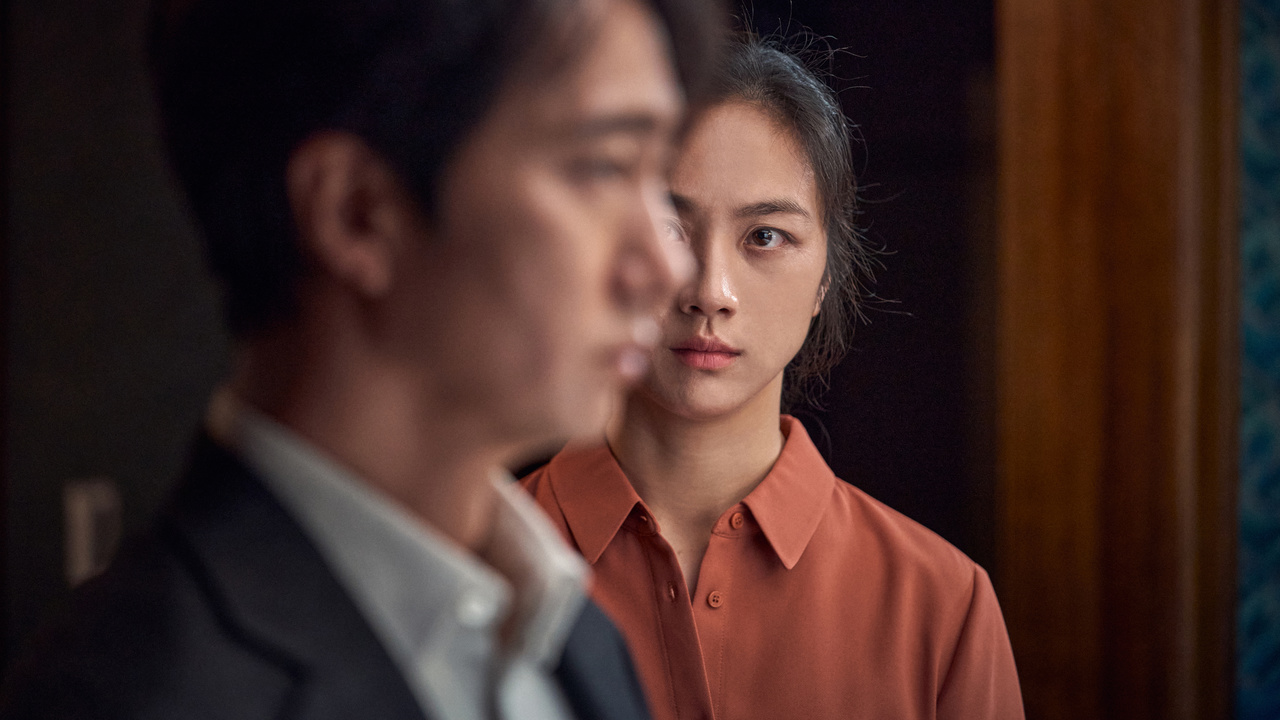
Park Chan-wook knows his detective’s obsessive gaze is the problem. What Decision to Leave cannot see is that knowing this is not the same as being outside it.
TRANSLATION LOG — AUTOMATED Device: SM-G998B. Language pair: KO → KR
ORIGINAL: 저는 당신이 나를 지켜보고 있다는 걸 알고 있어요. TRANSLATION: I know you are watching me. NOTE: Accurate.
ORIGINAL: 저는 당신이 알기를 바랐어요. TRANSLATION: I wanted you to know. NOTE: Accurate.
ORIGINAL: 저는 당신이 멈추기를 원하지 않았어요. TRANSLATION: I did not want you to stop. NOTE: Accurate.
ORIGINAL: [final transmission — 11:47pm, coastal coordinates withheld] TRANSLATION: — NOTE: No translation available. The original has been removed from the record.
| Director | Park Chan-wook |
|---|---|
| Year | 2022 |
| Runtime | 138 minutes |
| Cast | Tang Wei, Park Hae-il |
| Awards | Best Director, Cannes Film Festival; five Grand Bell Awards including Best Film |
| Streaming | Available on major platforms |
The Green Ray review ended by naming the Rohmer thread’s fullest formulation: across six films, the mechanism protecting the clear-eyed figure from the cost of their clarity changes, but the figure is always a woman, and the protection is always arranged by a man holding the camera. Decision to Leave arrives from an entirely different tradition — Korean neo-noir, 2022, Park Chan-wook’s most precisely controlled film — and the formulation holds. With one difference that changes everything: in every Rohmer film, the protection is arranged by Rohmer. In this film, the woman arranges her own.
Decision to Leave is the first noir in this archive, which means it is also the first film in the archive where the genre’s mechanics are themselves the argument rather than the context. Detective Hae-jun (Park Hae-il) is called to investigate a death on a mountain: a man who climbed regularly has fallen. His wife, Seo-rae (Tang Wei), a Chinese immigrant who works as a caretaker for elderly patients, becomes the prime suspect. She is composed where widows are expected to be shattered, curious about Hae-jun in ways that complicate the interview, and — it becomes clear very quickly — aware that she is being watched. Hae-jun watches her apartment through binoculars from a building across the street, tracks her movements through her phone records, builds a dossier. She prepares meals in her kitchen without curtains, completely at ease. She has known from the beginning.
Park Chan-wook is working with the full inheritance of film noir: the investigating detective, the woman who may or may not be guilty, the obsession that compromises the investigation, the gaze that is supposed to reveal but instead ensnares. He knows the inheritance. He makes Seo-rae know it too. She speaks Korean, and Hae-jun’s phone translates for him — a technological mediation that gives her speech a processed quality, a slight delay, an extra layer between what she says and what he receives. The device is Park Chan-wook’s formal acknowledgment that Hae-jun is always getting a version of Seo-rae rather than Seo-rae directly. The genre requires the woman to be partially illegible. He has built the illegibility into the apparatus.
This is the film’s most sophisticated formal move, and the place where its blind spot begins.
Watch the interview scene where Hae-jun asks Seo-rae about her relationship with her husband. She answers through the phone. The translation appears on screen: correct enough, but flattened, stripped of whatever texture the original carried. Hae-jun watches her face while the phone speaks for her. He is trying to read the distance between the face and the translation. This is exactly what the film asks the audience to do for its entire runtime: watch the distance between who Seo-rae appears to be and who she is, which is the genre’s fundamental promise — the mystery will be solved, the distance will close, the detective will know. Park Chan-wook never closes it. The phone always translates. The face always exceeds the translation.
But the film cannot step outside what the phone represents. The mediation is his critique of the investigating gaze, his acknowledgment that Hae-jun is receiving a processed version of a woman rather than the woman herself. What the film cannot see is that making the mediation visible is not the same as refusing it. Hae-jun keeps watching. The film keeps watching with him. The close-ups of Seo-rae — and there are many, Tang Wei’s face in extreme close-up with the camera very still, catching everything — are gorgeous and exact and belong fully to the investigating tradition they are critiquing. The genre requires the woman to be looked at with this intensity. The film looks.
Park Chan-wook builds the investigating gaze into the film’s formal apparatus, then critiques it from inside the apparatus. The critique is real. So is the apparatus.
The second timeline: years later, a coastal town. Hae-jun is stationed there with his wife. Seo-rae has remarried, is living nearby. They find each other again, which is to say the case reopens, which is to say Hae-jun’s obsession reactivates and Seo-rae permits it. A second man dies. The investigation repeats its structure. And then Seo-rae disappears.
She has engineered it. She drives to the beach at night, buries her personal effects in the sand at the low-tide line, and walks into the sea at high tide. No body will surface. Hae-jun will search for her forever. The case will never close. She has given him an infinite investigation, an unresolvable mystery, an obsession that will organize the remainder of his life. The film presents this as love. It is, in the grammar of the film, the most complete gift she could offer: she becomes the case he cannot close, which is the only form of permanence available inside a genre that requires women to either confess or disappear.
Film noir has always required this. The femme fatale must be removed at the end — convicted, dead, or vanished — so the detective can return to order. Seo-rae’s extraordinary, devastating move is to turn this generic requirement into an act of will. She is not removed. She removes herself. She chooses the genre’s ending and reframes it as devotion. And the film, which has been so careful about making the genre’s mechanics visible, cannot see that the mechanics have won even as it watches a woman choose them.
The film in this archive that creates the sharpest friction is our review of Vertigo, Hitchcock’s 1958 study of a detective who remakes a woman into the image of a dead woman and calls it love. In that review, we argued that Hitchcock “knows what he is doing” — the formal self-awareness is present in every composition. Park Chan-wook also knows what he is doing. Both directors know. The question the archive has been building toward — does knowing mean being outside the thing you know? — finds its most modern and precise answer here. In Vertigo, Scottie’s self-awareness is absent: he cannot see what the film shows us. In Decision to Leave, Seo-rae’s self-awareness is total: she sees everything, including what the genre requires of her, and chooses it anyway. This is supposed to be the more sophisticated position. It is also the more complete surrender.
The last shot: Hae-jun on the beach, the sea where Seo-rae entered it, the case file in his hand. He will look for her here every time he visits. The genre has given him his obsession, permanent and irresolvable. She arranged this for him. The film calls it love. The archive, having spent forty reviews watching men arrange things for themselves and women arrange things for men, recognizes the structure. Only the grammar has changed. The noir is newer. The arrangement is not.
If this stayed with you, watch these next:
Vertigo (Hitchcock, 1958): reviewed here; the detective who remakes a woman into his obsession and the film that knows this is happening without being able to stand outside it — and where the comparison with Park Chan-wook’s self-awareness reveals exactly how much has and has not changed in sixty years of cinema’s relationship with the investigating gaze.
About Elly (Farhadi, 2009): reviewed here; another film organised around a woman who disappears from the water, whose absence restructures everything around it — but where the disappearance is accident and catastrophe rather than choice and gift, and the difference reveals what each film believes about the woman at its center.