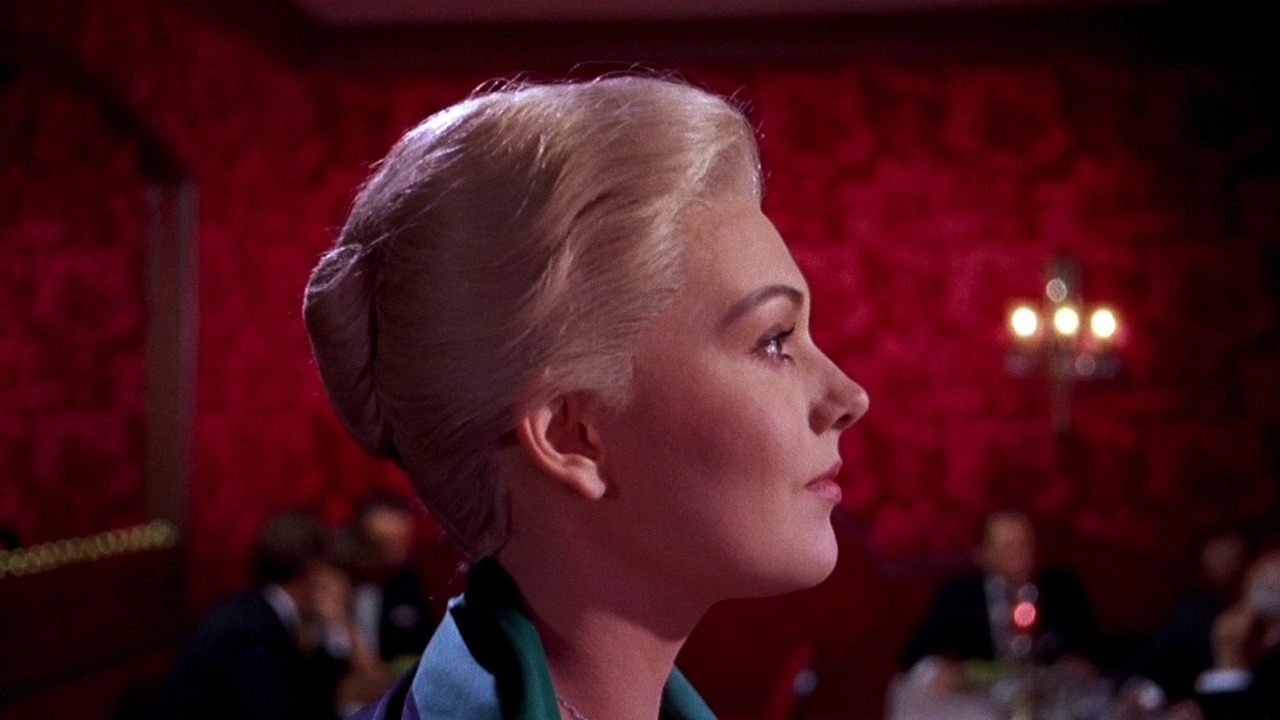
Hitchcock made a film about a man who destroys a woman by remaking her in the image of his obsession. He did not notice that his camera was doing the same thing.
I turn. She is standing in the light from the window, the green neon of the hotel sign bleeding through the curtain, and she is wearing the grey suit and the pulled-back hair and she is exactly — she is exactly right. I have been waiting for this. I did not know I had been waiting for this until now, this moment, when she walks out of the bathroom having made herself into the woman I needed her to be, and I turn with her, slowly, all the way around, because I cannot stop. Because I cannot get enough of what I am seeing.
This is not Scottie Ferguson describing what he sees.
This is the camera.
| Director | Alfred Hitchcock |
|---|---|
| Year | 1958 |
| Runtime | 128 minutes |
| Cast | James Stewart, Kim Novak, Barbara Bel Geddes |
| Award | National Film Registry, Library of Congress; consistently ranked among the greatest films ever made |
| Streaming | Paramount+, Apple TV (rental) |
Alfred Hitchcock’s Vertigo (1958) stars James Stewart as Scottie Ferguson, a former San Francisco police detective who develops a pathological fear of heights after witnessing a colleague’s death and is hired by an old acquaintance to follow his wife Madeleine, played by Kim Novak, who appears to be haunted by the spirit of a dead ancestor. The film’s midpoint revelation — that Madeleine was not real, that a different woman named Judy was paid to perform her, that Scottie fell in love with a fiction constructed to facilitate a murder — is among the most devastating pivots in American cinema. What follows is the film’s second and more disturbing half: Scottie finds Judy, who is also played by Novak, and proceeds, without knowing she was the original, to recreate Madeleine from her body. The grey suit. The hair. The shoes. The necklace. He is making Judy into the woman he lost, and Judy, who loves him, who was the woman all along, allows it. Vertigo was poorly received at its release, withdrawn from circulation by Hitchcock for decades, and returned to find itself declared — by the Sight and Sound poll, by the American Film Institute, by critics across three generations — one of the greatest films ever made. The previous review on this blog held it up as the film that, unlike Last Year at Marienbad, actually knows what it is showing: a man’s obsession remaking a woman’s identity, named as violence, building toward catastrophe. That was accurate. What it was not, quite, was complete.
Hitchcock scrutinises Scottie with the precision of a man who understands obsession from the inside. That is exactly the problem. He understands it from the inside.
The 360-degree tracking shot is the film’s most celebrated image and its most self-incriminating. Scottie has spent weeks remaking Judy: bought her the grey suit, directed the hairdresser, sent back the shoes twice. She has accepted every instruction with a patience that the film reads as love and that is also, if you stay with it, an obliteration of self so complete it barely registers as a choice. She walks out of the bathroom and into the green light and the camera begins to turn. It is a slow rotation around both of them, unhurried, ecstatic, the camera completing a full circle as if what it is watching is so precisely, perfectly right that leaving the frame would be a kind of bereavement. Hitchcock has said, and critics have repeated, that this shot gives us Scottie’s rapture from the inside. But the camera is not inside Scottie. It is alongside him, performing the same hunger, with the same satisfaction, finding the same completion in the successfully remade woman. There is no irony in the movement. There is no coolness in the frame, no distance that says: look at what this man is doing. The camera turns because it cannot help turning. Because what it is watching is exactly right.
The Marienbad review on this blog argued that what distinguishes Vertigo from Last Year at Marienbad is that Hitchcock knows his protagonist’s narration is obsession moving toward violence. This is true. Vertigo knows Scottie is destroying Judy. It knows the remaking is annihilation dressed as love. It delivers this knowledge with a formal clarity that makes Marienbad‘s obliviousness look naive. What the earlier review did not say — what required the film as subject rather than as comparison to be visible — is that knowing a thing is happening and being outside the thing happening are not the same condition. Hitchcock diagnosed Scottie with surgical precision and shared his pathology completely. The diagnosis and the disease look identical from where the camera stands, which is always next to Scottie, seeing what he sees, wanting what he wants, satisfied when he is satisfied. The film knows the name of what it is showing. It does not know that it is also showing it.
The biographical record is not proof, but it is suggestive in the way that biographical records sometimes are when a filmmaker’s obsessions and his film’s obsessions have the same texture. Hitchcock’s documented relationships with his leading women — his control over their appearance, his detailed instruction on hair and clothes and walk, his reported devastation when Vera Miles, whom he had been developing specifically for Vertigo, became pregnant and left the production — these are not the source of the film’s argument. But they are evidence that the argument runs through the filmmaker as well as through the protagonist, and that the 360-degree shot is not a controlled diagnosis of desire but desire itself, working through the only instrument it had available, which was a camera on a dolly on a studio floor in 1957.
The second thing the film cannot see is located in a scene that lasts ninety seconds and carries the weight of the entire film’s second half. Judy, alone in her hotel room after Scottie has found her and not recognised her, sits down and writes him a letter. She writes the whole truth: that she was hired to play Madeleine, that Gavin Elster constructed the fiction, that the real Madeleine is dead, that Judy Barton is the woman who was there and who now, knowing everything she knows, finds herself unable to leave. She reads back what she has written. Then she folds it. And then she does not send it, and the film moves on.
That decision — Judy choosing to suppress her own truth and remain near a man who does not yet love her for what she actually is — is the film’s entire argument about romantic obsession from the woman’s side. It is the moment where the film could have opened Judy’s interiority as fully as it has opened Scottie’s, where it could have held both of them in equal light and asked the harder question: what does it cost a person to consent to their own erasure, and is the consent freely given when the alternative is to lose the only love available? Hitchcock gives this ninety seconds. He shows Judy writing, reading, deciding, folding. Then the film returns to Scottie. The letter that gets torn up — or rather folded away, which is worse, because it means she kept it, knew what it said, and still said nothing — is the film’s own most important evidence against itself, and the film knows it has it, places it in front of the audience with apparent fullness, and moves on because following it completely would require a different film, one where Judy was the subject and not the site.
Rear Window (Hitchcock, 1954), made four years earlier, puts the same voyeuristic camera on a man watching a courtyard full of windows and manages something Vertigo never does: it acknowledges that the man behind the camera is morally implicated in what he sees, that watching is not neutral, that the desire to look is entangled with the desire to control. L.B. Jefferies is photographed with enough irony that his voyeurism reads as a condition to examine rather than a position to share. The camera in Rear Window is sometimes Jefferies and sometimes the film watching Jefferies, and the doubling keeps a critical distance that Vertigo‘s 360-degree shot closes completely. In Rear Window, Hitchcock retained the ability to step back from his protagonist. In Vertigo, that distance collapsed, and what replaced it was a film of overwhelming emotional power and zero critical perspective on its own desire. This is not a lesser achievement. It is a different kind, and a more honest one in ways the film cannot intend.
David Lynch’s Mulholland Drive (2001) inherits Vertigo‘s architecture so precisely that the debt is clearly conscious: a woman constructed for a man’s dream, a second woman who turns out to be the first, an identity built from another person’s image, the final revelation arriving too late to change what it explains. But Lynch refuses Vertigo‘s comfort. There is no single protagonist whose obsession organises the frame. The camera in Mulholland Drive is not aligned with any one desire. It circulates among desires, none of them innocent, all of them delusional in different registers, and the film ends not with a fall from a bell tower but with an implosion — the dreamer collapsing under the weight of what the dream was protecting her from. Lynch took the architecture Hitchcock built and removed the man who lived in it. What remained was the architecture itself, and what the architecture revealed, once its occupant was gone, was that it was designed for nobody’s survival.
Vertigo is the most intimate confession in American cinema disguised as a thriller. It knows exactly what Scottie Ferguson is. It does not know what it is to be the camera that watches Scottie Ferguson and turns, slowly, all the way around, because it cannot help it, because she is exactly right. Hitchcock made a film about a man who could not stop remaking the woman he lost. He did not notice that the film was the remaking.
If this stayed with you, watch these next:
Rear Window (Alfred Hitchcock, 1954): the same camera, the same eye, the same director — but four years earlier, Hitchcock could still step back from his protagonist’s voyeurism and make the moral implication visible; comparing the two films shows precisely where the distance closed and what closed it.
Mulholland Drive (David Lynch, 2001): the film that inherits Vertigo‘s architecture — a woman constructed for a dream, an identity built from another person’s image — and refuses every comfort the original offered; Lynch took Hitchcock’s structure, removed the man who organised it, and let the architecture reveal what it was built to conceal.
UnspokenCinema publishes every week. No ratings. No rankings. Just what films reveal without meaning to.