About Elly is named after a woman whose inner life it never enters. The title promises a portrait. What the film delivers instead is a mirror — and the people looking into it are not Elly.
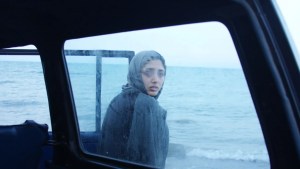
She is sitting in the back seat of a car on the way to the Caspian Sea. She has been told the trip is two days, not three. She has been told the villa will be clean. She has been told Ahmad is recently divorced and would appreciate company; she has not been told that her own engagement is something Sepideh has concealed from him. She watches the friends joke and sing out of the car windows, belonging to each other in the easy way of people who have known one another for years. She is the only one who doesn’t know the terms on which she was invited. She is weighing whether to stay.
Asghar Farhadi doesn’t write that paragraph.
About Elly (2009) won the Silver Bear for Best Director at the Berlin International Film Festival, was voted the fourth greatest Iranian film of all time by the national society of Iranian critics one year after its release, and earned David Bordwell — one of the most rigorous film scholars alive — to call it a masterpiece: “Gripping as sheer storytelling, the plot smoothly raises some unusual moral questions. It touches on masculine honor, on the way a thoughtless laugh can wound someone’s feelings, on the extent to which we try to take charge of others’ fates.” Every word of that is true. About Elly is a nearly perfect film in the register it works in. The question is which register that actually is, and whose story it tells.
A group of middle-class Tehran friends — three married couples, their children, and Ahmad, a recently divorced friend returning from Germany — drive to a rented villa on the Caspian Sea for a long weekend. Sepideh, one of the wives, has invited Elly, the kindergarten teacher of her daughter, as a potential match for Ahmad. Elly (Taraneh Alidoosti) is quiet, warm, uncomfortable in ways the group finds slightly charming. About forty-five minutes in, she disappears while supervising the children at the beach. The rest of the film — the greater part of its two hours — is the group’s response to her absence.
| Director | Asghar Farhadi |
|---|---|
| Year | 2009 |
| Runtime | 119 minutes |
| Cast | Golshifteh Farahani, Taraneh Alidoosti, Shahab Hosseini, Peyman Moaadi |
| Awards | Silver Bear Best Director, Berlin; Silver Bear Best Actress (ensemble); Tribeca Jury Award Best Narrative Feature |
| Streaming | MUBI, Kanopy |
Every comparison to L’Avventura is correct on the surface and misses the deeper divergence. In Antonioni’s film, Anna (Lea Massari) disappears during a yachting trip and the camera eventually abandons the search for her in favour of Claudia, her friend — Monica Vitti, whose interiority becomes the film’s new centre of gravity. The loss of one woman’s subjectivity is replaced with another’s. L’Avventura withholds Anna and gives us Claudia instead. About Elly withholds Elly and gives us the group. There is no Claudia here. There is no single consciousness that opens up to receive the camera’s attention after Elly disappears. What opens up instead is the social machinery of collective self-protection: who knew what, who told what to whom, whose reputation is most at risk, whether the fiancé should be called, what story the group will agree to tell him when he arrives. The question that the film pivots on is not “what happened to Elly?” It is “what will people think of us?”
Farhadi is entirely deliberate about this. It is the film’s moral argument: that these educated, secular, ostensibly modern Iranians are no less governed by reputation management and social performance than the more explicitly observant characters they might look down upon. The exposure of this collective failure is the film’s project, and it executes it with what Parviz Jahed, writing in Sight & Sound, precisely observed as a camera that “almost never closes in on their faces, picturing them often in long or medium shot. Even Elly, the main character of the film, is rarely the point of focus of the camera’s attention and is often seen in a crowd or in the margins of the frame.”
The film titled About Elly never once inhabits Elly’s perspective. It keeps her at the margins of the frame, exactly as the group keeps her at the margins of their concern. The moral argument and the formal method are the same act — and the film cannot see that they are both acts of the same kind.
Taraneh Alidoosti gives Elly something the screenplay withholds: a quality of watchful attention, a sense of someone continuously recalculating a situation she understood was not what she was told. Her eyes in the first half of the film are doing more work than any line of dialogue, registering the group’s dynamics, the mild condescension of the men, Sepideh’s overinsistent warmth. But the camera doesn’t settle on her long enough to let that work accumulate into interiority. She is seen at an angle. She is in the background. She flies a kite in a shot that critics have called the film’s most beautiful image — and the kite goes up and up and the line runs out and she is gone. It is a gorgeous image of disappearance. It is also the film’s formal signature: Elly is most fully present in the moment she leaves the frame.
Not knowing her name is the film’s most precise detail. The group, in the anxious consultation that follows her disappearance, cannot agree on it. Elham? Elmira? Elnaz? The film is called About Elly and the people it is supposedly about cannot be certain that Elly is even her name. This is intended as social criticism: these people invited someone into their circle without bothering to learn who she was. It works as criticism. It also works as an unintentional self-description. The film also doesn’t know who she is. It has her name in its title and her face on its poster and it never once looks at the world from behind her eyes. The architecture of exposure that Farhadi refined so perfectly in A Separation — where every adult lie is eventually uncovered, where the mechanism of revelation turns remorselessly on each character — here has a structural exception built in from the start. Elly is exempt from the exposure not because she has nothing to reveal, but because the film’s engine only runs on what the group conceals from each other. Her concealment, her fiancé Jafar’s existence, is held back from us in the same way it was held back from Ahmad. The film manipulates us with Elly’s secret the same way Sepideh manipulated Ahmad. It does what it accuses Sepideh of doing, and does not notice.
A Separation gave us this architecture perfected, with every lie stripped back, every partial truth exposed, right up to the one door it closed for reasons too personal to acknowledge. About Elly is the film where the architecture was being discovered, and where the blind spot is therefore rawer: a film that sets out to expose a group’s failure to see a woman as a full person, and that participates in that failure with every frame that keeps her at the margin, every scene that pivots away from what she might be thinking, every moment the camera lingers on Sepideh’s guilt rather than Elly’s vanishing interior.
Which is to say: About Elly is a greater film than its argument knows itself to be, and a more compromised one than its admirers tend to admit. Its greatness is in the precision of its social dissection. Its compromise is that the subject of the dissection is also its instrument. The film can feel both the pull of what it does not enter and the impossibility of entering it. What Elly might have wanted, what she made of the situation she was placed in, what choice she faced at the water’s edge — these stay behind, in the margins of the frame, where the camera left her.
If this stayed with you, watch these next:
A Separation (Asghar Farhadi, 2011): the film where the architecture of exposure reaches its refinement — each lie peeled back with unfailing precision, until the one door the film chooses not to open; our review is here, and the question of which character is given the full exposure of the camera’s attention runs directly between the two films.
L’Avventura (Michelangelo Antonioni, 1960): the film About Elly is most often compared to, and the comparison is most revealing in its divergence — where Antonioni abandons the search for a missing woman in favour of his surviving protagonist’s interiority, Farhadi abandons the missing woman in favour of the group’s guilt; both are films about the failure to see someone, but only one of them also fails to see her.
UnspokenCinema publishes every week. No ratings. No rankings. Just what films reveal without meaning to.