Cobb planted an idea in his wife’s mind and it killed her. The idea was simple: this world is not real. It burrowed so deep that Mal couldn’t distinguish the implant from her own thinking. She jumped from a window, believing she was waking up.
Now imagine the idea is planted not in one person but in an entire population. Imagine it’s not “this world is not real” but something quieter, something older, something so deeply embedded that it doesn’t even register as an implant anymore. Imagine the idea is: your body is not yours.
Get Out is a film about that inception. Not the kind that happens in a dream. The kind that happens over centuries. The kind so successful that both the perpetrators and the victims have forgotten it was planted. The kind that lives in smiles and compliments and the words “I would have voted for Obama for a third term.”
Jordan Peele didn’t make a horror film about racism. He made a horror film about the specific, suffocating, almost-impossible-to-name racism that lives in the people who believe they’ve already solved it.
And that is far more terrifying than a burning cross could ever be.
The Smile
Chris Washington drives to the country to meet his girlfriend’s family. Rose Armitage is white. Chris is Black. He asks if her parents know. She says it doesn’t matter. She says they’re not like that. She says her father would have voted for Obama a third term if he could.
This is the setup. And the setup works because every Black person watching this film, and a significant number of white people too, recognizes the social texture immediately. The reassurance. The preemptive disarming. The insistence that race has already been accounted for, that it won’t be an issue, that everyone here is enlightened.
The Armitage house is beautiful. The grounds are immaculate. Dean Armitage is a neurosurgeon. Missy Armitage is a psychiatrist. They are warm. They are welcoming. They say the right things. Dean calls Chris “my man.” He talks about how the Black experience is underrepresented. He performs, with what appears to be complete sincerity, the role of the progressive white father who is genuinely happy his daughter is dating a Black man.
And Chris feels wrong.
Not threatened. Not alarmed. Wrong. A low-frequency dissonance that he can sense but cannot source. The words are right. The tone is right. The house is right. And yet. Something. Something in the way the groundskeeper moves. Something in the way the housekeeper smiles. Something in the way the family’s warmth has a texture, a precision, a quality of being performed rather than felt.
Daniel Kaluuya plays this dissonance with an exactitude that is the film’s greatest technical achievement. Watch his eyes in the early scenes. Watch how they scan. Watch how they process. He is doing what every Black person in a white space learns to do: reading the room at a frequency the room doesn’t know it’s broadcasting on. Checking the exits not because he expects violence but because the absence of expected discomfort is itself a form of discomfort. The Armitages are too comfortable. Too easy. Too okay with him.
In a hostile environment, Chris would know what to do. Hostility is legible. It has a grammar, a vocabulary, a set of responses. What Chris faces in the Armitage house is something else entirely. It is friendliness so thorough, so seamless, so apparently genuine, that questioning it makes you the problem. If you name the wrongness, you become the one introducing race into a post-racial space. You become the one who can’t let it go. You become the angry Black man, and the liberal environment has made that role not just undesirable but socially impossible.
This is the first layer of the trap. And it is constructed not with chains but with courtesy.
The Garden Party
Chris attends a gathering at the Armitage estate. The guests are white. Affluent. Cultured. They are the kind of people who attend charity galas and read the right books and have the right opinions. They greet Chris with enthusiasm.
Too much enthusiasm.
A woman grabs his arm and squeezes his bicep. “How strong,” she says. A man asks about his athletic background. Another asks about the “advantages” of being Black. Another tells him that Black is “in fashion.” They examine him with a fascination that is openly, almost innocently, proprietary. They are looking at him the way you look at something you are considering acquiring.
This scene is the film’s central set piece, and it functions on two levels simultaneously.
On the surface, it is a comedy of liberal racial awkwardness. The white people saying dumb things. The microaggressions. The cringe. The audience laughs because the behavior is recognizable, because they’ve seen it or done it or been on the receiving end of it. The laughter is a release valve. It makes the scene bearable.
Underneath the comedy, the scene is an auction.
The guests are bidding. The compliments about Chris’s body, his strength, his physique, are not social pleasantries. They are evaluations. The party is a viewing. The estate is the auction block. And the transaction being conducted, the actual exchange of value happening beneath the surface of civilized conversation, is the sale of a Black body to a white buyer.
Peele stages this with a composure that amplifies the horror. He doesn’t signal the horror with music or camera angles. He lets the social reality of the scene do the work. The white guests don’t know they’re being monstrous. They think they’re being friendly. They think their fascination with Chris’s body is a compliment. And their inability to see the monstrosity, their absolute blindness to what they’re doing, is more frightening than any slasher’s knife.
Because the monster who doesn’t know it’s a monster cannot be stopped by the usual means. You can’t fight courtesy. You can’t run from a compliment. You can’t call the police on someone who is smiling at you and saying nice things about your body while measuring you for a cage.
The Sunken Place
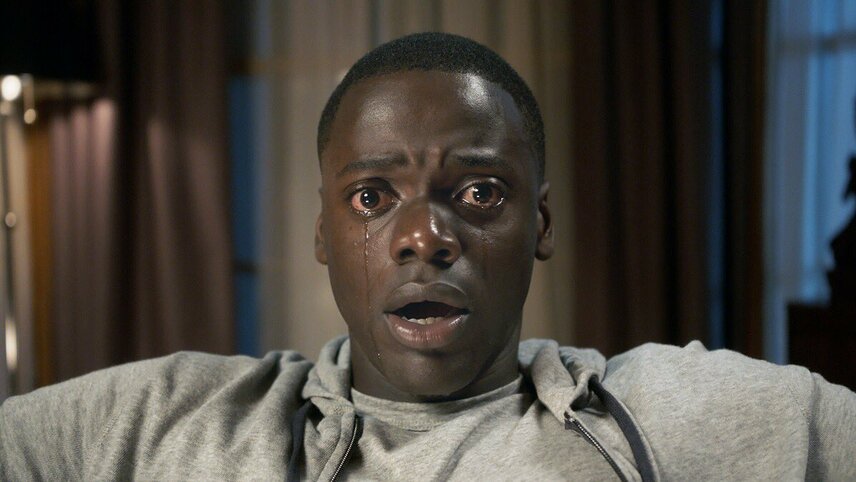
Missy Armitage hypnotizes Chris.
He sits in a chair. She stirs a teacup. She asks about his mother. She finds the wound. She opens it. And Chris falls.
He falls into the Sunken Place.
The Sunken Place is one of the most powerful images in 21st-century cinema, and its power lies in its specificity. Chris doesn’t lose consciousness. He doesn’t enter a fantasy. He sinks into a black void while his own perspective, his own vision, becomes a small screen above him. He can see out. He can see the world continuing. He can see his body sitting in the chair, responding, being manipulated.
He cannot move. He cannot speak. He cannot act.
He is conscious but paralyzed. Present but invisible. Aware but impotent.
This is not a generic metaphor for oppression. This is a very precise metaphor for a very specific experience: the experience of being a Black person in a space controlled by white people who are doing something to you that you can see clearly but cannot name, cannot resist, and cannot make anyone else see.
The Sunken Place is the board meeting where your idea is ignored and then repeated by a white colleague and praised. It is the classroom where your hand is up and the teacher’s eyes pass over you. It is the dinner party where the host says something grotesque and you calculate, in a fraction of a second, whether the cost of speaking is worth the exhaustion of being the one who “made it about race.” It is the thousand daily moments of watching your own life happen to you from a distance, conscious of everything, able to change nothing.
Cobb’s inception planted an idea in one person’s mind. The Sunken Place is an inception that has been running for four hundred years. The idea planted is: your body is a resource to be managed by others. And the genius of the Sunken Place as a cinematic image is that it shows you what that inception feels like from the inside. Not the anger. Not the resistance. The sinking. The watching. The helpless, conscious, fully aware experience of being swallowed by something so much bigger and older than you that fighting it feels not just futile but absurd.
Rose
Let’s talk about the smile.
Rose Armitage smiles when she meets Chris. She smiles when she defends him to the cop who asks for his ID at a traffic stop. She smiles when she reassures him about her family. She smiles in bed, in the car, in the garden. The smile is warm. The smile is real. The smile is the most terrifying thing in the film.
Because Rose is performing.
She is performing the Woke Girlfriend. The white woman who gets it. Who stands up for her Black partner. Who confronts authority on his behalf. Who rolls her eyes at her father’s awkwardness and touches Chris’s hand and communicates, through a thousand small gestures, that she is safe. That she is different. That she is on his side.
Allison Williams plays this performance with a technical precision that becomes, upon rewatch, genuinely chilling. Every moment of apparent spontaneity is calculated. Every gesture of solidarity is rehearsed. Rose confronting the cop at the traffic stop, the scene that makes the audience think “she’s one of the good ones,” is not Rose defending Chris. It is Rose preventing the cop from creating a record that Chris was in the area. She is protecting the operation, not the man.
But you don’t see this the first time. You can’t. Because the performance is too good. Because the woke girlfriend is too perfectly calibrated to the audience’s desire for a white character they can identify with, a white character who proves that not all white people are complicit, a white character who gives permission to relax.
Rose is Amy Dunne.
She is. The parallel is almost structural. Amy performed the Cool Girl to trap Nick. Rose performs the Woke Girlfriend to trap Chris. Both performances are built from a precise understanding of what their target wants to see. Both are sustained over months. Both are revealed, in a single scene, to have been strategic from the beginning. And both revelations depend on the audience having believed the performance, having needed it to be real, having invested in the lie because the alternative was too uncomfortable.
The scene where Rose is revealed, standing at the top of the stairs, eating cereal, browsing the internet for her next target, with Fruit Loops and milk separated because even her eating is controlled, her face emptied of every trace of warmth, is the most precise depiction of the mask dropping in any film we’ve discussed. There is nothing underneath. No guilt. No conflict. No hidden humanity. Just the blankness of a person for whom the performance was the entire relationship.
Chris wasn’t her boyfriend. Chris was her harvest.
The Body
The Armitages don’t want to kill Black people.
This is the detail that makes Get Out’s horror distinct from every other racial horror narrative. The Armitages are not trying to harm Black bodies. They are trying to use them. They admire Black bodies. They covet Black bodies. They want Black strength, Black youth, Black aesthetics. They want everything the Black body offers.
They just don’t want the Black mind inside it.
The Coagula procedure transplants a white consciousness into a Black body. The original consciousness is not destroyed. It is pushed down. Into the Sunken Place. The Black person is still there, still aware, still watching from the small screen in the void. But they no longer control anything. Their body belongs to someone else. Their muscles, their hands, their voice, their face, serve someone else’s will.
This is not science fiction. This is history.
The entire apparatus of American slavery was a Coagula procedure performed at civilizational scale. Black bodies were valued for their labor, their strength, their reproductive capacity. Black minds, Black culture, Black selfhood, were suppressed, punished, erased. The body was kept. The person was submerged. The institution ran for centuries and when it ended, legally, the logic persisted. Black bodies remained objects of fascination, desire, commerce, and fear. Black minds remained subject to suppression, suspicion, and the particular liberal condescension that says: we love your music, your style, your athleticism. We just need you to think like us.
The Armitages are not an anomaly. They are an allegory. And the allegory is not about the past. It is about the present. About the white liberal household that displays African art and listens to hip-hop and votes correctly and still, at some fundamental level, treats Black culture as an accessory and Black consciousness as an obstacle.
The garden party guest who squeezes Chris’s bicep and says “how strong” is not being rude. She is being honest. She is expressing, in the film’s heightened register, the same admiration-without-recognition that structures a thousand real interactions every day. I love what your body can do. I just wish someone else were driving it.
Rod
Lil Rel Howery’s Rod is the only character in the film who is never fooled.
He is Chris’s best friend. He works for the TSA. He is funny, paranoid, loud, and absolutely correct about everything. When Chris describes the Armitage household, Rod immediately says: they’re going to make you a sex slave. When Chris disappears, Rod goes to the police. The detective, a Black woman, listens to his story about white people kidnapping Black people and brainwashing them. She laughs. Her colleagues laugh.
Rod is dismissed as paranoid. As conspiracy-minded. As ridiculous.
He is right about everything.
The film uses Rod as comic relief, and the comedy works because Howery’s timing is impeccable. But underneath the comedy, Rod serves a function that is both structural and political. He represents the Black gaze. The perspective that sees the danger immediately, that isn’t seduced by the liberal performance, that knows, from cultural memory and lived experience, that white spaces that seem too welcoming are the most dangerous spaces of all.
And the film shows you, clearly and deliberately, that this perspective is dismissed. Not by racists. By reasonable people. By a Black detective who has internalized the rules of the liberal order and decided that Rod’s pattern recognition is paranoia rather than perception.
The system doesn’t just trap Black bodies. It discredits the people who see the trap.
The Ending Peele Didn’t Use
Jordan Peele originally wrote a different ending.
In the original version, Chris escapes the Armitage house. He is on the ground, hands around Rose’s throat. Police lights appear. Officers arrive. And Chris is arrested. The final scene was Chris in prison, visited by Rod, broken, caught by the system he was trying to escape.
Peele changed the ending. In the released version, the arriving vehicle is Rod in the TSA car. Chris is saved. The relief is enormous. The audience exhales.
Peele has said he changed the ending because, after the Obama era ended, the audience “needed to see Chris get out.” They needed the release. They needed the win.
But the original ending is the truer one. And the fact that Peele felt he had to change it is itself an argument about what audiences are willing to see.
Because in the original ending, the system completes the trap. Chris does everything right. He wakes up. He fights. He survives. And the system, indifferent to his survival, indifferent to his innocence, does what systems do to Black men found at night with their hands around a white woman’s throat. It processes him. It files him. It puts him away.
The original ending is the real Sunken Place. Not hypnosis. Not neurosurgery. Just the ordinary, grinding, impersonal mechanism of a justice system that cannot see a Black man’s survival as anything other than evidence of a Black man’s crime.
Peele gave us the happy ending instead. And the happy ending is a gift. But gifts and truths are not always the same thing.
The Circle Closes
Fourteen films ago, we began with The Shawshank Redemption. We noticed something the film itself could not see: that Red, a Black man, existed in the story to validate a white man’s journey. That his warmth, his wisdom, his narration, served Andy’s freedom. That the film’s racial architecture was invisible precisely because it was so perfectly naturalized.
Get Out takes that architecture and holds it under a surgical light.
The Armitages don’t want Red to narrate their story. They want to climb inside Red’s body and narrate it themselves. They want the warmth without the person who generates it. They want the voice without the mind that shapes it. They want the Morgan Freeman experience without Morgan Freeman.
This is not a stretch. This is the logical conclusion of the dynamic Shawshank embedded without examining. The white story that uses the Black body as a vehicle, as a lens, as a container for white meaning. Get Out just makes the surgery literal.
Inception showed the story consuming the mind. Get Out shows whose mind gets consumed and who gets to do the consuming. The Sunken Place is the ultimate inception: an idea so deep, so old, so perfectly integrated into the operating system of an entire civilization, that it doesn’t even register as an idea anymore. It registers as nature. As the way things are. As the friendly smile of a liberal family who would have voted for Obama a third term.
The dream is four hundred years old. And the top is still spinning.
Where This Leads Us
Get Out peeled back the liberal smile and found the auction block underneath. It showed a system that doesn’t need malice to function, only admiration without recognition, desire without respect, the warmth of a smile that wants your body and not your mind.
But what if the system is even older than race? What if it precedes America, precedes colonialism, precedes the specific machinery of slavery? What if the original performance, the first great lie, the inception that contains all other inceptions, is not about race or class or gender but about something more fundamental?
What if it’s about the stories we tell to make killing feel like civilization? What if the oldest trick isn’t the one you play on someone else but the one you play on yourself, the trick that turns violence into narrative, conquest into destiny, and the screaming of the conquered into the silence of the scenery?
What if the dream goes all the way down?