Get Out showed you a family that wanted Black bodies without Black minds. They smiled while they took. They performed love while they consumed.
Now pull the camera back. Further. Past the Armitage estate. Past the garden party. Past the liberal smile. Pull it all the way back to the beginning. To the land itself. To the moment before the house was built, before the garden was planted, before anyone was there to smile.
What do you see?
You see a man in a hole, digging.
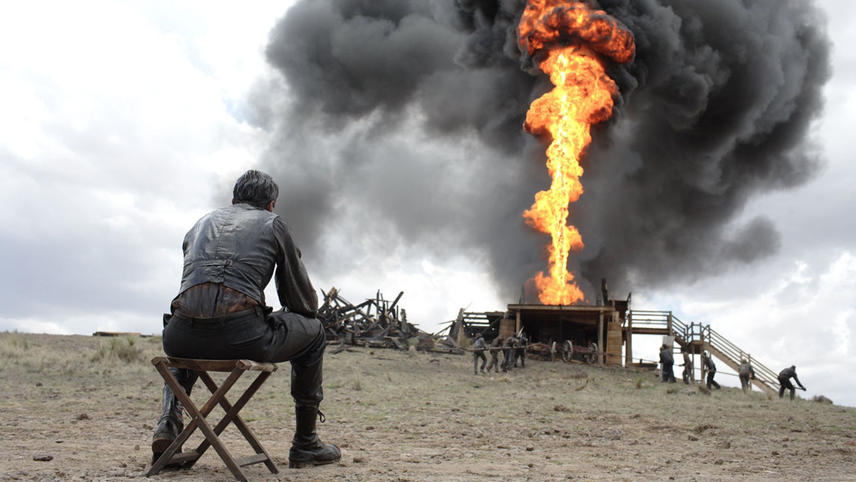
That’s the first image of There Will Be Blood. A man alone in the earth. No dialogue. No music. Just the sound of a pickaxe hitting rock, and the vast, indifferent desert sprawling in every direction. Daniel Plainview is mining for silver. He finds oil instead. He breaks his leg at the bottom of the shaft. He crawls out. He drags himself across the desert floor. He sells the oil.
He begins.
This is not a character introduction. This is a creation myth. Paul Thomas Anderson is showing you how a country is born. Not with declarations or constitutions or ideals. With a man in a hole. With a broken bone. With the decision to keep crawling. With the discovery that what’s under the ground is worth more than what’s on top of it, and the willingness to do whatever is necessary to get it out.
What Plainview Wants
Daniel Plainview does not want money.
This is the first thing most readings of the film get wrong. They see the oil. They see the empire. They see the mansion at the end, the bowling alley, the wealth. And they diagnose greed.
Greed is too small a word. Greed implies a desire for things. Plainview doesn’t want things. He wants the absence of other people.
“I have a competition in me,” he tells Henry, the man who claims to be his brother. “I want no one else to succeed. I hate most people. I want to earn enough money I can get away from everyone.”
Listen to this confession. It is not about acquisition. It is about elimination. Plainview doesn’t want to have more than everyone else. He wants everyone else to have nothing. The distinction is crucial. A greedy man can be satisfied. A man who needs the annihilation of all competition cannot, because competition is a condition of existence, not a problem to be solved. As long as other people exist, Plainview’s need goes unfulfilled.
Daniel Day-Lewis understands this. His performance, which won every award available to it and deserved more, is built not on intensity but on a particular quality of attention. Watch how Plainview listens. Watch how his eyes move when someone else is speaking. He is not hearing words. He is assessing terrain. Every conversation is a negotiation. Every human interaction is a transaction. Every person who enters his field of vision is either a tool to be used or an obstacle to be removed.
This is not madness. This is not villainy. This is the logical endpoint of a system that rewards the individual who extracts the most, gives back the least, and outlasts everyone else. Plainview is not an aberration of American capitalism. He is its purest expression. He is what happens when the frontier logic of take, use, discard is applied not just to land but to every human relationship the land-taker encounters.
The Pitch
Plainview arrives in Little Boston, California. There is oil under the ground. The community is poor. They are farmers, ranchers, people of faith. They live on the land. They do not know what is underneath it.
Plainview knows. And the first thing he does is perform.
He stands before the community and he tells them a story. He tells them he is a family man. He gestures to H.W., his young son, standing beside him. He tells them he is an oil man, yes, but an oil man with values. He tells them about his workers, how he provides for them, how he builds schools and roads and infrastructure. He tells them he wants to be a good neighbor. He tells them their lives will improve.
He is lying. Not about the oil. About everything else.
The scene is extraordinary because Day-Lewis plays it not as deception but as craft. Plainview isn’t nervous. He isn’t calculating in real time. He has done this before. Many times. He has the pitch perfected. He knows which words to use and which pauses to leave and where to place his hand on H.W.’s shoulder for maximum effect. He is a storyteller. He is an inception artist. He is planting an idea in a community’s mind: I am here to help you.
The idea will take root. The community will believe it. They will sell their land. They will welcome the derricks. They will watch the oil come out of the ground and they will believe, for a while, that the man who is taking it is giving them something in return.
By the time they realize the extraction is one-directional, it will be too late. The oil will be gone. The land will be changed. And Plainview will be somewhere else, giving the same pitch to the next town.
This is how inception works at scale. Not through hypnosis or dream architecture. Through narrative. Through the story a man tells a community about who he is and what he wants and why they should trust him. The tools are not syringes and sedatives. They are a boy’s face and a firm handshake and the words “I’m a family man, a plain, simple man.”
The dream that Get Out diagnosed, the four-hundred-year inception that makes extraction feel like partnership, begins here. In a room full of people who don’t know what they’re sitting on, listening to a man who does.
H.W.
Plainview’s son is not his son.
H.W. is the child of a worker who died in one of Plainview’s early oil wells. Plainview took the boy. Raised him. Brought him to every pitch meeting, every land negotiation, every community performance.
Because a man with a child is trusted.
This is the detail that reveals the depth of Plainview’s strategic intelligence and the void where his emotional life should be. H.W. is a prop. He is a narrative device. He is the human evidence of Plainview’s “family man” claim, the visual proof that this oil man is not just a predator but a father, a provider, a man with something to lose.
When an oil well explosion deafens H.W., Plainview’s reaction is not grief. It is disruption management. He holds the boy. He carries him. He performs concern. But watch Day-Lewis’s face in the moments after. Watch what happens behind the eyes. The calculation is visible. The tool has been damaged. The prop no longer functions as intended. A deaf child cannot perform the role of “family” with the same effectiveness as a hearing one.
Plainview sends H.W. away. He tells himself it’s for the boy’s benefit. The film lets you decide whether he believes this or whether the self-deception is just another pitch, this time directed inward.
Later, much later, when H.W. is grown, when H.W. tells his father he is leaving to start his own oil company, Plainview reveals the adoption. He calls H.W. a “bastard in a basket.” He severs the relationship with the same brutal efficiency he applies to business rivals. He doesn’t just let H.W. go. He destroys the fiction that connected them, publicly, cruelly, completely.
He liquidates the asset.
And the audience, which has spent two and a half hours watching Plainview perform fatherhood, realizes that the performance was never for H.W.’s benefit. It was for theirs. They believed it. They believed the man with the boy was a man with a heart. They fell for the pitch, just like Little Boston.
Eli Sunday and the Mirror
Eli Sunday is a preacher. He is young. He is charismatic. He runs the Church of the Third Revelation with the fervor of a man who has discovered that God is the most powerful narrative technology available.
He is also Daniel Plainview in different clothes.
This is the claim that the film makes structurally, visually, and through every interaction between the two men. And it is the claim that most readings of the film resist, because accepting it means accepting that the church and the oil rig are the same machine.
Plainview extracts oil from the ground. Eli extracts faith from his congregation. Plainview tells communities a story to gain access to their resources. Eli tells his congregation a story to gain access to their devotion. Plainview uses H.W. as a prop. Eli uses God as a prop. Both men perform. Both men manipulate. Both men understand, with an intelligence that never needs to be stated, that power belongs to the person who controls the narrative.
Their hatred is the hatred of recognition. Plainview looks at Eli and sees his own methods dressed in sanctimony. Eli looks at Plainview and sees his own ambition stripped of its disguise. They cannot coexist because they are competing for the same thing: the community’s belief. And the community can only be shared so many times before the stories start contradicting each other.
Paul Dano plays Eli with a trembling intensity that is easy to mistake for weakness. It isn’t. Eli is as ruthless as Plainview. He is just operating in a different medium. When Eli performs an exorcism, slapping the arthritis out of an old woman’s body while the congregation howls, the performance is as calculated, as precisely timed, as Plainview’s family-man pitch. Different audience. Same technique. Same extraction.
The baptism scene is their finest shared performance. Plainview submits to Eli’s church. He confesses, publicly, that he abandoned his son. Eli forces him to say it louder. The congregation weeps. The water flows. The ceremony is completed.
Neither man believes a word of it.
And both men know the other doesn’t believe a word of it. And neither one breaks character. Because the congregation is watching. The audience is watching. And the performance, whether it’s performed in a church or an oil field or a bowling alley, must continue as long as there is someone to consume it.
The Land
Here is the silence at the center of the film. The silence the film itself does not break.
The land was there before Plainview arrived. The land will be there after he’s gone. The oil was under the ground for millions of years before anyone knew it existed. The desert was vast and indifferent and beautiful and it belonged, before it belonged to anyone in this story, to people who are not in this story.
There Will Be Blood takes place on land that was, within living memory of the film’s 1898-1927 timeframe, inhabited by indigenous peoples. The Chumash. The Tongva. The Yokuts. They lived on this land. They had economies. They had cultures. They had relationships with the ground beneath their feet that did not involve drilling.
The film does not mention them. Not once.
This is not a flaw. This is the film’s most radical act of reproduction. Anderson is not ignoring indigenous presence because he doesn’t know about it. He is reproducing the American gaze. The gaze that looks at land and sees resource. The gaze that looks at a continent and sees a blank page. The gaze that performs the founding inception: this land is empty. This land is waiting. This land is mine.
By not showing the people who were there before, the film does exactly what Plainview does. It erases them from the narrative so that the extraction story can proceed uninterrupted. It makes the audience complicit in the erasure, because the audience, watching Plainview dig and drill and build, never asks: who was here first? The story is so compelling, the performance so complete, that the question doesn’t arise.
And that is how inception works. Not by answering the question wrong but by making sure the question is never asked.
The Bowling Alley
The film ends in 1927. Plainview is rich. He lives alone in a mansion with a bowling alley in the basement. He drinks. He fires a rifle at furniture. He is, by every measure the world offers, a success.
Eli comes to visit. He is broke. His church has failed. The radio ministry he invested in has collapsed. He needs money. He comes to Plainview the way communities came to Plainview: desperate, willing to perform, ready to give up what he has left.
Plainview makes Eli say it.
“I am a false prophet,” Eli must confess. “God is a superstition.”
Eli says it. He screams it. He humiliates himself completely, performing the destruction of his own mythology with the same theatrical commitment he once brought to its construction.
And Plainview kills him. With a bowling pin. In the basement. While the blood pools on the polished wood and the strings are still standing and Plainview sits on the floor and says, to his butler or to the audience or to no one: “I’m finished.”
The line is perfect. It means: I’m done with this scene. It means: there is nothing left to take. It means: the extraction is complete. Every rival has been defeated. Every community has been drained. Every performance has been concluded. The man who wanted no one else to succeed has gotten his wish. No one else has succeeded. And the reward for total victory is total solitude.
Plainview sits in his bowling alley. The last man standing. The founding myth, fulfilled. The American dream, completed.
It looks exactly like hell.
The Dream Goes All the Way Down
Fourteen films. Fourteen lies. Fourteen performances. Fourteen variations on the same question: what happens when the story replaces the truth?
Shawshank told a beautiful lie and called it hope. The Truman Show exposed the construction and called it freedom. Fight Club said the self is a performance. The Dark Knight said the lie is necessary. Gone Girl said the lie is the marriage. Ripley said the lie is you. Black Swan said perfection kills. Joker said the symbol eats the person. Whiplash said the audience is complicit. Amadeus said greatness is unjust. Birdman said relevance is an addiction. Logan said the franchise consumes the body. Inception said the story consumes the mind. Get Out said the dream is four hundred years old.
There Will Be Blood says the dream is the country.
The dream is the man in the hole, digging. The dream is the pitch to the community. The dream is the family man with the boy. The dream is the oil coming out of the ground, and the money going into the account, and the land emptied of everything it had, and the people who lived on it scattered or submerged or simply written out of the story.
The dream is America. Not the ideals. Not the Constitution. Not the amber waves of grain. The dream is the extraction. The dream is the performance that makes the extraction possible. The dream is the smile, the handshake, the words “I’m a plain, simple man,” spoken by a man who is neither plain nor simple nor, in any meaningful sense, a man at all. He is a function. He is the mechanism by which a continent becomes a commodity.
And the dream, as Plainview demonstrates in his bowling alley, as the film demonstrates in its final, blood-soaked, devastatingly quiet last shot, doesn’t end with triumph.
It ends with a man sitting alone in a room, having taken everything, owning everything, surrounded by everything, and having nothing left to want.
“I’m finished.”
The dream is finished too. But finishing and waking up are not the same thing.