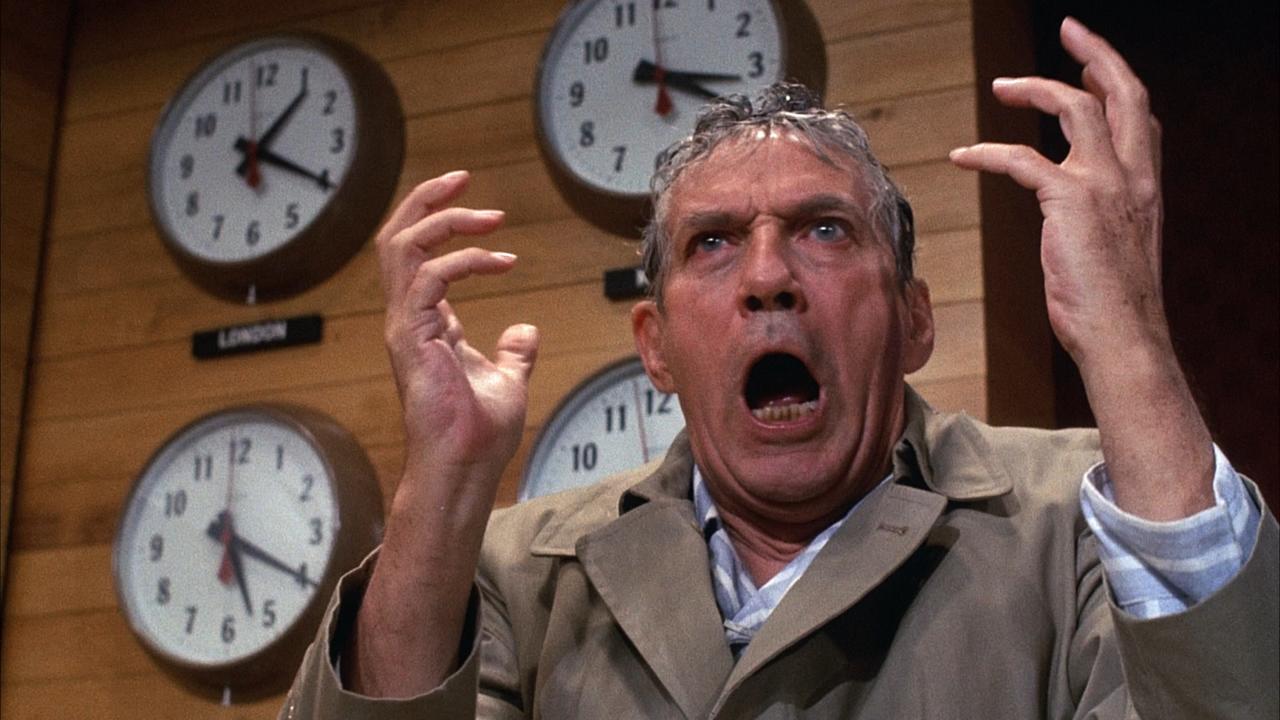
In 1976, Paddy Chayefsky wrote a film about a news anchor who has a nervous breakdown on live television and becomes the highest-rated show in America.
The film was called Network. It was received as satire. It won four Academy Awards. It was praised for its prescience, its anger, its willingness to imagine a world in which television would devour everything it touched.
Here is what nobody says about Network: it wasn’t prescient. It was late.
Everything Network warns about had already begun. The line between news and entertainment had been dissolving since the quiz show scandals of the 1950s. The commercial logic that drives the film’s plot, that ratings determine content and content determines reality, was not a future Chayefsky was predicting. It was a present he was describing. The reason Network felt like prophecy was not that it imagined something that hadn’t happened yet. It was that it named something that had already happened but that nobody had been willing to say out loud.
And the reason it still feels like prophecy fifty years later is that the naming changed nothing. The diagnosis was delivered. The patient heard it, nodded, and went back to watching.
That’s the real horror of Network. Not that it predicted the future. That it described the present and the present absorbed the description and kept going.
The Breakdown
Howard Beale is going to be fired.
He is the anchor of the UBS Evening News, and his ratings have been declining for years, and the network has decided to let him go. His friend and producer, Max Schumacher, tells him over drinks. Beale takes it the way a man of his generation would: with alcohol and silence and a plan.
He goes on the air the next night and announces that he is going to kill himself on live television.
Watch what happens next. Not to Beale. To the network.
There is panic, briefly. Then Frank Hackett, the network’s corporate operative, sees the overnight numbers. The announcement spiked the ratings. And in that moment, in the space between the panic and the numbers, the entire moral calculus of the institution shifts. Beale’s breakdown is no longer a crisis. It is an opportunity.
This is the mechanism Network exposes, and it is more dangerous than any conspiracy or corruption this series has examined. Noah Cross diverted water in secret. The Overlook operated behind closed doors. The military in Apocalypse Now hid its madness upriver, out of sight.
Television doesn’t hide anything. Television puts everything on the screen and lets the screen transform it. The breakdown becomes a segment. The despair becomes a format. The genuine scream of a man who has lost his reason for living becomes the most compelling content the network has ever produced.
The institution doesn’t suppress Howard Beale’s pain. It schedules it.
“Mad as Hell”
“I’m as mad as hell, and I’m not going to take this anymore.”
This is the line. The one everyone knows. The one that escaped the film and entered the culture and became a bumper sticker, a meme, a rallying cry that people use without irony decades after the film demonstrated, with surgical precision, exactly what happens to rallying cries.
Beale delivers it during a broadcast. He has been ranting. He has been telling his viewers that things are bad, that the air is unfit to breathe and the food is unfit to eat, that they sit in front of their televisions while the world is being run by forces that don’t care about them. And then he tells them to get up, go to the window, open it, and scream.
And they do. Across the city, people open their windows and scream into the night. “I’m as mad as hell, and I’m not going to take this anymore!” It is cathartic. It is powerful. It feels, for a moment, like the beginning of something.
It is the end of something.
Because watch what happens to the scream. Diana Christensen, the programming executive played by Faye Dunaway with the terrifying focus of a woman who has replaced her entire inner life with audience metrics, sees the ratings. She sees that Beale’s anger is performing. And she does the thing that the film argues is the essential act of the television institution: she turns the anger into a show.
The Howard Beale Show. Live, nightly, a man having a breakdown in front of a studio audience. Fortune tellers and soothsayers and astrologers as regular segments. Beale ranting about the dehumanization of American life while the dehumanization is being packaged and sold in four-minute blocks between commercials.
The scream works because it is genuine. Beale is not performing. He is breaking. His anger at the emptiness of modern life is real, and his audience feels it, and for that one moment at the window, the connection between the man and the people is unmediated.
Then the institution mediates it. It puts a frame around the scream. It assigns the scream a timeslot. It sells advertising against the scream. And the scream, inside the frame, is no longer a scream. It is content. And content is not dangerous. Content is profitable.
This is the move that Network identifies as the fundamental operation of broadcast media, and it is more radical than anything the film says out loud. The institution does not fear your anger. The institution loves your anger. Your anger is the most engaging thing you’ve ever produced. The institution’s only concern is that your anger might happen off-camera, in a space it can’t monetize. As long as the anger is on screen, it is on the schedule, and the schedule is the institution’s territory.
You’re not mad as hell. You’re the eight o’clock slot.
Diana
Faye Dunaway’s Diana Christensen is the most important character in Network, and she is the one most often reduced to a type.
The standard reading: she is the soulless corporate woman, the embodiment of television’s cold logic, the character who has sacrificed her humanity on the altar of ratings. This reading is not wrong, but it is shallow, and it misses what Chayefsky is actually doing with her.
Diana is not a person who chose ratings over humanity. Diana is a person who was formed by television. She is the first generation to have grown up with the medium, and the medium has shaped her consciousness so thoroughly that she does not experience the world in human terms. She experiences it in programming terms. Everything is a segment. Every conversation is a pitch meeting. Every emotion is a data point measuring engagement.
Watch her scenes with Max Schumacher, the older producer she has an affair with. Max is from the generation before television. He processes the world through relationships, through ethics, through the messy, unquantifiable experience of being a person in the company of another person. Diana cannot do this. Not because she is evil. Because she has been formatted by the institution that raised her, and the format does not include the unquantifiable.
Their love scene is one of the most devastating in American cinema because Diana narrates it like a programming executive. She talks about audience demographics while Max tries to reach her as a person. She is not withholding herself. She is giving everything she has. This is everything she has. The institution did not take her humanity. It replaced it with metrics before she was old enough to know the difference.
This is a portrait of institutional violence more intimate than anything in The Godfather or Apocalypse Now. Michael Corleone was consumed by the family. Willard was consumed by the mission. These are dramatic transformations. Diana is not transformed. She was never anything else. The institution didn’t change her. It built her. She is its product, not its victim, and the distinction between product and victim is the distinction Network refuses to let you make comfortably.
Jensen
And then Arthur Jensen enters the film and the floor falls away.
Jensen is the CEO of the conglomerate that owns UBS. Beale, in one of his broadcasts, has ranted against a Saudi Arabian deal that the network’s parent company is negotiating. Jensen summons Beale to a boardroom.
What follows is one of the great scenes in American cinema. Jensen delivers a monologue that is, structurally, a sermon. He stands at the end of a long, dark conference table, curtains drawn, voice rising and falling with the cadence of a preacher, and he tells Beale the truth.
There are no nations. There are no peoples. There is no America. There is no democracy. There is only IBM, and ITT, and AT&T, and DuPont, and Dow, and Union Carbide, and Exxon. The world is a business. It has been a business since man crawled out of the slime.
Beale listens. Beale believes. Beale has been looking for a truth large enough to match his anger, and Jensen gives him one. Not the populist truth of the angry prophet (the world is corrupt, fight back), but the corporate truth of the systems analyst (the world is a flow of capital, and capital has no nationality, and resistance is a category error).
And Jensen tells Beale to preach this new gospel on his show. And Beale does. And the ratings drop.
Because the audience doesn’t want the truth. The audience wants the anger. The audience wants “mad as hell.” The audience wants the window and the scream. The truth, which is that the system is not broken but functioning exactly as designed, is not engaging. It is not cathartic. It does not produce the spike in cortisol and adrenaline that makes people feel alive for the thirty seconds between their window and their chair.
Jensen’s monologue is the moment Network stops being a satire about television and becomes something else: an argument about the relationship between truth and engagement. The truth is not engaging. Anger is engaging. The institution knows this. The institution will always choose the engaging over the true, because the institution is not an agent with beliefs. It is a system that optimizes for attention, and truth and attention are not correlated, and when they conflict, attention wins.
This is the principle that connects Network to every content platform built in the half-century since. The algorithm doesn’t care if you’re right. The algorithm cares if you’re watched.
Max
William Holden’s Max Schumacher is the conscience of the film, and the film’s most painful argument is about the uselessness of conscience.
Max is a good man. He is a competent producer, a loyal friend, a person who believes in the distinction between news and entertainment, between information and spectacle, between the real and the performed. He objects to what is happening to Beale. He objects to Diana’s programming philosophy. He objects, in the steady, articulate way of a man who still believes objection is meaningful.
He is fired. He has an affair with Diana, which fails because she is constitutionally incapable of intimacy. He goes home to his wife. He delivers a speech about Diana that is one of Chayefsky’s finest pieces of writing, in which he tells his wife that Diana is television incarnate, that she is incapable of real feeling, that everything she touches turns to content.
And then the film sets him aside.
Max is right about everything. His diagnosis of Diana is correct. His understanding of what television is doing to journalism is correct. His moral framework is correct. And the film demonstrates, methodically, that being right is a category the institution does not recognize. Max’s objections are absorbed the way a body absorbs a vitamin: noted, processed, and excreted. The system continues.
This echoes what this series traced in Chinatown. Jake Gittes was right about Noah Cross. His investigation was correct. His moral outrage was justified. And the film ended with Evelyn dead and Cross walking away with the girl. Being right, in both films, is presented as a condition that exists entirely inside the person who is right and has no necessary effect on the world outside.
Max is the audience’s representative in the film. He feels what we feel. He sees what we see. He objects the way we would object. And his irrelevance is our irrelevance, and Chayefsky knows it, and the film never lets us forget that our sympathy with Max is itself a form of comfortable spectatorship. We agree with the man on the couch. We do not turn off the television.
The Execution
Howard Beale’s ratings continue to drop. Jensen won’t let the network fire him. Diana needs the timeslot.
So they kill him.
On air. During a broadcast. Two men with guns walk into the studio and shoot Howard Beale, the mad prophet of the airwaves, during the taping of his show. The UBS Evening News becomes the first program to feature a live assassination as content.
Chayefsky writes this as the logical endpoint, and it is. Not because the network is especially evil. Because the logic of the system has only one direction. If a man’s breakdown is content, and a man’s anger is content, and a man’s depression is content, then a man’s death is content. The system does not distinguish between these. It measures engagement. And death, as every news broadcast since the invention of news has demonstrated, engages.
The film closes with a voiceover describing the aftermath in ratings terms. The Howard Beale Show is off the air. New programming is being developed. The machine continues.
No one is arrested. No one is tried. The killing is not treated as a murder. It is treated as a programming decision. Because within the institution’s logic, that is what it is. The institution does not recognize categories like murder. It recognizes categories like content, ratings, audience share, cost per thousand impressions. The man is dead. The timeslot is open. What goes in the timeslot next?
The Content Machine
Stand back and see what Chayefsky built.
Network is not a film about bad people running a television network. It is a film about a system that does not require bad people. Diana is not cruel. She is formatted. Jensen is not malevolent. He is clear-eyed. Frank Hackett is not a villain. He is a middle manager. Even the decision to kill Beale is not personal. It is procedural.
This is the argument that connects Network to the deepest current in this series. In The Godfather, the institution was personal. Michael’s absorption was a family tragedy. In The Shining, the institution was supernatural. The Overlook’s claim on Jack was ghostly, ritualistic, ancient. In Chinatown, the institution was a man, Noah Cross, whose personal appetites drove the system.
Network strips the institution of personality entirely. There is no Noah Cross. There is no Overlook. There is only the logic of attention, which is that attention must be captured, and whatever captures it is valuable, and whatever is valuable will be produced, and the question of whether the thing being produced is true or false, healthy or toxic, human or monstrous, is a question the system has no mechanism to ask.
The system does not suppress. It does not censor. It does not fear. It absorbs. It takes your anger, your despair, your breakdown, your prophecy, and it broadcasts them, and the broadcast transforms them into content. And content, by definition, is something the system can manage. Content has a timeslot and a sponsor and a rating and a demographic. Content is safe. Even when it screams.
No Country for Old Men showed a world where meaning had evacuated. Network shows the institution that discovered the evacuation was a product. You can sell emptiness. You can sell rage. You can sell the end of meaning itself, as long as you can keep it to twenty-two minutes plus commercials.
Where This Leads Us
After the content machine, what is left?
There is a man in Seoul who has been imprisoned for fifteen years. He does not know why. He does not know by whom. He is released, given a suit, a wallet, a phone, and a mission: find out who did this to you.
It sounds like a revenge story. It is built like a revenge story. Every piece of the narrative is designed to feel like the kind of story where a man who was wronged traces the wrong to its source and delivers justice. The audience knows this story. The audience has been trained to follow it. The audience leans forward.
But what if the revenge story was designed too? What if the prison, the release, the clues, the mission were all authored by someone who understands exactly what story you’d tell yourself, and built the trap inside the story’s climax?
If Network is about the institution that broadcasts your breakdown, the next film is about the institution that engineers your narrative and waits for you at the end of it.