You watched a man escape prison and you cheered.
In The Shawshank Redemption, Andy Dufresne crawled through filth and emerged clean on the other side, arms raised to the rain, free at last. You felt that freedom in your body. You exhaled. You maybe even cried. And you never once asked yourself an uncomfortable question.
Why did it feel so good to watch?
The Truman Show asks that question. And it does not let you off the hook.
The Mirror No One Wanted
Peter Weir’s 1998 film arrived at a peculiar cultural moment. Reality television was still a novelty. Big Brother wouldn’t premiere in the Netherlands for another year. Survivor was two years away. The idea of millions of people watching a single human being live an unscripted life, day after day, was still hypothetical enough to feel like satire.
It doesn’t feel like satire anymore.
But here’s what’s strange. Most retrospective praise of The Truman Show focuses on its prescience. “It predicted reality TV!” “It predicted surveillance culture!” “It predicted social media!” Critics love this framing because it turns the film into a prophet, and prophets are easy to admire from a safe distance. You can nod along. You can say yes, how visionary, how ahead of its time.
What you don’t have to do, when you frame the film as prophecy, is recognize that the prophecy is about you.
Not about some abstract “society.” Not about “the media.” You. Sitting in your chair. Reading this. The person who watches.
Seahaven, or: The Prison That Loves You
Shawshank is a prison that looks like a prison. Grey walls. Iron bars. Men in uniform. The cruelty is visible. You know immediately that Andy does not belong here, that the system is unjust, that escape is righteous.
Seahaven is a prison that looks like paradise.
White picket fences. Friendly neighbors. A wife who smiles. A best friend who shows up on cue. The sun rises on time. The weather is perfect. Nobody is cruel to Truman Burbank. Nobody beats him. Nobody throws him in solitary. His captor, Christof, says it plainly: “I have given Truman the chance to live a normal life.”
And he means it.
This is the detail that separates The Truman Show from almost every other dystopian narrative. The architect of Truman’s prison is not a tyrant. He is not Warden Norton with a Bible in one hand and a ledger in the other. Christof is something far more unsettling.
He is a man who genuinely believes he is offering love.
Ed Harris plays Christof with a terrifying tenderness. Watch his face when he speaks about Truman. There is no malice there. There is no greed. There is something closer to a parent’s possessive devotion, the kind that says: I know what’s best for you. The world will hurt you. Stay here. Stay where I can see you. Stay where I can keep you safe.
The film understands that this is the most dangerous form of control. Not the kind that announces itself with violence, but the kind that wraps itself in care. The cage that is decorated so beautifully you forget it’s a cage.
The Longest Performance in History
Everyone in Seahaven is an actor. Truman’s wife, Meryl. His best friend, Marlon. His mother. His colleagues. Every person he has ever known, every relationship he has ever formed, is a performance.
Most discussions of the film glide past this fact on their way to bigger themes. But stop here. Stay with it. Because this is where the true horror lives.
Truman has never had a real conversation.
Not once. Not in thirty years. Every exchange he has ever had with another human being has been scripted, or improvised within parameters, or shaped by someone else’s agenda. Every “I love you” from Meryl has been a line reading. Every late-night beer with Marlon has been a scene. Every word of comfort from his mother has been a direction followed.
What does that do to a person?
The film, wisely, does not fully answer this question. But it gives us clues. Watch Jim Carrey in the quieter moments. Not the broad comedy, not the mugging. Watch him when Truman is alone. There is a restlessness in him that looks, at first, like curiosity. But look closer. It’s not curiosity. It’s a low-grade, permanent sense that something is wrong. That the surfaces don’t quite hold. That the world is answering him a beat too quickly, a shade too perfectly.
Truman doesn’t know he’s in a prison. But his body knows.
This is Carrey’s great achievement in the role, and it is routinely undervalued. Critics praised him for “going dramatic,” as if drama were simply the absence of comedy. But what Carrey does here is more specific than that. He plays a man whose emotional responses are almost right but never quite calibrated, because he has never had a genuine emotional exchange to calibrate against. Truman is, in a profound sense, a man who has learned to be human from actors. And something in him, some deep animal instinct, keeps snagging on the falseness he can sense but not name.
Meryl, or: The Woman Who Sold Intimacy
Let’s talk about the character nobody wants to talk about.
Laura Linney’s Meryl is, on the surface, a comic figure. She holds up products to invisible cameras. She delivers ad copy in the middle of marital arguments. She smiles with the desperate brightness of a woman whose entire career depends on maintaining a fiction.
But think about what the film is actually asking her character to do.
Meryl is a woman who has been hired to be another person’s wife. To share his bed. To kiss him. To perform affection, domesticity, intimacy, day after day, year after year, with a man who does not know she is performing. A man who believes she loves him.
The film never says the word. But what Meryl is doing, stripped of its cheerful production-design veneer, is a sustained act of sexual and emotional deception on a scale that should be staggering. Truman cannot consent to this relationship because he does not have the basic information required for consent. He doesn’t know who she is. He doesn’t know what she is. He doesn’t know that every touch, every shared meal, every moment of what he believes is love, is a transaction.
And the film plays this mostly for laughs.
This is not a flaw in the film, exactly. It’s a choice. And the choice reveals something important about how comfortable we are with certain violations when they happen inside familiar domestic frames. If Truman were a woman and Meryl a man hired to perform a husband’s role, would the comedy land the same way? If the genders were reversed, would we still be chuckling at the product placements, or would we be watching a horror film?
The question lingers.
The Audience Inside the Film
Here is where Weir’s genius becomes genuinely uncomfortable.
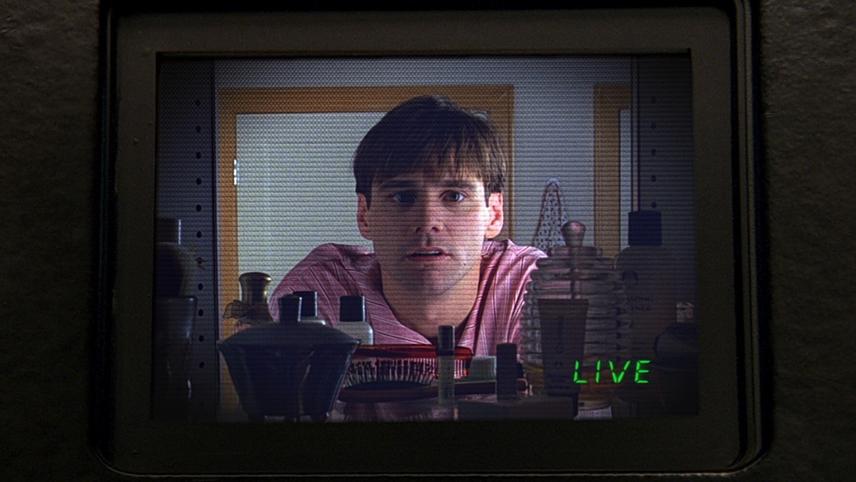
Throughout The Truman Show, we see the audience. The people watching Truman’s life on their televisions. The two old women on the couch, clutching cushions. The man in the bathtub. The waitresses at the bar. The security guards. They gasp when Truman is in danger. They cry when he is sad. They cheer when he stands up to his manufactured world.
They love him.
And they will not turn off the television.
Weir films these audience members with a warmth that is almost affectionate, and that warmth is the sharpest knife in the film. Because these people are not villains. They are not complicit in the way Christof is complicit. They haven’t designed the cage. They haven’t scripted the lies. They are just watching. They are just emotionally invested. They just want to see what happens next.
They are us.
The film knows this. And it knows that we know this. And it lets the knowledge sit there, between us and the screen, without ever becoming preachy about it. Weir never has a character turn to the camera and say, “You’re no different.” He doesn’t need to. The structure of the film does the work. Every time we laugh at Truman’s confusion, every time we root for his awakening, we are performing exactly the same act as the audience inside the film.
We are watching a man’s life for entertainment. And we are calling it empathy.
Christof as God, and the God Problem
“I am the creator of a television show that gives hope and joy and inspiration to millions.”
Christof says this without irony. And the film, remarkably, does not entirely disagree.
There is a scene late in the film where Christof speaks to Truman directly for the first time. Truman has reached the edge of his world. He has sailed across the artificial ocean, survived a manufactured storm, and touched the painted sky. And Christof, his voice booming from above, his face on a screen shaped like the sun, says: “I know you better than you know yourself.”
The framing is unmistakable. This is God speaking to his creation. The dialogue is theological. The imagery is theological. The entire scene is structured as a conversation between a man and his maker.
But here’s the part that doesn’t get discussed enough.
Christof might be right.
He does know Truman. He has watched him every day for thirty years. He has seen every fear, every joy, every private moment. He knows Truman’s dreams. He knows Truman’s patterns. He has shaped the very conditions that produced Truman’s personality. In a clinical, comprehensive sense, Christof’s knowledge of Truman is total.
And it is also worthless.
Because knowledge without consent is not intimacy. It is surveillance. And surveillance, no matter how detailed, no matter how long-sustained, never crosses the threshold into love. This is the film’s deepest theological argument, smuggled inside a summer blockbuster. That God’s omniscience, if it exists, does not automatically produce a relationship. That being watched is not the same as being known. That being provided for is not the same as being free.
The film poses this argument and then walks away from it. It lets Truman bow and exit through the door in the sky. It gives us the catharsis. But the question stays behind, vibrating in the empty set.
The Door in the Sky
Truman walks through the door. The audience inside the film cheers. The audience watching the film cheers.
And then what?
This is the silence that matches Shawshank’s silence. Andy reaches Zihuatanejo and the film ends. Truman reaches the exit and the film ends. Both films close on the image of freedom without ever showing us what freedom actually costs.
But The Truman Show is slightly more honest about this. Because in its final moments, after the cheering stops, the two old women on the couch look at each other and say: “What else is on?”
They change the channel.
Truman’s liberation, the event that consumed him, that cost him everything he believed was real, is for his audience a momentary emotional experience. A season finale. They felt deeply. They cheered sincerely. And now they want something new to watch.
If that doesn’t chill you, watch the scene again.
Because the film is saying something brutal about the nature of spectatorship. That our emotional investment in other people’s suffering, no matter how genuine it feels, is always, at some level, consumptive. We take it in. We are moved. We move on. And the person who actually lived through it is left standing on the other side of the door, alone, in a world they have never been prepared for, while we look for the next story.
What Truman Doesn’t Know
The film’s final, most radical silence is about Truman himself.
He walks through the door. He is free. But free to do what? He has no education that wasn’t scripted. No social skills that weren’t shaped by actors. No understanding of money, of danger, of how cities work, of how strangers behave. He has never met a person who wasn’t paid to interact with him. He has never experienced weather that wasn’t manufactured.
Truman Burbank, at thirty years old, is walking into a world he is spectacularly unprepared for. He is, in terms of lived experience, a newborn.
The film frames his exit as triumph. But triumph and catastrophe, in this story, are separated by nothing more than where you choose to stop watching.
And we all choose to stop watching at the moment that feels best.
Why It Still Matters
The Truman Show was released in 1998. Since then, we have built Seahaven for real.
Social media platforms that reward performance over authenticity. Algorithms that construct personalized realities. Influencers who monetize their most intimate moments. The slow, ambient awareness that someone, somewhere, might be watching. The uneasy sense that our choices are being shaped by systems we can feel but cannot see.
Truman’s prison was built by a visionary with a God complex. Ours was built by committees, by code, by quarterly earnings reports. The walls are not painted to look like sky. They are screens. And the door in the wall is always there, always visible, always one click away.
We just haven’t walked through it yet.
Or maybe we have, and the two old women on the couch have already changed the channel.
Where This Leads Us
The Truman Show ends with a man walking into reality for the first time. Unprotected. Unsupervised. Alone.
But what if reality itself is the performance? What if there is no door in the sky because the sky is real and the horror is that nobody built it? What if the world isn’t a stage that someone designed but a joke that no one is telling, and the punchline is that you have to show up every day and pretend it means something?
What if freedom isn’t walking out of the set? What if freedom is learning to perform in a world where everyone is already performing, and the only honest act left is to admit that you’re faking it too?
That’s where we’re going next.