You need to understand what Alfred Hitchcock did.
He didn’t make a horror film. He didn’t make a thriller. He didn’t make a mystery, though there is a mystery in it, or a character study, though it contains one of the most studied characters in American cinema. What he made was an experiment. A controlled, deliberate, meticulously engineered experiment in complicity, designed to answer a single question: how far can you move an audience’s loyalty before they notice it’s been moved?
The answer, it turned out, was all the way.
Psycho is the most influential American film that almost nobody talks about correctly. They talk about the shower scene. They talk about the twist. They talk about Bernard Herrmann’s strings, about Hitchcock’s no-late-admissions policy, about Janet Leigh never taking a shower again. They talk about what the film did to them. They almost never talk about what the film did with them.
Because what Psycho does is use you. It places you inside one character’s guilt, kills that character, and then deposits you inside a murderer’s anxiety, and you go willingly. You don’t resist. You don’t recoil. You lean forward. You start hoping the killer gets away with it. And Hitchcock, sitting behind the camera like Kurtz behind his temple walls, watches you do it and knows exactly what it means.
The Money
The first forty minutes of Psycho are not a horror film. They are a crime film. A heist. A road movie about a woman on the run.
Marion Crane is a secretary in Phoenix. She’s having an affair with Sam Loomis, a man who can’t marry her because he’s buried in debts and alimony. She wants a life they can’t afford. During a Friday afternoon transaction, her boss asks her to deposit forty thousand dollars in cash at the bank. She takes the money and drives.
Janet Leigh plays Marion with a precision that disappears under the surface of what feels like naturalism. Watch her face during the drive. Watch the way her eyes move. She is calculating. She is performing calm while her mind runs scenarios: what if the boss notices before Monday, what if the car dealer reports her, what if the cop who pulled her over calls it in. She is, in every frame, a woman performing normalcy while committing a crime.
She is every character in this series.
She is Amy Dunne before the diary. She is the Kim family folding pizza boxes while rehearsing their con. She is Marion Crane, good secretary, dependable employee, and she has pocketed forty thousand dollars and pointed her car toward a man who doesn’t know she’s coming, carrying stolen money he doesn’t know exists, building a future on a theft she hasn’t confessed.
And you are with her.
This is Hitchcock’s first move. He gives you a protagonist who is committing a felony, and he makes you root for her. Not because you approve of theft. Because the camera is with her. Because her anxiety is your anxiety. Because the cop in the sunglasses is terrifying and the car dealer is suspicious and the rain is coming down and every mile she drives is a mile further into a life she can’t undo, and you feel it in your body: the tight chest, the held breath, the desperate hope that she makes it.
You are already recruited. You don’t know it yet.
The Parlor
She stops at the Bates Motel.
Norman Bates makes her a sandwich. He invites her to the parlor behind the office. They sit among the stuffed birds, Norman’s hobby, and they talk. This scene lasts roughly ten minutes, and it is the most important scene in the film. Not the shower. The parlor.
Because in the parlor, the film tells you everything. It tells you what Norman is, what the house is, what is about to happen. And you don’t hear it. You can’t hear it, because you are still inside Marion’s story, still calculating her escape, still hoping she’ll get back on the road and make it to Sam and start over. Norman is, at this point in your viewing experience, a detour. A pleasant, slightly awkward young man who runs a motel nobody visits. He’s scenery.
But listen to what he says.
He says: a boy’s best friend is his mother. He says: we all go a little mad sometimes. He says that we’re all in our private traps, that we’re born into them, that we scratch and claw but never budge an inch. He describes, in plain language, the architecture of his entire existence: the trap he was born into, the mother he can’t leave, the madness he visits and returns from. He describes the house on the hill. He describes the motel below. He describes the vertical structure that organizes his life the way the Park house organized the Kims’: the past above, preserved and monstrous, and the present below, functional and false.
Marion hears this and suggests he put his mother “someplace.” An institution. Norman’s face changes. Something crosses it, fast and gone, and Anthony Perkins plays the moment with a stillness that contains multitudes. He says: a boy’s best friend is his mother. And he means it. Not as sentiment. As diagnosis. As the description of a condition so total that the distinction between love and imprisonment has ceased to exist.
The parlor scene is the film’s confession. It is Norman’s version of Salieri’s monologue in Amadeus, of Kurtz’s speech about the horror, of Marylin Delpy’s line about trying so hard to be an asshole. It is the moment the film tells you who the real subject is. And you miss it. You miss it because Marion is still alive, because her story is still running, because the money is still in the room, because the narrative contract you signed when the film began, the contract that says the protagonist is the person you follow, is still in force.
For twelve more minutes.
The Shower
Then Hitchcock tears the contract up.
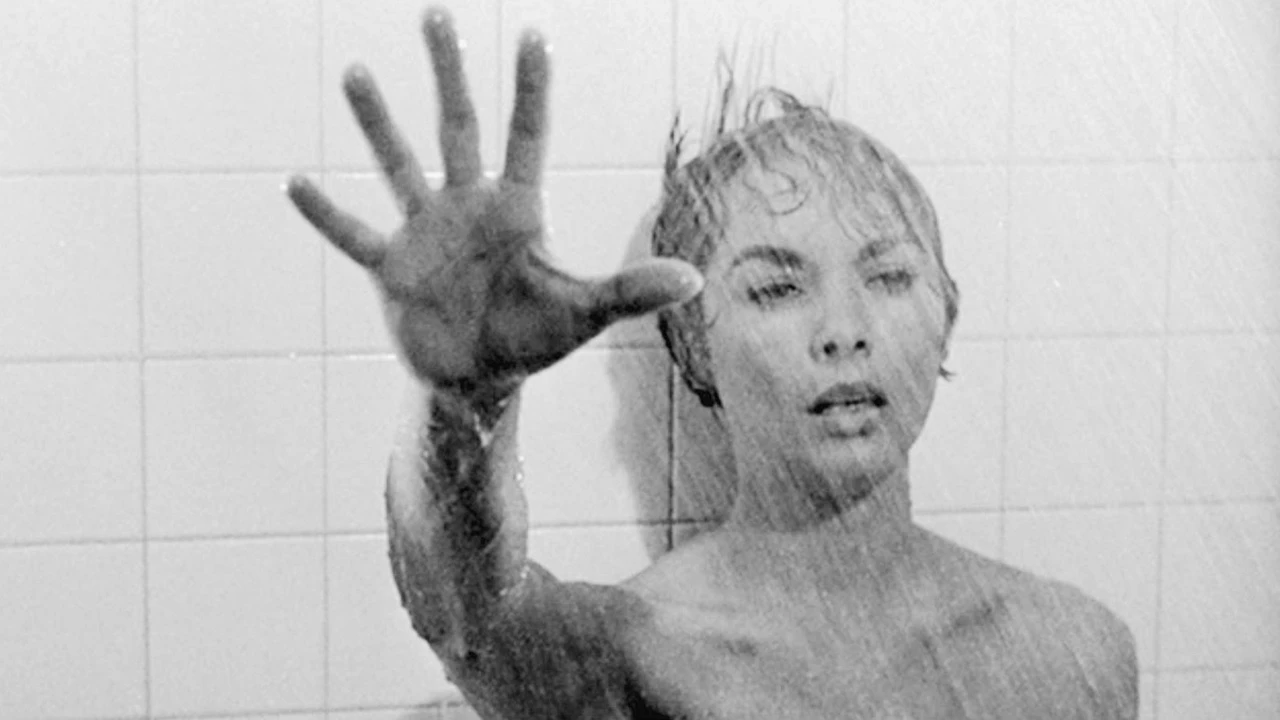
Marion steps into the shower. The curtain is pulled aside. The knife descends. Herrmann’s strings shriek. Seventy camera setups. Forty-five seconds of screen time. Approximately seventy-eight cuts. The most analyzed sequence in cinema history.
And the protagonist is dead.
This is the cut that gives Psycho its power, and it has nothing to do with blood. It is a structural murder. Hitchcock kills the narrative itself. He takes the character you’ve been riding with, the character whose guilt was your guilt, whose anxiety was your anxiety, whose escape was the thing you were invested in, and he removes her from the film. Forty minutes of identification, forty minutes of carefully constructed empathy, and she’s gone. Bleeding out in a bathtub in a motel no one visits.
What are you supposed to do now?
You are audience without a protagonist. You are a viewer without a contract. The story you thought you were watching, a woman on the run with stolen money, has been terminated with extreme prejudice. And into the vacuum that Marion’s death creates, into the space where your loyalty used to live, Norman Bates walks in with a mop and a bucket.
The Cleanup
Here is where Hitchcock completes the recruitment.
Norman finds the body. His face registers shock. Horror. He stands in the doorway and his hands come up to his mouth and he looks like what he is, or what he appears to be: a young man walking into the worst moment of his life, a son whose mother has done something terrible, a person who is afraid.
And then he cleans up.
He wraps the body in the shower curtain. He mops the floor. He puts Marion’s belongings in her car. He puts the body in the trunk. He drives the car to the swamp behind the motel. And he pushes it in.
The car sinks. Slowly. The black water rises around it. It goes down, and down, and then it stops. The car sits there, half-submerged, not quite gone. Norman watches. You watch Norman watching. And somewhere in your chest, something tightens. Because you want it to sink. You want the evidence to disappear. You want Norman to get away with it.
The car sinks the rest of the way.
You feel relief.
You just felt relief at the successful concealment of a murder. Hitchcock put you there. He engineered the identification with Marion, killed her, left you stranded, gave you Norman’s fear as a replacement vessel for your empathy, and then placed you inside the logic of the cleanup. The camera didn’t cut away. The score didn’t moralize. Hitchcock simply let you sit inside Norman’s perspective long enough for Norman’s problem to become your problem, and your nervous system did the rest.
This is what the entire series has been building toward. In Whiplash, you cheered for Andrew’s solo. In Apocalypse Now, you surfed with Kilgore. In The Social Network, you admired Mark’s speed. In every case, the film gave you the spectacle first and the reckoning second. Psycho eliminates the gap. There is no reckoning. There is no moment where the film pulls back and lets you see what you’ve done. The recruitment is permanent. For the rest of the film, you are with Norman. You are rooting for the murderer. And Hitchcock never gives you an exit.
The House
The Bates house stands on a hill above the motel.
It is Victorian. It is dark. Its windows look like eyes. It is, in every visual vocabulary the audience possesses, the haunted house: the Gothic structure where bad things happen, where the past refuses to stay dead, where the architecture itself is the antagonist.
But Hitchcock is doing something more specific than Gothic atmosphere. He is building the same vertical structure that has organized every institutional space in this series. The house is above. The motel is below. Norman moves between them the way the Kims moved between the Park house and their semi-basement, the way Geun-sae lived beneath the floor no one knew about. The house contains the preserved past: Mother’s room, untouched, her clothes in the closet, her impression in the mattress. The motel contains the transactional present: guests checking in, checking out, passing through.
Norman lives in both. He is the corridor. He carries the past down the hill and into the present every time he puts on the dress, the wig, the voice. He carries the present up the hill every time he climbs the stairs to the room where Mother sits by the window. He is, architecturally, the connection between what was and what is, and the connection is killing people.
In The Godfather, the house had an office where the real business happened while the wedding played out in the garden. In Parasite, the house had a sub-basement where someone lived in the dark. The Bates property has the same structure, the same vertical logic: the visible operation below, the hidden truth above, and one person who moves between them, maintaining both, serving both, unable to separate them.
But there is a difference. In every other film, the institution was external. The family, the corporation, the military, the platform. Something out there that consumed the individual. In Psycho, the institution is internal. Mother is not in the house. Mother is in Norman. The house on the hill is a projection of an architecture that exists inside a single mind. The institution has colonized the self so completely that the self no longer exists as a separate entity. There is no Norman without Mother. There is no motel without the house. The consumption is total.
This is where the series’ long argument about institutions arrives at its most intimate and most terrifying conclusion. You can leave a corporation. You can escape a family, sell a house, delete a platform, resign a commission. But you cannot leave a mind. You cannot escape the institution when the institution is the voice in your head, the personality that surfaces when you aren’t looking, the figure in the window that is also you.
The Psychiatrist
After Norman is caught, a psychiatrist explains everything.
He stands in a room full of cops and officials and he delivers a clinical monologue. Norman’s mother died years ago. Norman killed her. He couldn’t bear the guilt, so he preserved her, kept her, gave her a room, gave her a voice, gave her half of his mind. When “Mother” felt threatened by a woman Norman was attracted to, “Mother” killed the woman. Norman didn’t know. Or Norman did know. Or Norman was Mother. The psychiatrist uses words like “dissociative” and “personality” and “matricide” and the words land in the room like cards being dealt, clinical and orderly and entirely inadequate.
Hitchcock includes this scene because the audience expects it. They need the explanation. They need the taxonomy. They need someone in a suit to stand in front of them and translate the horror into language that can be filed and processed and put away.
But the scene doesn’t work. Not because the psychiatrist is wrong. Because the explanation doesn’t reach the thing it’s trying to explain. It describes Norman’s condition the way a blueprint describes a house: accurately, completely, and without any understanding of what it’s like to live inside it. The parlor scene, ten minutes of a young man talking about his mother over sandwiches, told you more about Norman Bates than the psychiatrist’s five-minute monologue. Because the parlor scene let you feel the trap. The psychiatrist only labels it.
This is what institutions do when they encounter something that exceeds their categories. They classify it. They name it. They file it. Oppenheimer’s security hearing reduced a man’s moral anguish to a clearance question. The Corleone family’s rituals reduced murder to business. The military’s briefing reduced Kurtz to “unsound.” And the psychiatrist reduces Norman Bates to a case study. In every instance, the institutional language exists not to illuminate but to contain. To make the unmanageable manageable. To close the door.
The Skull
The final shot.
Norman sits in a cell. He is wrapped in a blanket. He looks at the camera. And Mother’s voice plays over the image, calm and deliberate. She is the one speaking now. She is explaining that she wouldn’t hurt a fly. She’s proving to “them” that she’s harmless. That it was Norman all along. That she, Mother, is the innocent one.
And as the voice speaks, Hitchcock superimposes, for a fraction of a second, the skull of Mother’s preserved corpse over Norman’s face. The living face and the dead face merge. They become one image. Then the film cuts to Marion’s car being pulled from the swamp, and the credits roll.
That superimposition is the film’s thesis in a single frame. There is no Norman. There is no Mother. There is only the composite: the living flesh shaped by the dead architecture, the son who became the institution, the individual consumed so completely that even the face belongs to someone else.
In Fight Club, Tyler Durden was a projection. A fiction the narrator created to do what he couldn’t do himself. But the narrator eventually destroyed Tyler. He shot himself in the cheek and the buildings fell and the fiction collapsed. There was, at least in theory, a person underneath.
Norman has no underneath. The institution goes all the way down. When you peel back Norman, you find Mother. When you peel back Mother, you find Norman. There is no ground floor. There is no authentic self beneath the performance. There is only the performance, repeating, the voice saying she wouldn’t hurt a fly while the skull grins beneath the skin.
This is the endpoint of every identity the series has examined. Tyler Durden, Amy Dunne, Tom Ripley, Riggan Thomson, Arthur Fleck. All of them performed. All of them wore the mask. But all of them, however tenuously, existed beneath it. Norman Bates is what happens when the mask wins. When the institution doesn’t just consume the person but replaces them. When the door doesn’t close on someone else, as it closed on Kay Adams, but closes on the self, from the inside, permanently.
The Director in the Dark
One more thing.
Hitchcock controlled everything. He bought every copy of Robert Bloch’s novel he could find so audiences wouldn’t know the ending. He mandated that no one be admitted after the film started. He filmed a trailer in which he personally guided viewers through the Bates Motel and house, cheerful and avuncular, showing them the rooms where the horrors occurred while revealing nothing. He controlled the marketing, the distribution, the experience. He told audiences when to arrive, what to expect, and what not to tell their friends.
He was the institution.
Hitchcock did to his audience what Mother did to Norman. He constructed the trap, the architecture of identification and transfer and complicity, and he sealed the audience inside it. You went into Psycho as a free viewer. You came out as Hitchcock’s instrument. He decided when you would feel sympathy, when that sympathy would be withdrawn, where it would be redirected, and what it would cost you. He made you want the car to sink. He made you root for the murderer. He made you, for two hours, into exactly the kind of person you went to the movies to feel superior to.
And he did it smiling. Standing in the lobby. Telling you not to reveal the ending.
The filmmaker as the institution. The audience as the subject. The screen as the closed door. This is what Psycho understands that no other film in this series has articulated so purely: the horror isn’t on the screen. The horror is in the seat. It’s in the body watching. It’s in you, sitting in the dark, hoping the car sinks, relieved when it does, and never quite reckoning with what that relief means about who you are when no one is watching.
Where This Leads Us
Psycho made the audience fall for a murderer by accident. By structural coercion. By killing the protagonist and leaving the viewer no one else to hold onto. You didn’t choose to root for Norman. The film didn’t give you a choice.
But what happens when a film does give you a choice? When it presents a monster who is brilliant, cultured, witty, and incarcerated, and it lets you walk right up to the glass and look at him, and it lets you admire him, and it lets you want him to escape, and you do it freely? When the recruitment isn’t coerced but voluntary? When you root for the cannibal not because the film tricked you but because you find him fascinating, and the film knows you will, and it uses your fascination as a mirror?
In 1991, Jonathan Demme made a film about a young FBI trainee sent to interview a man in a basement cell. A man who sees through every performance, who reads people the way an institution reads data, who offers the truth in exchange for intimacy. A man who eats people. And the audience loved him. Not reluctantly. Not through structural coercion. Willingly. Eagerly. With a pleasure the film never lets them disown.
That film is The Silence of the Lambs. And the glass between you and the monster is thinner than you think.