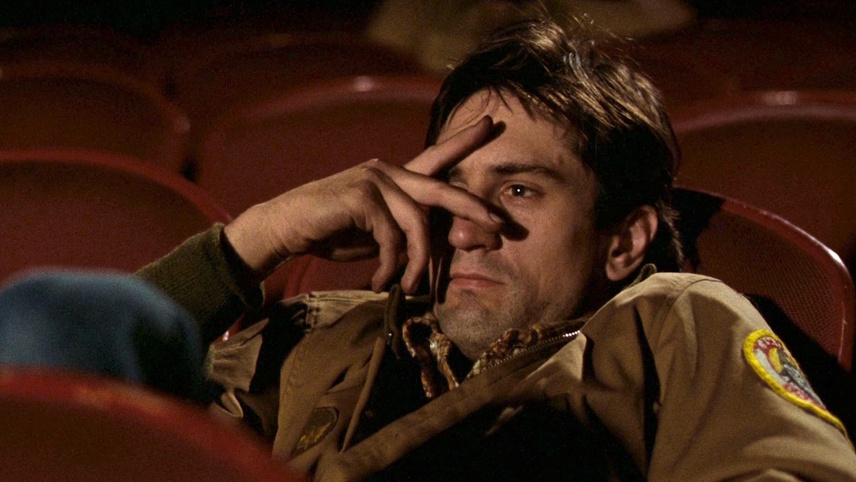
Travis Bickle does not snap.
This is the most important thing to understand about Taxi Driver, and it is the thing almost everyone gets wrong. The popular reading goes something like this: a lonely, disturbed Vietnam veteran drives a cab through the hellscape of 1970s New York, spirals into madness, and eventually explodes in a burst of violence. The film is a character study of a man coming apart.
It’s a clean reading. It’s also completely backwards.
Travis Bickle is not a man who comes apart. He is a man who comes together. From the first frame, he is assembling something. A mission, a narrative, a reason to do what he was always going to do. The violence at the end of Taxi Driver is not a breakdown. It is a completion. Travis finds a story that makes the violence feel necessary, and then he follows it to its logical end, and then the world rewards him for it.
That’s not tragedy. That’s something much worse. That’s the machine working exactly as designed.
The Voiceover
Listen to the voiceover.
Travis keeps a diary. We hear it throughout the film, Scorsese layering his handwriting over shots of the city at night, the cab gliding through steam and neon and garbage. The prose is awful. It is stilted, grandiose, trying to sound like something it read once but can’t quite remember. “Loneliness has followed me my whole life. Everywhere. In bars, in cars, sidewalks, stores, everywhere. There’s no escape.”
Critics have always noted the bad writing. What they less often note is what the bad writing is doing. Travis is narrating himself into a genre. He is trying to be the protagonist of a film noir, or a war memoir, or a vigilante picture. The diary isn’t self-expression. It is self-casting. He is auditioning for a role in a story that doesn’t exist yet, and the audition requires a particular kind of language: brooding, world-weary, implying depth.
This connects directly to where we just came from. Diane Selwyn built Betty as the version of herself who could survive Hollywood. Travis Bickle builds Travis Bickle. The voiceover is his dream. It is the story he is telling himself about who he is, and that story requires a city full of filth, and a righteous man who stands apart from it, and an inevitable confrontation.
The city cooperates. 1970s New York cooperates with almost any dark story you want to project onto it. But the filth Travis sees is not simply observed. It is curated. He drives past the same streets, the same sex workers, the same hustlers, and each circuit confirms the narrative he needs. The city is his evidence. He is building a case, and the defendant is everything outside the cab.
The Two Women
Travis encounters two women who define the shape of his story. They are not characters to him. They are roles.
Betsy works for Senator Charles Palantine’s presidential campaign. She is blonde, composed, and moves through the world with the kind of easy confidence that Travis registers as purity. He watches her through the window of the campaign office before he approaches. He takes her to a movie, makes the catastrophic choice of a porn theater, and loses her. She stops returning his calls.
A man without Travis’s particular engine would absorb this as an embarrassment. A bad date. A misreading of social cues. But Travis is not processing events. He is processing a narrative, and in the narrative, Betsy’s rejection is not a consequence of his own misjudgment. It is proof of the world’s corruption. She was supposed to be the reward for his righteousness. She was supposed to see him the way he sees himself. When she doesn’t, the fault transfers to the world.
Then Iris.
Iris is twelve years old. She is a sex worker controlled by a pimp named Sport. Travis encounters her briefly when she tries to get into his cab and Sport pulls her back. He could have driven on. He could have called someone. Instead, Iris becomes the replacement for Betsy in the narrative. She becomes the innocent he will save.
Watch how the film handles this substitution. It is not accidental, and Scorsese does not endorse it. Travis doesn’t rescue Iris because he cares about Iris. He rescues Iris because the story he is telling himself requires an object of salvation. Betsy was supposed to be that object but she turned out to be a person, which ruined it. Iris, in Travis’s narrative, is not a person. She is a function. She is the thing that makes the violence righteous.
This is the mechanism that Taxi Driver exposes more clearly than any film in this series: the hero narrative requires a victim. Not a victim who has asked for help. Not a victim whose agency is respected. A victim who exists, in the hero’s story, to justify what the hero was going to do anyway.
The Mirror
“You talkin’ to me?”
It is the most quoted line in the film, possibly in American cinema. Robert De Niro, shirtless, in front of his mirror, rehearsing a confrontation with an imaginary adversary. Drawing a gun. Perfecting the gesture. The scene is usually read as improvisation, as madness, as Travis losing his grip.
It is none of those things. It is a rehearsal.
Travis is practicing. He is not spiraling. He is preparing. The mirror scene is not the moment he breaks. It is the moment the performance is nearly ready. He has the weapons. He has the body (newly mohawked, stripped down, hardened). He has the target (first Palantine, then Sport). All he needs is the right delivery.
And notice who he’s talking to. He is talking to his own reflection. He is performing for himself. The entire scene is a man who has built a story about who he is and is now rehearsing the climactic scene, and there is no audience except the mirror, and the mirror always agrees.
This connects to a thread this series has pulled at since Fight Club. The Narrator created Tyler Durden. Nina rehearsed the Black Swan. Diane dreamed Betty’s audition. In each case, the invented self requires a performance, and the performance requires a mirror, and the mirror does not talk back. The mirror does not say: you are a lonely man with no social skills who bought guns because a woman wouldn’t return your calls. The mirror says: you talkin’ to me?
The mirror is always on your side.
The Veteran
Here is the thing the film almost says but never quite does, the thing Scorsese leaves for you to assemble.
Travis is a Vietnam veteran. He can’t sleep. He watches violent films in empty theaters. He has no friends, no community, no one who knows him. He moves through the city like a ghost in a machine, sealed inside the cab, watching the world through glass.
The film never shows us Vietnam. Not a single flashback. Not a single explicit trauma. This is a deliberate structural choice and it is the key to the film’s power.
Because what Vietnam gave Travis is not damage. It is a skill set.
He can handle weapons. He knows how to modify them, conceal them, maintain them. He has the physical capacity for violence. He has the training. What he does not have is a context. In Vietnam, the context was provided. There was a mission, an enemy, a structure that told you where to point the gun. Back in New York, the skill set remains but the context is gone.
Travis is not a man who was broken by war and now cannot function. Travis is a man who was trained by war and now cannot stop functioning. The machine is still running. It just needs a target.
This is the unspoken argument about institutional violence that connects Taxi Driver to Apocalypse Now, which this series examined at Film 20. Willard goes upriver into the heart of military madness and finds Kurtz, who has stopped pretending the violence has a purpose. Travis comes home from the same war and desperately needs the violence to have a purpose. They are opposite responses to the same institutional betrayal: the military trained us to kill and then expected us to stop.
Kurtz drops the pretense. Travis doubles down on it. He doesn’t need less narrative. He needs more. He needs the filth, the innocence, the rescue, the showdown. He needs the structure that war provided and peace took away.
The cab is his patrol boat. The city is his river. And somewhere upstream, there is always a compound to raid.
Palantine
Travis’s first target is Senator Charles Palantine.
This is the part of the film that people tend to rush past to get to the Sport sequence, but it is essential. Travis goes to a Palantine rally. He has a gun. He is ready. He is going to assassinate a presidential candidate.
Why?
Not for any political reason. Travis has no politics. When he drives Palantine in his cab earlier in the film, he can barely articulate a position. He gestures at the filth, the crime, the city’s decline, but there is no ideology. There is no program. There is only the feeling that someone should do something, and the conviction that he is that someone.
The assassination attempt fails. Secret Service agents spot him and he flees. And here is the turn that the film makes so quietly that its full horror takes years to register.
Travis simply redirects.
He was going to kill a senator. Now he will kill a pimp. The target changes. The narrative adjusts. The violence was always the constant. The story wraps itself around whatever target is available. Palantine or Sport, it doesn’t matter. What matters is the climax. What matters is the moment when the gun goes off and the story completes and Travis Bickle becomes, at last, the thing he has been rehearsing in the mirror.
This is the most chilling thing in the film. The target is interchangeable. The righteousness is not attached to the cause. It is attached to the self. Travis doesn’t care about political corruption or child exploitation in any meaningful sense. He cares about being the man who acts. The victim, the villain, the context are all furniture. The only thing that’s real is the gun and the man holding it.
The Bloodbath
The final sequence is among the most violent in 1970s American cinema. Travis enters the building where Sport operates. He shoots Sport. He goes upstairs. He shoots the mafioso at the door. He enters the room where Iris is with a client. More shooting. A knife. Blood on the walls, the ceiling, Travis’s face. Bodies everywhere. Travis, wounded, sits on a couch and puts a bloody finger to his temple, miming a gun, pulling an invisible trigger. Click. Click. Click.
He wants to die. He cannot even accomplish that.
And then Scorsese does the thing that elevates Taxi Driver from a great character study to one of the most disturbing American films ever made.
He shows us the aftermath.
The camera glides over the crime scene from above, a slow God’s-eye view, retracing the path of carnage. It is a tour of the violence, almost reverential, and it leads us out of the building and onto the street, where we find newspaper clippings pinned to Travis’s wall.
He is a hero.
The papers celebrate him. “Taxi Driver Battles Gangsters.” A grateful father has written a letter thanking him for saving Iris. Iris has gone home to her parents. Travis is back driving the cab. His colleagues treat him with a new, faintly awed respect.
The system looked at what Travis did and called it heroism.
The Reward
This is where the film becomes truly unforgivable, in the best sense.
Betsy gets in the cab.
She has read the articles. She looks at Travis differently now. There is something in her eyes, a new interest, maybe respect, maybe attraction. Travis is polite. He drives her where she needs to go. He doesn’t charge her. He pulls away. In the rearview mirror, he glances at his own reflection.
The story worked.
The narrative Travis constructed, the lonely righteous man in a city of filth who rescues the innocent through violence, has been validated by every institution that matters. The press. The family. The law (no charges). And now the woman who rejected him. The story worked because the outcome happened to land on a target the world could agree deserved it. If the Secret Service hadn’t spotted him at the rally, if the bullet had hit Palantine instead of Sport, the same man with the same motivations and the same diary and the same mirror rehearsal would be an assassin instead of a hero.
The distance between Travis Bickle, American Hero, and Travis Bickle, Presidential Assassin, is one afternoon and one failed security checkpoint.
Scorsese knows this. The film knows this. The question is whether the audience does.
And here is the connection to the series’ long thread of audience complicity. In Whiplash, the audience applauds genius purchased through abuse. In Psycho, Hitchcock makes you clean up after Norman. In The Silence of the Lambs, you voluntarily ally with the cannibal. In Mulholland Drive, you prefer the dream because the dreamer does.
In Taxi Driver, Scorsese lets the world reward the violence you just watched. He gives you newspaper clippings and a grateful family and Betsy’s changed expression and asks you: do you also feel the pull? Do you also want the story to have worked? Do you also feel, somewhere beneath your better judgment, that Travis did a good thing?
If you do, the film has diagnosed you.
The City That Doesn’t See You
Pull back from Travis for a moment and look at the city.
Scorsese and cinematographer Michael Chapman shoot 1970s New York as a kind of organism. The steam from the manhole covers, the neon reflected in wet asphalt, the crowds that flow around the cab like water around a stone. The city is alive and indifferent. It is not hostile toward Travis. It simply does not register him.
This is the institutional violence that Taxi Driver identifies more precisely than almost any film in this series. The institution here is not a corporation, a family, a government, or a bathhouse. The institution is the city itself. And the city’s violence is not what it does to you. It is that it doesn’t do anything to you. It doesn’t notice you. It doesn’t care.
Every institution this series has examined offers a bargain, even a predatory one. Hollywood told Diane she could be a star. The Overlook Hotel will tell Jack Torrance he was always the caretaker. The bathhouse told Chihiro she could work and eventually leave. These bargains are exploitative, but they are bargains. They are a form of recognition, however warped.
New York offers Travis nothing. No bargain. No recognition. No name, not even a wrong one. He is a cab driver. He drives. He goes home. He drives again. The city takes his labor and gives him back nothing but a windshield view of everything he isn’t part of.
The violence that follows is not a response to oppression. It is a response to invisibility. Travis would rather be notorious than anonymous. He would rather be a killer the city has to reckon with than a driver the city will never see.
This is the dark underside of the Spirited Away principle. Yubaba takes your name, and the task is to remember it. But what if no one ever asked your name in the first place? What if the institution didn’t bother to rename you because you weren’t worth naming?
That is the wound Travis carries. Not what the city did to him, but what it didn’t.
The Hero’s Story Is the Most Dangerous Dream
Mulholland Drive showed us a woman who built a dream because the truth was unsurvivable. The dream was private, internal, a last mercy before the end.
Taxi Driver shows the other version. Travis builds a story too, but his story has a body count. His dream goes outward. It requires victims and a stage and an audience, and the audience cooperates, because the hero narrative is the most seductive structure a culture has.
We know this story. The lone man. The corrupt world. The decisive act. The rescue. We know it from Westerns, from war films, from superhero cinema, from a thousand action movies that followed Taxi Driver and learned all the wrong lessons from it. We know it because it is, in some sense, the American story. The individual who sees what others won’t and does what others can’t.
Scorsese’s genius is to give us this story with perfect fidelity and let us sit with the fact that the man at its center is building the narrative around a hollow core. There is no moral vision. There is no genuine empathy. There is only the need for the climax, and the willingness to arrange everything, the filth, the innocence, the target, so that the climax feels earned.
Travis Bickle is the hero of his own movie. That is the most terrifying sentence in American cinema.
Where This Leads Us
There is a hotel in Colorado where a man goes to write.
He has a story about himself too. He is a writer, a father, a provider. He has brought his family to a grand, empty building where he will finally produce the work that justifies his existence. The institution is beautiful, vast, and older than he is, and it has been waiting for him, and it agrees with the worst things he suspects about himself.
If Taxi Driver is about a man who builds his own story in a city that refuses to give him one, the next film is about a man who walks into an institution that has a story ready-made. All he has to do is step into it. All it will cost is everything.