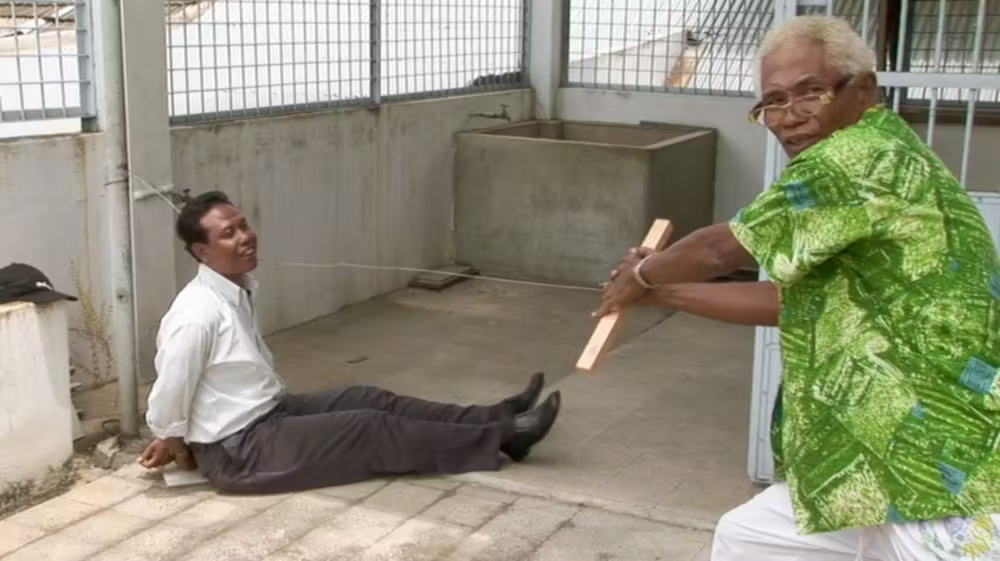
Joshua Oppenheimer gave perpetrators a camera and waited for performance to produce conscience. He did not notice what it produced first.
We open on a waterfall. Two giant fish emerge from the rocks — men in fish costumes, shimmering, surreal — and a woman in gold descends from a platform in the cascade. A man in white receives a medal from her. He is smiling. The scene is ecstatic, operatic, completely unhinged. He choreographed this himself. He chose the costumes. He decided the waterfall needed the fish. The woman in gold is thanking him, on behalf of all the souls he sent to a better place, for the courage and grace with which he delivered them there. This is his vision of what his life deserves.
His name is Anwar Congo, and he is one of the leaders of the death squads that killed an estimated one million alleged communists in Indonesia in 1965 and 1966. He has never been tried for anything.
| Director | Joshua Oppenheimer |
|---|---|
| Year | 2012 |
| Runtime | 115 minutes (Director’s Cut: 159 minutes) |
| Cast | Anwar Congo, Herman Koto, Adi Zulkadry |
| Award | BAFTA for Best Documentary; 83 international awards |
| Streaming | MUBI, Criterion Channel |
Joshua Oppenheimer’s The Act of Killing (2012) began when he was making a film about survivors of the 1965 Indonesian genocide and found, to his astonishment, that the perpetrators were not in hiding. They were celebrated. Anwar Congo and his associates — members of the paramilitary group Pancasila Youth, men who had tortured and strangled and shot their way through the anti-communist purge under Suharto — were local celebrities, boasting openly to grandchildren and journalists about their methods. Oppenheimer’s response was, by any conventional measure, perverse: he asked them to re-enact their killings on camera, in whatever cinematic genre they chose. They could be gangsters, cowboys, film noir detectives, musical performers. They could write the scripts, design the costumes, direct the sequences. He would film them doing it. The film won the BAFTA for best documentary and eighty-three other awards internationally. Errol Morris and Werner Herzog served as executive producers. It was called, by widespread critical agreement, one of the most important documentaries ever made.
The previous review on this blog described The Act of Killing as a film that discovers “some truths, once performed, cannot be contained.” That was accurate, and it was also, on reflection, too comfortable. It described the film’s final promise without examining what the film required the audience to accept in exchange for that promise. The truth that cannot be contained arrives in the film’s last ten minutes. What the film required the audience to accept for the preceding hundred minutes was something quite different, and the film never asked whether that acceptance had a price.
The proof is in how the film makes you feel during the re-enactment sequences, and the answer is: fascinated. The gangster sequence is genuinely compelling cinema. The musical waterfall number is one of the most bewildering and inventive images in contemporary documentary. The film-within-a-film passages, in which Anwar and his friends dress as their victims and are subjected to the interrogation techniques they themselves once used, generate a vertiginous tension that no scripted thriller has managed with equivalent economy. Oppenheimer is a gifted filmmaker and he is making gifted cinema, and it happens to be about men who murdered hundreds of thousands of people, and for most of the film’s runtime you are watching their creative process with something very close to aesthetic delight. The film never submits this delight for inspection. It never asks what it means that Anwar Congo’s re-enactments are interesting, that his mise en scène is inventive, that his casting instincts are sound. It never asks what the audience is when the audience is this appreciative. For two hours, The Act of Killing was the most attentive, most engaged, most aesthetically responsive collaborator Anwar Congo ever had. The film cannot see this. It believes the collaboration was a vehicle for eventual reckoning. It does not see that the vehicle was also the destination, and that a great many people arrived there and got comfortable before the reckoning showed up.
The film waited for performance to crack a perpetrator open. It did not ask what performance was doing to the audience in the meantime.
The final scene is real, and it matters. Anwar Congo, back on the rooftop in Medan where he killed people, where he worked out the wire-garrotte method because shooting made too much mess, begins to retch. His body overrides his mind’s long insistence on the virtue of what he did. The retching is involuntary and prolonged and the camera stays with it without comment. Oppenheimer, in interviews, has said this was the moment the film had been building toward: the body finally knowing what the conscious mind had refused. It is genuinely moving. It is also, after everything that preceded it, the ending of a very particular kind of film — the kind that structures itself around a conversion it cannot guarantee and then, when the conversion partially arrives, presents it as the argument rather than as one data point inside a much more complicated picture. Anwar Congo retches on the rooftop. He does not go to prison. He does not confess publicly. He does not face any consequence. The retching is private, involuntary, and complete. Then the film ends.
What the film cannot see — what it needed to look at directly and did not — is Adi Zulkadry. Adi is Anwar’s old friend, fellow death squad leader, co-architect of the killings. He appears in the film’s first half with disquieting composure: reflective, articulate, entirely untroubled. He says, at one point, with the calm of a man discussing an accounting principle, that war crimes are defined by the winners, and that he is simply not a loser who had to accept that definition. He is not performing impunity. He has simply thought it through, arrived at a conclusion, and moved on. He is not in denial. He is in resolution. When Oppenheimer presses him — are there ever nightmares, moments of doubt — he considers the question with apparent sincerity and says no. Not really. He seems like he is telling the truth. And then, quietly, without announcement, Adi disappears from the film. He is not in the later re-enactment sequences. He is not present for the final rooftop scene. The film loses him somewhere in its second half and does not acknowledge the loss.
His disappearance is the film’s most telling structural decision, made without being acknowledged as a decision. The whole architecture of The Act of Killing rests on the theory that staging the act will eventually produce self-confrontation: that if you ask a man to direct a re-enactment of his own atrocities, the performance will open something in him that impunity has sealed. Anwar Congo, with his nightmares and his physical fragility and his genuinely unresolved relationship to what he did, is the subject through whom this theory can be tested. Adi Zulkadry is the subject through whom it fails. He is more articulate than Anwar about what he did. He is more intellectually honest about its political context. And he is completely, permanently, unreachably fine. The film could not use him, so it let him go, and in letting him go it quietly excised its own most important counter-evidence from the record.
Shoah, reviewed on this blog, was built on Lanzmann’s conviction that testimony returned to the conditions of its origin could deliver what the archive could not: the irreducible fact of a living body that was present, and knows, and carries it. Oppenheimer took that conviction and asked whether it applied to perpetrators as well as survivors — whether staging could open a perpetrator the way Lanzmann believed return opened a witness. Shoah never tried this. It interviewed perpetrators, but only for what they knew, not for what they felt, not to produce breakdown. Oppenheimer’s film goes further, and in going further discovers both more and less than Lanzmann found. More: that performance can, in at least one body, eventually override the will. Less: that it reliably does so, that it does so without significant cost, and that the filmmaker’s collaboration in the performance is ethically neutral. Between these two documentaries, the question of what cinema can do with atrocity has been asked more seriously than anywhere else in film history. Neither film has finished answering it.
Oppenheimer’s second film, The Look of Silence (2014), illuminates The Act of Killing more sharply than any critical argument can. Where The Act of Killing centred the perpetrators, The Look of Silence follows Adi — a different Adi, an optometrist whose brother was killed in the purge — as he sits across from the men who murdered his brother and asks them, quietly, to account for themselves. They cannot. The scene in which he examines the eyes of the man who drank his brother’s blood, while the man explains on camera that drinking blood prevented madness, is the most unbearable scene in either film, and it is unbearable in a different register entirely: not because a perpetrator is being creative with his crimes, but because a survivor is being patient with a man who has no language for what he did. The two films are the same event seen from opposite seats at a table that should never have been a table. Together, they are one of the most serious arguments cinema has made about what justice looks like when justice is not available. Separately, The Act of Killing is the more famous, more celebrated, more aesthetically extraordinary film. The Look of Silence is the more honest one, because it never lost Adi.
The Act of Killing is a film about whether conscience can be ambushed by art. The answer it arrives at is yes, once, on a rooftop, in a body that retched and then recovered and then went on living the same life. That is not nothing. That is not a small thing. But the film spent two hours making the audience genuinely interested in a murderer’s creative vision, and it never asked whether being that interested was itself a position, and whether the position required examination. The retching on the rooftop is real. So is everything the audience felt before it arrived.
If this stayed with you, watch these next:
The Look of Silence (Joshua Oppenheimer, 2014): Oppenheimer’s companion film, centred not on the perpetrators but on the optometrist brother of a victim, sitting across from the men who killed his family and asking them to see what they did — the film that illuminates The Act of Killing by showing everything the first film chose not to centre, and which is, quietly, the more devastating of the two.
Shoah (Claude Lanzmann, 1985): our review is on this blog — the film that asked what testimony could do that the archive could not, and whose answer Oppenheimer extended, tested, and partially contradicted; taken together, the two films form the most rigorous argument in documentary cinema about whether the truth of atrocity can be produced on camera, and what is lost or distorted in the production.
UnspokenCinema publishes every week. No ratings. No rankings. Just what films reveal without meaning to.