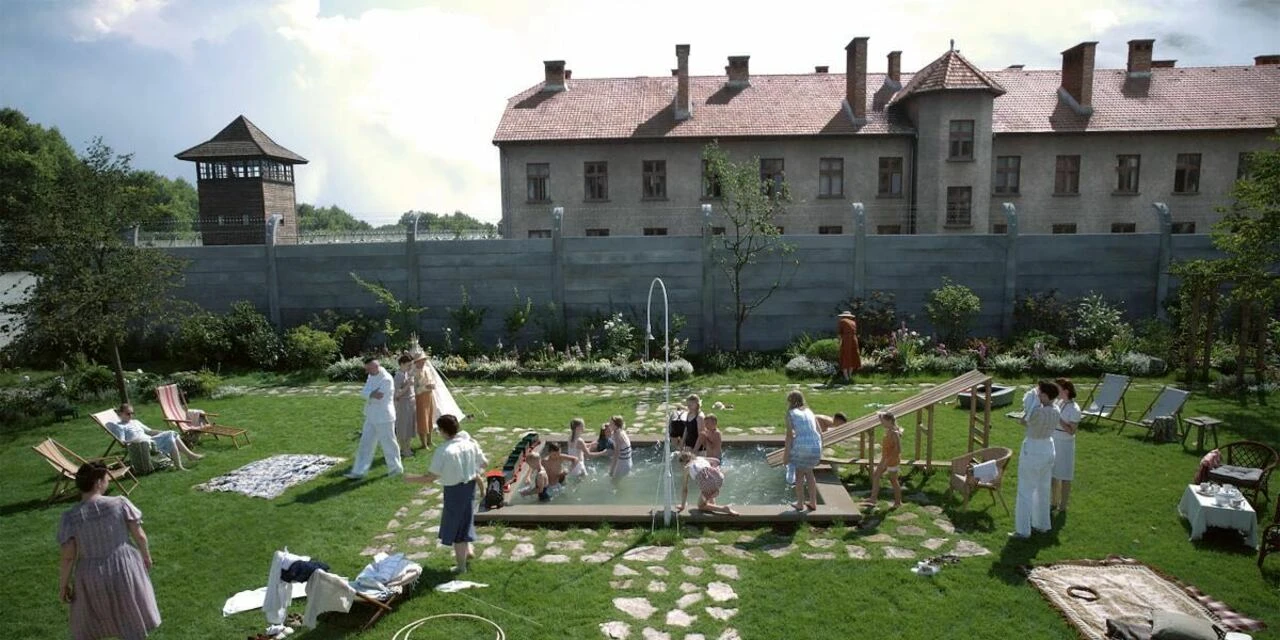
A Family Tends Their Garden. The Film Never Crosses Over. Neither Do They.
A Dossier on The Zone of Interest (Jonathan Glazer, 2023)
The film opens on a black screen. Two minutes. No image. Only sound — Mica Levi’s score, a low choral drone that seems to rise from underground, as if the earth is humming a frequency too deep for language. You sit in the dark and you wait, and the waiting is the first act of the film, because The Zone of Interest is a film about what you do while something unbearable is happening just beyond the edge of your attention.
Then light. A family by a river. A picnic. Summer. Children splashing. A mother drying a toddler with a towel. A father lying on the grass with his eyes closed. It is the most ordinary image in the world. It could be any family, anywhere, in any decade.
The father is Rudolf Höss, commandant of Auschwitz. The river is in Poland. The year is 1943. The garden they will return to shares a wall with the camp.
WHAT THE CAMERA SEES
Jonathan Glazer embedded up to ten cameras in and around the Höss house and ran them simultaneously, with no crew on set. The actors — Christian Friedel as Rudolf, Sandra Hüller as Hedwig — improvised within the domestic space, cooking, gardening, bathing children, arguing about furniture. Glazer watched from a separate building on monitors, like a nature documentarian observing an animal in its habitat.
The result is a film that looks like nothing else in cinema. No close-ups. No reaction shots. No score cuing you toward emotion. The camera sits in the corner of a room the way a security camera sits, or the way a conscience might sit if it had given up trying to intervene. It records. It does not comment. It watches Hedwig arrange flowers while, on the soundtrack — faintly, persistently, like tinnitus you can’t shake — you hear a scream.
This is the formal principle of the entire film: you see the garden; you hear the camp. The wall divides not just two physical spaces but two cinematic modes. On this side, image — domestic, sunlit, banal. On the other side, sound — gunshots, dogs, the industrial drone of the crematorium, the low rumble of arriving trains. Glazer never crosses the wall. Not once. The camera stays in the garden, in the kitchen, in the children’s bedroom. What is happening fifty metres away — the mechanised murder of over a million people — is present only as acoustic residue bleeding through stone.
“There are two films here: one you hear and one you see.” — Jonathan Glazer
WHAT THE FILM REFUSES
Nine dossiers have preceded this one on Unspoken Cinema, and each has examined a different species of withholding. Five Easy Pieces withheld Bobby Dupea from his own life. Burning withheld the answer to whether Ben was a killer. Caché withheld the sender of the tapes. Mulholland Drive withheld the border between dream and waking. Picnic at Hanging Rock withheld the girls. Stalker withheld nothing — the Room was open, and the men withheld themselves from entering.
The Zone of Interest does something none of them did. It withholds atrocity. It places the most documented horror of the twentieth century on the other side of a wall and refuses to show you a single frame of it. No gas chambers. No selections. No bodies. No emaciated prisoners. No liberation footage. Nothing.
Glazer has said that we have become desensitised to the imagery of the Holocaust — that showing it again, using actors and extras to re-enact it, would produce not understanding but a kind of aesthetic consumption. The images are seared into collective consciousness already. To reproduce them would be, in some structural sense, to manage them — to give the audience the catharsis of witnessing and the relief of having witnessed. The Zone of Interest denies you that relief. It gives you a garden. It gives you tulips and a greenhouse and a swimming pool and children playing, and behind all of it, beneath all of it, inside the very air of it, the sound of mass murder at industrial scale.
The effect is almost unbearable, and the reason it is unbearable is that the film has placed you exactly where the Höss family stands — on this side of the wall, hearing everything, seeing nothing, and continuing with your afternoon.
HEDWIG’S GARDEN
Hedwig Höss does not want to leave.
This is the film’s only dramatic event, if you can call it that. Rudolf is transferred to another camp. Hedwig would have to leave the house, the garden, the life she has built. She refuses. She tells Rudolf she would have to be dragged out. She calls herself “the Queen of Auschwitz.” She has her mother visit. She shows her the garden. She shows her the greenhouse. She shows her the wall, beyond which smoke rises in a column so constant it has become weather.
Sandra Hüller plays Hedwig not as a monster but as something far more disturbing: a woman who is genuinely, sincerely proud of what she has built. The garden is beautiful. The flowers are real. The children are healthy. The house runs well. Hedwig has constructed, through domestic labour and aesthetic attention, a life of comfort and order — and the film refuses to distinguish between her pride and the pride of any person who has built something good with their hands. The tulips do not know what is on the other side of the wall. Neither does the greenhouse. Neither, in some fundamental sense, does Hedwig — not because she lacks information, but because she has perfected the art of not converting information into knowledge.
In Caché, Georges Laurent built a book-lined bourgeois life on the suppression of a childhood cruelty. The dossier on that film argued that not-looking is itself a form of violence. Hedwig is Georges taken to the absolute limit. She is not suppressing a single act of childhood betrayal. She is tending a garden adjacent to a death factory, and the distance between those two activities — gardening and genocide — has collapsed to zero, and she experiences no friction whatsoever. She is not in denial. Denial implies a truth pressing against a membrane. Hedwig has removed the membrane entirely. She lives on one side of the wall, and she has arranged her interior life so that the wall is not a boundary she is aware of crossing or not crossing. It is simply the edge of the garden.
WHAT THE CHILDREN HEAR
The children play. They swim. They fight. One boy locks his younger brother in the greenhouse and turns off the light, and the smaller child screams, and it’s the ordinary cruelty of siblings that you’ve seen a thousand times in a thousand homes. The children seem healthy, normal, well-adjusted. The worst you can say about any of them is that they are children.
But there is a scene — quiet, almost invisible — in which one of the boys plays with a collection of teeth. Gold teeth. He examines them the way a child examines any collection of small, interesting objects: with focus, without context. He does not know what they are. Or he does know, in the way that children know things they’ve been given no language for — the way Ana Torrent in The Spirit of the Beehive knew that the adults were hiding something but couldn’t name what, the way children absorb the shape of a silence before they understand its content.
Erice’s film was about a child trying to read a world that had stopped explaining itself. The Zone of Interest is about children growing up inside an explanation so monstrous that it has become invisible through repetition. Ana searched for the monster. The Höss children live with the monster and do not recognise it as such, because the monster looks like their father, and their father looks like a man who goes to work in the morning and comes home for dinner and reads them stories before bed. The Spirit of the Beehive asked: what happens to children raised in silence? The Zone of Interest asks something worse: what happens to children raised in noise they’ve been taught not to hear?
THE RETCHING
Near the end of the film, Rudolf Höss walks down a staircase in his Berlin office. He has just received news that he will return to Auschwitz to oversee the acceleration of the killing — the Hungarian transports, the largest and fastest programme of extermination in the camp’s history. He will preside over the murder of approximately 430,000 people in eight weeks.
He stops on the stairs. He retches. His body convulses. He stares into the dark corridor ahead of him. He retches again.
Then he straightens up. He continues down the stairs. He disappears into the darkness.
Glazer has said this scene was inspired by Joshua Oppenheimer’s The Act of Killing, in which a perpetrator of the Indonesian mass killings retches while revisiting the site of his crimes. The body knows what the mind has compartmentalised. The body keeps the score. Höss’s retching is the wall made flesh — the moment when the thing on the other side breaks through, not as conscience or guilt but as a physical reflex, an involuntary spasm of the organism that carries the information the man has refused to hold.
And then it passes. And he keeps walking.
This is the unease that will follow you out of the cinema. Not the retching, which is almost a relief — at least the body responded, at least something registered — but the fact that he keeps walking. The wall rebuilds itself. The garden closes over. The noise returns to its place in the background, indistinguishable from weather.
WHAT YOU HEAR NOW
The film’s final minutes cut to the present day. Cleaning staff vacuum the floors of the Auschwitz-Birkenau State Museum. They dust the glass cases. They mop around the exhibits. They tend the building the way Hedwig tended the garden — with care, with routine, with the quiet professionalism of maintenance.
Glazer has said this sequence came from visiting the museum early one morning and watching the cleaners at work. “It was like they were tending graves,” he said. The present-day sequence is not a postscript. It is the wall’s final trick. It asks: what are you hearing right now, today, in 2026, that you have learned to convert into background noise? What is on the other side of your wall? What atrocity have you arranged your garden around?
The film does not answer. It is not in the business of accusing you. It is in the business of something more terrible: showing you the family on this side of the wall, in all their ordinariness, and trusting you to recognise the resemblance.
The Stalker stood at the threshold of a Room that would reveal his deepest self and couldn’t go in. Chow Mo-wan whispered his secret into a wall at Angkor Wat and sealed it with earth. Bobby Dupea drove away without his jacket. Llewyn Davis played the same song in the same club and walked into the same alley.
The Höss family never left the garden. The wall was always there. The sound was always playing. They simply arranged the flowers so beautifully that they forgot to listen.
You’re listening now. The question is for how long.