Two People Fall in Love. Neither Acts on It. The Film Watches the Gap and Refuses to Close It.
A Dossier on In the Mood for Love (Wong Kar-wai, 2000)
They pass each other on the stairs.
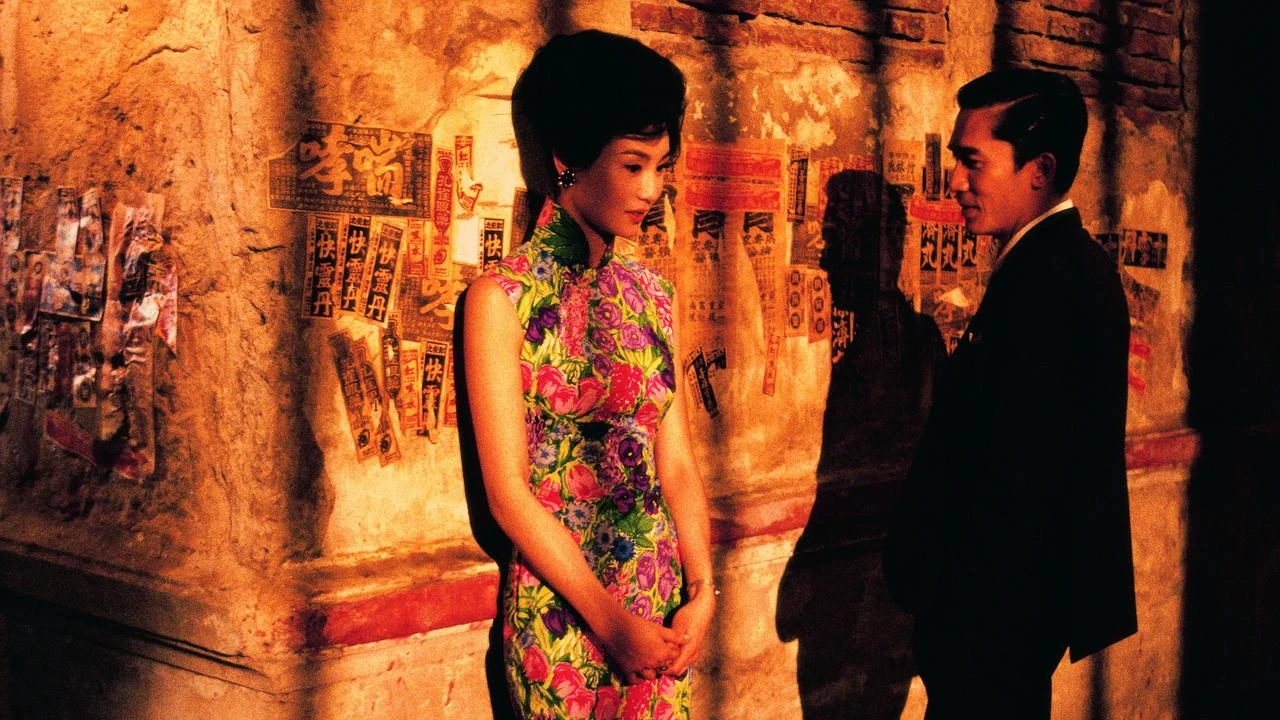
She is carrying a thermos to the noodle shop. He is carrying a thermos to the noodle shop. They live in adjacent rooms in a crowded Hong Kong boardinghouse, 1962. Their spouses are away — always away, always working late, always unavailable — and the narrow staircase is the only space where they exist alone together. She wears a different cheongsam in every scene, each one more beautiful than the last, as if dressing for someone she hasn’t admitted she’s dressing for. He smokes and looks at her with eyes so full of restrained feeling that the smoke seems like the only thing keeping him from saying what he’s thinking.
They pass. They nod. Shigeru Umebayashi’s waltz plays on the soundtrack — a piece of music so saturated with yearning that hearing it once brands it into your memory — and Wong Kar-wai slows the image to half-speed, quarter-speed, until the passing on the stairs becomes a ceremony, a ritual repeated across dozens of evenings, each one fractionally closer than the last and never close enough.
This is In the Mood for Love, and the unease it produces is unlike anything else on this site, because it is not the unease of something withheld by the film or by the world. It is the unease of something withheld by the characters from themselves — deliberately, consciously, at enormous cost, and perhaps, the film seems to whisper, correctly.
Here is what happens, and what doesn’t happen, and how the distance between those two things becomes the most devastating love story in modern cinema.
Chow Mo-wan is a journalist. Su Li-zhen is a secretary at a shipping company. They move into their adjacent rooms on the same day, their furniture colliding in the hallway, their landlords trading gossip across the partition. Their spouses are rarely home. Slowly — and Wong constructs this slowness with a precision that borders on cruelty — they begin to realise that her husband and his wife are having an affair with each other.
The realisation comes not through confrontation but through accumulation. A handbag. A tie. A pair of slippers. The same brand of noodles ordered at the same time from the same place. The evidence is domestic, banal, and for exactly that reason, irrefutable. You cannot argue with a matching handbag. You cannot explain away a tie your husband doesn’t own being worn by the woman next door’s husband in a different city.
Chow and Su begin to meet. They eat together. They talk. They rehearse conversations — practising how to confront their spouses, playing the roles of the unfaithful partners, performing the affair that is happening to them. And somewhere inside these rehearsals, they fall in love.
They do not act on it.
For eight dossiers, Unspoken Cinema has examined people who act — destructively, desperately, violently, or not at all. Bobby Dupea runs. Llewyn Davis spirals. Jong-su kills. Georges in Caché manages. Diane in Mulholland Drive dreams. The girls in Picnic at Hanging Rock walk into the rock. Ana in The Spirit of the Beehive walks into the night. The Stalker walks to a Room he’ll never enter.
Chow and Su do none of these things. They stand at the threshold of everything they feel and choose not to cross it. Not because they don’t want to — the film makes their wanting almost unbearable to watch — but because of a single, devastating line that Su speaks early in the film, a line that becomes the moral architecture of everything that follows:
“We won’t be like them.”
Them — their cheating spouses. The affair they have discovered. The betrayal that has shattered the quiet dignity of their lives. Su’s refusal is not prudishness or fear. It is a decision — a conscious, principled, agonising decision — that she and Chow will not replicate the cruelty that was done to them. They will love without possessing. They will feel without acting. They will be better than the people who hurt them, even if being better means being alone.
The unease is that the film never tells you whether this is noble or tragic. It might be both. It might be neither. It might be the most exquisite form of self-destruction the site has yet encountered — because Bobby Dupea destroyed his life through action, and Llewyn Davis destroyed his through paralysis, but Chow and Su destroy something by refusing to let it exist at all. They choose restraint, and the restraint is beautiful, and the beauty is the wound.
Wong Kar-wai has spoken about the film’s relationship to Hitchcock’s Vertigo — a darkness in male desire that interested him. But where Vertigo is about a man who remakes a woman into the image of someone he’s lost, In the Mood for Love is about two people who refuse to make anything at all. Chow does not try to turn Su into a replacement for his unfaithful wife. Su does not try to use Chow to fill the absence her husband has created. They exist in the gap, and the gap is the film.
Wong shoots this gap with an architectural obsession. Doorframes, corridors, partitions, curtains, walls — every composition places something between Chow and Su. They are filmed through windows, past pillars, around corners. The camera often observes them from the position of a neighbour peering through a half-open door, as if even the act of looking at their intimacy is a trespass. Maggie Cheung noted, watching the finished film for the first time, that she hadn’t realised how much the camera angles would make the audience feel like an outsider — like someone peeping into a story that isn’t theirs to see.
This connects to something Caché explored from the opposite direction. Haneke made the viewer complicit in surveillance — unable to distinguish between watching and spying. Wong does something more tender and more painful: he makes you a witness to a privacy that is so fragile it might not survive being witnessed. You watch Chow and Su, and you want them to act, and you know that your wanting them to act is the same impulse that would destroy the delicacy of what they’ve built. The film positions you as the boardinghouse neighbours, the gossiping landlords — the audience whose gaze is the very thing the characters are protecting themselves from.
There is a scene that the film never shows you, and its absence is louder than anything it contains.
Wong Kar-wai shot a sex scene between Chow and Su. Maggie Cheung and Tony Leung performed it. It exists somewhere on film stock in a vault. Wong cut it. He has never shown it publicly, and he has never said exactly why.
The decision is the most important edit in the film. If the sex scene remained, In the Mood for Love would be a story about two people who succumbed to desire — poignant, moving, but ultimately legible. Without it, the film becomes something rarer and more disturbing: a story about two people who may or may not have succumbed, and whose restraint — if it held — constitutes either the most beautiful or the most wasteful thing either of them ever did.
The film leaves traces. A scene where Su visits Chow’s office and stays, and the next shot is the following morning, and she is putting on her shoes, and Nat King Cole is singing in Spanish on the radio. You can read this as evidence that they slept together. You can read it as evidence that she fell asleep in his chair and he watched her and said nothing. The film will not confirm either reading. It sits in the gap between them, in the space it has been sitting in for two hours, and it holds.
This is the inverse of the Room in Stalker. The Stalker’s men refused to enter the Room because they feared what their deepest wish would reveal about them. Chow and Su refuse to close the distance between them because they fear what acting on love would reveal — not about their desires, which they already know, but about their characters. To act would be to become the people who hurt them. The Room offers your deepest wish and you can’t survive the knowledge. Restraint offers dignity and you can’t survive the loss.
The film ends at Angkor Wat.
Chow travels to the ruins of the temple complex in Cambodia. He finds a small hole in a crumbling stone wall. He leans close, and he whispers something into the hole, and he seals it with a handful of earth. The camera holds on the sealed wall. We do not hear what he said.
An ancient custom, the film tells us, or invents — when someone had a secret they could never share, they would go to a mountaintop, find a hollow in a tree or a crevice in a rock, and speak the secret into it, and then seal it with mud, so the secret would be kept forever.
Chow’s secret is the film. What he felt. What he didn’t do. What happened or didn’t happen in the room where Su put on her shoes in the morning while Nat King Cole sang. He speaks it into a ruin — a structure as old and as indifferent as the Hanging Rock in Weir’s film, as patient as the Zone in Tarkovsky’s — and he seals it, and he walks away, and the secret remains in the wall, and the film ends, and you will never know what he said.
“It is not about love. It is about the mood for love.” — Wong Kar-wai
The mood. Not the thing but the atmosphere of the thing. Not the act but the space around the act. Not the fulfilment but the ache of proximity to fulfilment. In the Mood for Love is a film about two people who lived inside the most beautiful near-miss in cinema — who stood so close to each other that they could feel the heat of the other’s skin through silk and linen, and who chose, because of pride or principle or fear or grace, not to close the final inch.
That inch is the film. That inch is the unease. You will carry it out of the cinema the way Chow carried his secret to Angkor Wat — sealed, unresolved, and permanent.