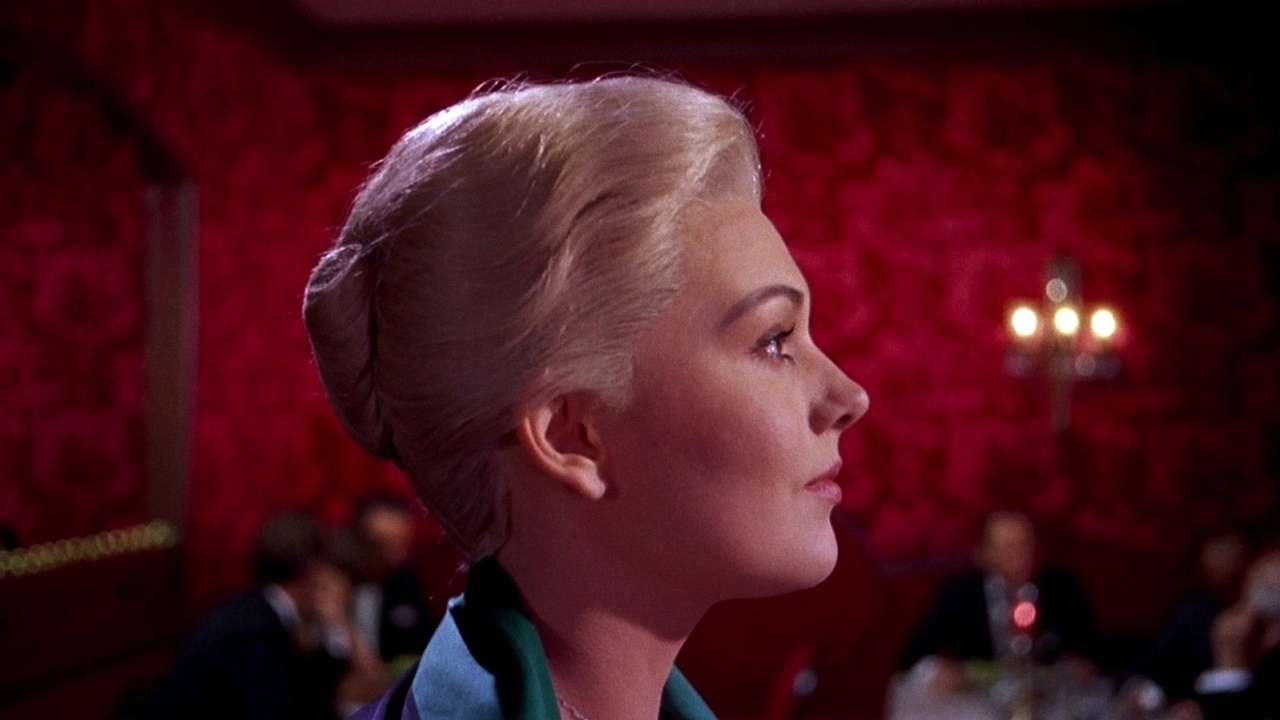
You’ve done it. You’ve met someone and within minutes you were already building them. Not getting to know them. Building them. Selecting which of their qualities to notice, which to amplify, which to quietly set aside. The way they held their glass. The way they said your name with a slight pause before it, as though your name had weight. You took these fragments and you built a person out of them, and the person you built was perfect, and the person who actually existed was standing right there, being not-perfect, and you chose the building over the standing.
You called it love. Everyone does.
Hitchcock made a film about what happens next.
Scottie Ferguson, a retired detective with a fear of heights, is hired to follow a woman. Her name is Madeleine. She is beautiful in the specific way that certain women in 1950s cinema are beautiful: like a sentence you want to read again. She drifts through San Francisco as though the city is a museum and she is visiting her own portrait. Scottie follows her. He watches her stand before a painting. He watches her sit by the water. He watches her buy flowers. He falls in love.
He is not falling in love with her.
He is falling in love with watching her. With the version of her that exists only in his gaze, arranged by his attention, edited by his need. Madeleine, the real woman, is doing something quite specific with her days, and what she is doing will become clear later, and when it becomes clear, it will be too late, because by then Scottie has built something over her that cannot be removed without removing her.
I’m not going to walk you through the plot because the plot is a trap, and the trap is the point.
Hitchcock himself told the audience the twist two-thirds of the way through. He didn’t hide it. He didn’t save it for the final reel. He gave it away because he understood that the power of the film is not in the revelation but in what Scottie does after the revelation. What Scottie does after learning the truth is the thing that will make you put the film down and sit with your hands in your lap and feel something you really don’t want to feel.
He finds another woman. Judy. She is ordinary in ways that Madeleine was not. She is warm and open and real and slightly desperate and she loves him in the unguarded, unflattering way that real people love, which is to say: visibly. Needily. Without the composure of a woman drifting through a museum.
Scottie begins to change her.
He buys her the same clothes Madeleine wore. He asks her to dye her hair. He adjusts her posture, her walk, her lipstick, her silence. He takes a living woman and reshapes her into a dead one, and the reshaping is filmed by Hitchcock with such erotic precision that you feel, in your stomach, the horrible truth the film is telling you: this is what desire looks like when it’s fully honest. Not the desire for a person. The desire for your idea of a person. The desire to make the world match the image in your head, regardless of what the world actually contains.
Here is where the film finds you.
Not if you’ve done exactly what Scottie does. You haven’t dressed someone in a dead woman’s clothes. But you’ve done the smaller version. The version that fits inside a relationship and looks, from the outside, like preference.
You’ve said: “You look better with your hair like that.” You’ve said: “I liked you more when you used to…” You’ve said nothing at all but withdrew some invisible thing, some warmth, some attention, when the person in front of you failed to match the person in your head. And the withdrawal was so slight, so deniable, so far from Scottie’s operatic reconstruction, that you filed it under taste. Under compatibility. Under “I just know what I like.”
Vertigo will not let you file it there. The film takes your small, deniable acts of reconstruction and scales them up to the size of a man remaking a woman from scratch, and at that scale you can see the machinery clearly: this is not love adjusting to reality. This is love refusing reality. This is love as authorship. You are not the partner. You are the sculptor, and the person you’re with is the marble, and you have been chipping away at everything that doesn’t match your design and calling the chipping “growth” or “compatibility” or “bringing out the best in each other.”
Judy lets him do it.
This is the part of the film that cuts deeper than Scottie’s obsession, because Scottie is at least visibly unwell. He is sweating, compulsive, clearly in the grip of something he cannot control. The audience can see that he’s lost. Judy is worse. Judy sees what he’s doing, understands exactly what he’s doing, and submits to it. She puts on the dress. She dyes her hair. She becomes the dead woman, piece by piece, because Scottie’s love, even this warped, reconstructive, annihilating love, is better than his absence.
You know this arithmetic. You have done it or you have watched someone you love do it. The calculation that says: I would rather be the person they want me to be than be myself and be alone. The quiet, catastrophic bargain where you trade your own reality for someone else’s approval, and the trade feels like devotion, and the devotion is real, and the realness of the devotion does not make the trade any less destructive.
Judy stands in the hotel room, fully transformed, green neon light washing over her, and Scottie sees Madeleine again, and his face shows something that Hitchcock, in his most devastating stroke, refuses to label. It might be love. It might be relief. It might be the satisfaction of a man whose sculpture is finally finished. The film lets all three readings coexist because all three are true, and the coexistence is the horror.
Wong Kar-wai understood something adjacent. In In the Mood for Love, two people build elaborate structures of restraint and never reach for each other, and the not-reaching is either dignity or cowardice and the film refuses to say which. Hitchcock inverts this. Scottie reaches. He reaches with both hands and full commitment and absolute certainty. And the reaching is the destruction. The distance Wong Kar-wai’s characters maintain is the thing that preserves them. The closeness Scottie demands is the thing that kills.
Between these two films, you have the complete map of romantic failure: the love that never closes the distance and the love that closes it so completely it crushes what it holds.
The film ends on a ledge. Scottie, who has been afraid of heights for the entire film, stands at the top of a bell tower. He has cured his vertigo. He can look down. He can see clearly. And what he sees clearly, for the first time, is what he has done.
The cure is worse than the disease. The vertigo was protecting him. The dizziness, the inability to look down, the swirling pull of the abyss, all of it was a mechanism that kept him from seeing the full distance between who Judy was and who he made her become. Now the mechanism is gone and the distance is visible and the distance is fatal.
Hitchcock doesn’t give you a redemption. He gives you a man standing at the edge of a building, finally able to see, with nothing left to see that isn’t wreckage.
What this film does to you is not immediate. It’s not the cello from In the Mood for Love or the phone call from Tokyo Story or the mulberry from Taste of Cherry. It’s slower. More architectural. Over the days after watching, you will begin to notice the small ways you author the people around you. The tiny edits you make. The versions you prefer. The withdrawals you perform when reality fails to match the draft.
You will catch yourself mid-sentence, mid-preference, mid-withdrawal, and you will feel, for a half-second, the vertigo. The dizziness of looking down and seeing clearly the distance between the person in front of you and the person in your head. And you will have to choose, in that half-second, which one to keep.
Scottie chose the one in his head. The film cost him a woman and a bell tower and whatever was left of his ability to love a real person in real time with real flaws.
The half-second is yours. You’ll get it again tomorrow.
You’ll get it every day for the rest of your life. That’s Hitchcock’s parting gift. Not guilt. Not revelation. Just the half-second. The wobble at the top of the stairs where you see the drop and decide, again, whether to keep building or to let the person standing in front of you be the person standing in front of you.
The green light fades. The woman was always Judy.
Whether that’s enough for you is the question the film leaves on the ledge.