“I always thought it would be better to be a fake somebody than a real nobody.”
Tom Ripley says this early in the film. He says it casually, almost like a joke. And the audience nods, maybe even smiles, because it sounds like a clever line from a clever character. It sounds like self-awareness. Like wit.
It is neither.
It is a confession. It is the most honest thing anyone says in this entire film. And the tragedy of The Talented Mr. Ripley is that nobody hears it as honesty, because Tom Ripley has spent his whole life making sure nobody takes him seriously enough to listen.
Before Italy
Most discussions of this film begin in Italy. The sun. The coast. The water. The golden bodies. Most discussions begin where the beauty begins, because the beauty is what you remember.
But the film begins in New York. And what it shows you in New York, before a single Italian landscape appears, is the most important sequence in the entire movie.
Tom Ripley is a bathroom attendant. He borrows a Princeton jacket to play piano at a rooftop party. A wealthy man named Herbert Greenleaf mistakes him for a Princeton graduate, someone who might have known his son, Dickie. Tom has never met Dickie. He has never been to Princeton. But the jacket fits. The assumption is made. And Tom, in that split second, makes a choice that will define everything.
He doesn’t correct the mistake.
That’s it. That’s the original sin. Not a murder. Not a theft. An omission. A moment where a poor man in a borrowed jacket lets a rich man believe something untrue because the truth, the real truth of who Tom Ripley is, has no value in that room. Nobody at that party wants to meet a bathroom attendant. Nobody wants to hear his story. The only version of Tom Ripley that has currency in that world is a fictional one.
The film understands this with a precision that borders on cruelty. It understands that Tom’s lie is not born from malice. It is born from invisibility. He lies because the truth makes him disappear.
The Basement
Matt Damon plays Tom Ripley as a man made entirely of surfaces.
This sounds like a criticism. It is, in fact, the performance of a lifetime.
Watch Damon in the early scenes. Watch how Tom moves through rooms. He doesn’t occupy space the way confident people do. He edges. He accommodates. He positions himself slightly off-center, slightly in the background, always watching, always calibrating. His smile appears a fraction of a second too late, as if he’s checking it against an internal reference before deploying it. His laughter follows other people’s laughter. His opinions arrive after he’s scanned the room to see which opinions are safe.
This is not shyness. This is surveillance.
Tom Ripley is a man who has learned, through years of being nobody, to read rooms the way a predator reads terrain. Not for malicious reasons. For survival. Because when you have no money, no connections, no family, no social position, the only power available to you is the power of observation. You watch how the golden people move. You study their gestures, their inflections, their easy confidence. You catalog everything. And then, when the moment comes, you perform it back to them.
Tom’s talent, his actual talent, is mimicry. He can do voices. He can forge handwriting. He can learn the rhythms of another person’s speech and reproduce them so faithfully that the person themselves might not notice the difference. These are presented in the film as party tricks, amusing little skills. But they are something else entirely.
They are the survival mechanisms of a man who has never been allowed to have a self of his own.
Dickie, or: The Man Who Never Had to Try
Jude Law’s Dickie Greenleaf is one of the great performances of careless beauty in cinema.
He is gorgeous. He is charming. He is talented enough at jazz to be interesting but not disciplined enough to be serious. He lives in a coastal Italian village, spending his father’s money, sleeping with local women, playing saxophone on boats, and treating every day like a vacation from the responsibilities he will never actually face.
He is, in other words, everything Tom is not.
And the film is careful, more careful than most viewers notice, to show you that Dickie’s ease is not a personal achievement. It is an inheritance. Dickie is relaxed because he has never had a reason to be tense. He is generous because he has never had to count. He is confident because the world has been arranged, since birth, to confirm his value.
Dickie doesn’t perform his identity. He doesn’t have to. His identity was given to him, fully formed, by money and class and the particular American entitlement that comes from knowing your family’s name opens doors you didn’t even know existed. Dickie can afford to be spontaneous because structure was never in question. He can afford to be reckless because consequences are for other people.
Tom sees all of this. Tom sees it with a clarity that Dickie himself will never possess, because you can only see the machinery of privilege from the outside. From the inside, it just looks like life.
And Tom wants it. God, does he want it.
The Nature of Tom’s Desire
Here is where most readings of the film get tangled, and where the film itself is doing its most sophisticated work.
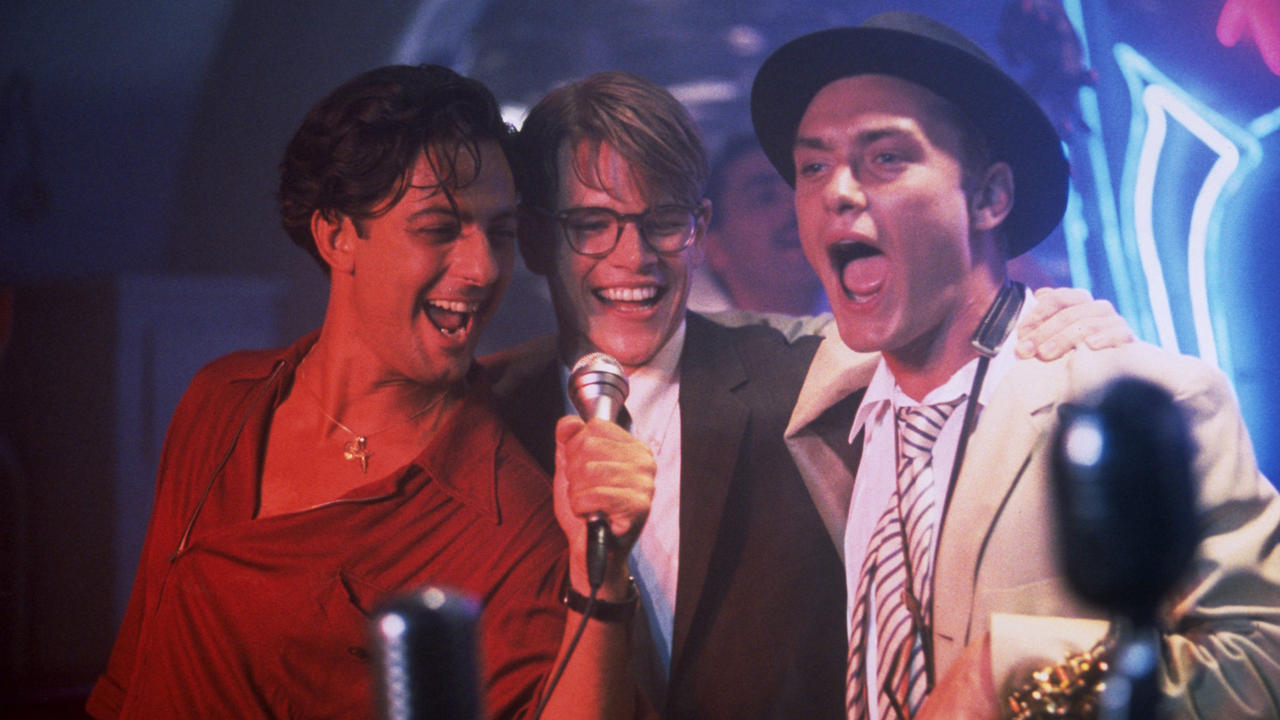
Tom Ripley desires Dickie Greenleaf. This is obvious. The film makes it unmistakable. The lingering looks. The bathroom scene. The jazz club scene where Tom watches Dickie play with an intensity that goes beyond admiration into something rawer, something closer to hunger.
But what does Tom want from Dickie?
The easy answer is sex. Tom is attracted to men. The film makes this clear, though it handles it with a restraint that is itself meaningful. Tom’s sexuality is not a revelation. It is not a twist. It is one thread in a much larger weave, and the film refuses to reduce his entire psychology to it.
Because Tom doesn’t just want Dickie’s body. He wants Dickie’s life. He wants the boat. The villa. The Italian light. The saxophone. The ease. He wants to wake up in the morning with nowhere to be and nothing to prove and a certainty, deep in his bones, that the world is arranged for his pleasure.
And he wants, most desperately of all, Dickie’s carelessness. That specific, infuriating, beautiful carelessness that only people who have never been afraid can achieve. Tom has been afraid his entire life. Afraid of being seen. Afraid of being caught. Afraid of being revealed as the nobody he knows himself to be. Dickie has never been afraid of anything. And Tom wants to absorb that fearlessness the way you’d absorb warmth from a fire.
The desire is erotic. It is also aspirational. It is also existential. The film braids these three strands so tightly that they become inseparable, and this is Minghella’s great insight: that desire, especially desire across class lines, is never just one thing. When a poor person wants a rich person, they are never wanting only the person. They are wanting the world that made the person possible. And that wanting is so immense, so total, so tangled with longing and shame and fury, that it cannot be contained in any single category.
Tom doesn’t want to sleep with Dickie. Tom doesn’t want to be Dickie. Tom wants to live in a world where someone like him could become someone like Dickie without having to destroy anyone to get there.
That world doesn’t exist. And the film is a record of what happens when Tom realizes it.
The Murder That Changes Everything (And the One That Doesn’t)
Tom kills Dickie in a boat.
It happens fast. An argument. A confrontation. Dickie, bored with Tom, finally says the things that have been accumulating. He is cruel. Casually cruel, the way only people who have never been hungry can be cruel. He tells Tom, in essence: you are not one of us. You never were. You were entertainment. A project. A diversion. And now the diversion is over.
And Tom, who has spent his entire life being told he is not enough, who has spent months performing the most exhausting role of his life just to stay in the light a little longer, does the only thing left to him.
He refuses to disappear.
The murder is ugly. It is desperate. It is not calculated. Tom doesn’t kill Dickie because he planned to. He kills Dickie because the alternative is to go back to being nobody, to return to the basement, to lose the only life that has ever felt real. The oar comes down not out of cunning but out of animal panic. It is the violence of a man who would rather kill than be invisible again.
And then something shifts.
After the murder, Tom becomes Dickie. He forges documents. He learns the signature. He wears the clothes. He moves between cities, answering to Dickie’s name, spending Dickie’s money, inhabiting Dickie’s world. And here is the unsettling thing: he’s good at it. He’s better at being Dickie than Dickie was.
Because Dickie was careless. Dickie was sloppy. Dickie didn’t value the things he had because he’d never had to earn them. Tom, who has earned nothing and paid for everything with performance, treats Dickie’s identity with the meticulous care of a man handling stolen art. Every detail is managed. Every interaction is controlled. Every potential exposure is anticipated and neutralized.
Tom Ripley, the real nobody, is a more convincing Dickie Greenleaf than the real Dickie Greenleaf ever was.
And the film asks you to sit with the vertigo of that. Because if a fake Dickie can be more Dickie than the real Dickie, then what was “real” about Dickie in the first place? What was real about any of it? The charm, the confidence, the golden ease. Were those Dickie’s authentic qualities, or were they simply the natural byproducts of wealth and privilege, reproducible by anyone with enough skill and enough desperation?
The film doesn’t answer this. It lets the question hang in the Italian air like humidity.
Marge Sees Everything
Gwyneth Paltrow’s Marge Sherwood is the most important character in the film who is not named Tom Ripley.
She is also the character the film treats with the most quiet, aching sympathy, precisely because nobody in the story treats her with any at all.
Marge knows. She doesn’t have evidence. She doesn’t have proof. She has something more fundamental and more routinely dismissed: instinct. She looks at Tom and feels wrong. She watches him move through Dickie’s world and something in her recoils. Not from his poverty. Not from his awkwardness. From something she can sense but not name. A frequency that doesn’t match. A note that’s slightly off.
And she says so. She tells people. She tells Dickie. She tells the investigators. She says: something is wrong with Tom Ripley.
Nobody listens.
Dickie dismisses her. The investigators treat her as emotional, overattached, a jealous girlfriend making accusations she can’t support. The men in the film, every single one of them, respond to Marge’s instinct with some variation of the same gesture: a pat on the hand, a gentle correction, a subtle redirection toward reason and evidence and the things that men trust and women merely feel.
The film is furious about this. Anthony Minghella buries his fury deep, under the lush photography and the gorgeous score, but it’s there. Every scene where Marge is dismissed is filmed with a particular stillness, a particular attention to her face, that communicates something the dialogue won’t say. She was right. She was always right. And the world she lives in is structured so that her rightness doesn’t count.
This connects to Gone Girl in ways that are almost too precise. Marge, like Detective Boney, represents actual perception. Actual truth. And like Boney, she is overridden by narrative. The narrative of Tom-as-Dickie is more convincing, more socially acceptable, more comfortable, than the truth Marge is trying to tell. The story wins. The woman loses.
The Price of the Performance
Freddie Miles.
Philip Seymour Hoffman plays him as a braying, entitled, casually vicious creature of privilege. He arrives in Rome, looks at Tom, and sees through him instantly. Not because Freddie is smart. Because Freddie, unlike the others, has no reason to be polite. Freddie doesn’t need to accommodate Tom. Freddie doesn’t need to give him the benefit of the doubt. Freddie looks at Tom the way a rich man looks at a stain on his shirt: with undisguised contempt.
“It’s like a coat you try on and you can’t put back,” Tom tells Dickie’s friend Peter later, talking about his lies. And this is exactly right. Each murder is not a choice but a consequence of the previous one. Dickie’s murder necessitates the performance. The performance necessitates Freddie’s murder. Freddie’s murder necessitates more lies. The lies necessitate more performance. The coat gets heavier. The fabric gets tighter. And Tom, who started out desperate simply to be seen, is now desperate never to be seen again.
This is the film’s tragic inversion. Tom began as a man defined by invisibility. He was nobody. He was unseen. He wanted, more than anything, to be visible, to matter, to exist in the world as a person of consequence. And now, having achieved that, he discovers that visibility is the one thing he can no longer afford. Every person who sees him clearly is a threat. Every genuine connection is a liability. Every moment of authentic human contact is a risk that could unravel everything.
He has become somebody. And being somebody is killing him.
Peter, or: The Thing Tom Cannot Have
Peter Smith-Kingsley enters the film late. He is played by Jack Davenport with a gentleness that feels, in the context of the film’s escalating violence, almost unbearable.
Peter likes Tom. Not Dickie. Not the performance. Tom.
He likes Tom’s nervousness. He likes Tom’s intelligence. He likes Tom’s earnest, slightly overwrought engagement with music and art. He likes, without knowing it, the closest thing to a real person that Tom has allowed himself to be since arriving in Italy.
And Tom likes Peter back. Genuinely. Perhaps for the first time in the film, Tom’s feelings for another person are not tangled with aspiration or class hunger or the desperate need to be someone else. Peter is not above Tom. He is not a rung on a ladder. He is just a kind man who plays good music and looks at Tom without suspicion.
The film gives us this. It gives us several scenes of Tom and Peter together, and in these scenes, the tension drains away, the score softens, and Damon’s performance opens up in ways that feel almost painful to watch. Tom smiles. Not the calculated smile. Not the performance smile. Something smaller and more fragile. Something that looks, for one terrible moment, like happiness.
You know where this is going.
The Cabin
The final scene of The Talented Mr. Ripley is one of the most devastating endings in modern cinema, and it is devastating precisely because it is so quiet.
Tom is on a cruise ship. He is with Peter. They are sharing a cabin. For a brief, fragile moment, it seems possible that Tom might have found something real. That the performance might relax. That the fake somebody might discover, in Peter’s company, that the real nobody was worth knowing all along.
And then Tom sees another passenger. Someone who knows him as Dickie. Someone who knows Peter. Someone who, if allowed to talk, will connect the dots.
Tom goes to the cabin. He sits on the bed next to Peter. Peter sleeps, or is close to sleep, and Tom wraps his hands around Peter’s neck.
The screen goes black.
He kills the one person who loved him as himself.
Not as Dickie. Not as the performance. As Tom. The flawed, frightened, genuinely complicated Tom Ripley who exists underneath every mask. Peter saw that person. Peter wanted that person. And Tom destroys him. Not because Peter threatened the lie. Because Peter threatened something worse.
Peter threatened to make the truth viable. Peter was the evidence that Tom Ripley, the real Tom Ripley, could be loved. And if that were true, then every murder, every deception, every elaborate performance was not just criminal but unnecessary. If Tom could be loved as himself, then everything he did to become someone else was waste. Pure, irredeemable waste.
Tom cannot survive that knowledge. The lie has become too expensive to abandon and too total to sustain. And so he does the only thing the logic of his situation permits. He eliminates the possibility of an alternative.
The screen stays black. There is no beach. No sunrise. No Pacific as blue as it has been in his dreams. There is a man alone in a dark room, holding the body of the person who could have saved him, understanding that he has just made his prison permanent.
The Class Architecture of Identity
Here is the thing that almost nobody says about The Talented Mr. Ripley, the thing that connects it to every film we’ve discussed and goes beyond all of them.
Tom Ripley’s crime is not murder. Tom Ripley’s crime is class trespass.
He entered a world he was not born into. He wore clothes that didn’t belong to him. He used manners he had to learn rather than inherit. He spoke with an accent he had to practice. He appreciated art with an intensity that betrayed effort rather than breeding.
And the world punished him. Not through the legal system. Through something more fundamental. Through the simple, relentless logic of a social order that permits you to be anything, anything at all, as long as you don’t try to be something above your station.
Dickie can be reckless. He’s rich. Freddie can be cruel. He’s rich. Meredith can be shallow. She’s rich. These are permitted identities. They carry no penalty. But Tom, poor Tom, cannot even be kind without it reading as calculation. He cannot be generous without it reading as manipulation. He cannot love without it reading as obsession.
The film understands that identity, in a class society, is not something you discover. It is something you are assigned. And if you reject the assignment, if you insist on being someone other than the person your birth dictates, the world will not forgive you. It will call you a psychopath. It will call you a monster. It will make your ambition a diagnosis and your longing a disease.
Tom Ripley is all of these things. He is a killer. He is a fraud. He is dangerous.
He is also a boy from a basement who wanted to sit in the sun.
And the film, for all its horror, never stops seeing both things at once.
The Thread That Connects
Gone Girl ended with two people locked in a mutual performance, each knowing the other is lying, each choosing the lie over the terrifying alternative of truth. The marriage survived because the performance was shared.
Tom Ripley has no partner in his performance. There is no Amy to mirror him, no co-conspirator to share the weight. He is alone with his lie, and the lie requires him to remain alone. Every person who gets close enough to see him clearly must be removed. Every possibility of genuine connection must be destroyed. The performance is total, and the price of totality is solitude.
Shawshank said hope sets you free. The Truman Show said freedom is terrifying. Fight Club said there is no authentic self. The Dark Knight said the lie is necessary. Gone Girl said the lie is the relationship.
The Talented Mr. Ripley says the lie is you. And once the lie has replaced you, there is no one left to set free.
Where This Leads Us
Tom Ripley killed to become someone else. He murdered his way into an identity that wasn’t his, and the performance consumed the person.
But what if the consumption goes the other direction? What if, instead of becoming someone else, you become too much of yourself? What if the performance isn’t about escaping who you are but about amplifying it, inflating it, turning the volume up until the person and the persona are indistinguishable and the audience cannot tell where the human ends and the spectacle begins? What if the real horror isn’t losing yourself in a role but being devoured by your own mythology?
What if the mask doesn’t hide the face? What if the mask eats it?