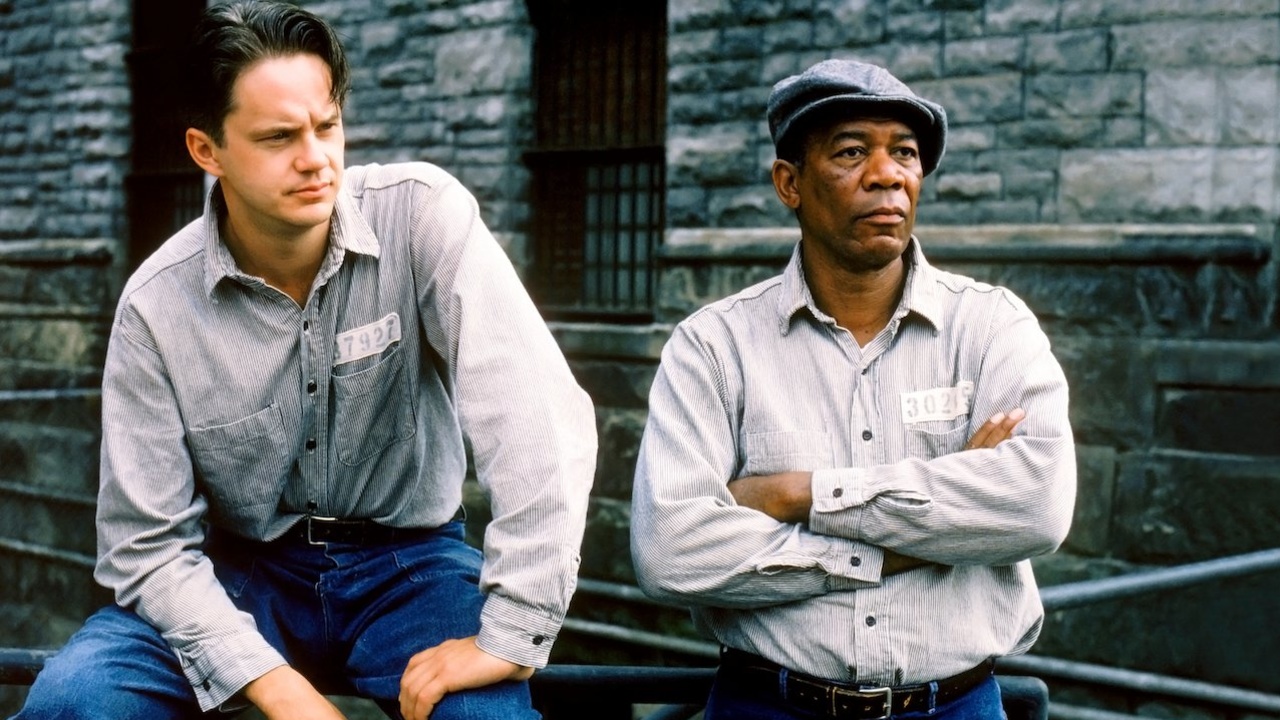
The Shawshank Redemption is not a film you are allowed to dislike.
Try it sometime. Say it at a dinner table, at a film club, online. Say you found it sentimental. Say it troubled you. Watch what happens. People won’t just disagree. They’ll look at you like you’ve confessed to something. Like you’ve revealed a deficiency not in the film, but in yourself. In your capacity for hope. In your basic humanity.
That reaction is worth sitting with.
Because a film that generates that kind of defensive devotion is doing something more complicated than just telling a good story. It’s doing something to us. And the fact that we can’t see it, or refuse to, is precisely what makes The Shawshank Redemption one of the most fascinating cultural objects of the last thirty years.
The Strange Afterlife of a Box-Office Failure
Let’s start with something most people forget. Shawshank flopped. It made $16 million against a $25 million budget during its theatrical run in 1994. It opened the same year as Pulp Fiction, Forrest Gump, and The Lion King. Nobody cared.
Then something happened.
On home video, on cable television, on late-night reruns, the film began its slow, quiet conquest. By the time IMDb’s user-voted rankings became culturally significant, Shawshank had climbed to the top. And it has stayed there. Not for a year. Not for a decade. For over twenty years.
No marketing campaign did this. No studio push. Audiences chose it, again and again, as the greatest film ever made. Greater than The Godfather. Greater than Schindler’s List. Greater than Citizen Kane.
Why?
The standard answer is: because it’s about hope.
The more honest answer is: because it’s about the kind of hope that costs us nothing.
Andy Dufresne and the Myth of the Clean Man
Andy Dufresne arrives at Shawshank Prison in 1947, convicted of murdering his wife and her lover. He says he didn’t do it. The film believes him. And from the very first frame, so do we.
This is not a small thing. This is, in fact, the load-bearing wall of the entire movie.
Think about it. Andy never has to earn our belief. He doesn’t go through a crisis of credibility. We never genuinely waver. Tim Robbins plays him with such quiet, composed dignity that the possibility of his guilt feels almost rude to entertain. The film doesn’t ask us to wrestle with ambiguity. It asks us to trust the face of a well-spoken, well-educated white man. And we do. Instantly.
Now compare this to how the film introduces Ellis Boyd “Red” Redding. Red sits before the parole board. “I’m the only guilty man in Shawshank,” he says. It’s played as a wry joke, and Morgan Freeman’s warm delivery makes it land perfectly. But underneath the humor, there’s a quiet confession: Red actually killed someone. He did the thing. The film never explores what he did, never gives us the details, never forces us to sit with the weight of it. Red’s guilt is acknowledged and immediately aestheticized. It becomes charm. It becomes a punchline.
Andy’s innocence, meanwhile, is never aestheticized. It is sacred.
And this asymmetry is the first silence the film refuses to break.
The Racial Architecture Nobody Talks About
Here is the part of the conversation where most people get uncomfortable. That’s fine. Discomfort is where the interesting things live.
Red, in Stephen King’s original novella, is a white Irishman. “Maybe it’s because I’m Irish,” he says, explaining his nickname. The film casts Morgan Freeman and keeps the line, turning it into a joke. A knowing wink. The audience laughs. The film moves on.
But what actually changed with that casting decision?
Everything.
Red becomes the narrator. He becomes our eyes, our voice, our conscience inside the prison walls. He is the one who watches Andy. Admires Andy. Chronicles Andy. Testifies to Andy’s goodness. In every way that matters, Red exists in the film to validate a white man’s journey toward freedom.
This is not a minor structural detail. This is the engine of the movie.
Red doesn’t have his own interior arc for most of the runtime. He doesn’t have desires outside of Andy. He doesn’t have a past we are forced to reckon with, a family we see destroyed, a crime we must confront. He is warm, wise, perceptive, patient. He is, in other words, the most beautifully written supportive friend a protagonist could ask for.
And if that description sounds familiar, it should. Because the “wise, warm Black man who helps a white protagonist find meaning” is one of the oldest and most durable archetypes in American storytelling. It shows up in Driving Miss Daisy. In The Legend of Bagger Vance. In The Green Mile, which, not coincidentally, is also a Stephen King adaptation directed by the same filmmaker.
Frank Darabont clearly has deep affection for his Black characters. That’s not in dispute. But affection and agency are not the same thing. You can love a character deeply and still make them a mirror for someone else’s story.
The Warden, or: How the Film Picks Its Villains
Warden Norton is a Bible-quoting hypocrite who runs a forced labor scheme, launders money, and eventually murders to protect his secrets. He is the film’s villain, and he is painted in bold, unmistakable strokes.
Too unmistakable, actually.
Norton is so obviously corrupt, so cartoonishly wicked in his later scenes, that he lets the audience off the hook. We don’t need to think about systemic injustice when we can point at one bad man. We don’t need to question the prison system as a structure when we can blame its worst individual operator. Norton is a pressure valve. He absorbs all the film’s moral outrage so that the institution itself escapes scrutiny.
And here’s the deeper trick: the film never asks why a man like Norton can thrive inside a system like Shawshank. It never connects his corruption to anything larger. The implication is that prisons are fine, even redemptive, as long as the wrong people aren’t running them. Replace Norton with a decent warden, and Shawshank becomes, what? A tough but fair place? A community?
The film almost believes this. Think about how it photographs the prison yard. The warm amber light. The baseball games. The beers on the rooftop at sunset, the men silhouetted against the sky like a beer commercial for blue-collar brotherhood. These images are not accidental. They romanticize captivity. They turn a site of state violence into a backdrop for male bonding and personal growth.
Brooks Hatlen, the elderly librarian who hangs himself after being paroled, is the film’s most devastating illustration of this. Brooks can’t survive outside. The world has moved on without him. The institution has become his entire self.
But the film frames this as Brooks’s tragedy, not Shawshank’s crime.
It’s a story about a man who was broken by prison, told by a movie that can’t stop making prison look beautiful.
The Crawl
Let’s talk about the sewage pipe.
Andy escapes Shawshank by crawling through five hundred yards of raw sewage. Red tells us this in voiceover, with something close to awe. “Andy Dufresne, who crawled through a river of shit and came out clean on the other side.”
Clean. That word is doing enormous work.
Because Andy doesn’t just come out physically clean (the rain washes him, arms spread, face raised to the sky in a pose that deliberately echoes the Crucifixion). He comes out morally clean. He has stolen the warden’s laundered money, built a false identity, manipulated the postal system, and essentially constructed a sophisticated financial fraud. And the film frames all of it as heroism.
Now, is it satisfying? Absolutely. Is it cathartic? Without question.
But is it honest?
Andy beats the system by mastering the system’s own tools. He wins not through moral courage but through financial sophistication. He is, in the end, a banker who out-banks the corrupt banker. The skills that make his escape possible are the same skills that, outside prison, serve the wealthy and powerful. Tax evasion. Shell companies. Hidden accounts.
The film asks us to cheer for these things because Andy is a good man. But the separation between “good man uses these tools” and “bad man uses these tools” is thinner than the movie wants us to believe.
Zihuatanejo, the beach paradise where Andy waits for Red at the end, is funded by stolen money laundered through fictional identities. It’s a beautiful dream. It’s also, if you tilt your head just slightly, an offshore retirement plan built on fraud.
Hope as Ideology
“Hope is a good thing, maybe the best of things, and no good thing ever dies.”
This is the line everyone remembers. This is the line people put on posters, on mugs, on tattoos. It is a genuinely lovely sentence. It is also, in context, a fascinating piece of ideology.
Because hope, in this film, is not a collective project. Nobody organizes. Nobody protests. Nobody challenges the structure. Hope is private. Hope is individual. Hope means: one exceptional man, with exceptional talents, can dig his way out over twenty years, and the rest can admire him for it.
What about the men who aren’t Andy? What about the men who don’t have a background in banking? What about the men who can’t play Mozart on the PA system or charm the guards with tax advice? What about the men who are actually guilty?
The film has no interest in these questions. Its vision of hope is entirely personal, entirely focused on the extraordinary individual. And this is a deeply American idea, one that the film never examines: the belief that the system doesn’t need to change because the right person can always transcend it.
This is, perhaps, why Shawshank resonates so powerfully and so broadly. It tells us that injustice is survivable through personal virtue. It tells us the world is hard but navigable, if you’re smart enough, patient enough, good enough. It tells us these things in Morgan Freeman’s voice, with Thomas Newman’s score swelling underneath, and it feels true. God, does it feel true.
But feeling true and being true are different things.
What the Film Sees and What It Won’t
Frank Darabont is a genuinely skilled filmmaker. The pacing is immaculate. The performances are lived-in and deeply felt. Roger Deakins’ cinematography finds warmth in concrete and steel. Thomas Newman’s score is one of the most emotionally precise of the 1990s. These are not small achievements.
And Tim Robbins does something very difficult with Andy. He makes stillness compelling. He makes silence active. There are long stretches where Andy barely speaks, and the film trusts that his presence alone will hold the frame. That’s rare in mainstream American cinema, which usually mistakes noise for energy.
But craft and vision are separate things. Shawshank is a film of extraordinary craft in service of a vision that never quite interrogates itself. It sees cruelty and names it. It sees friendship and honors it. It sees endurance and celebrates it.
What it won’t see is its own blind spots. The racial dynamics it inherits without examining. The class assumptions it smuggles in under the guise of meritocracy. The way it uses one man’s innocence to avoid asking harder questions about guilt, punishment, and who the system is actually built to serve.
So Why Do We Love It?
Because it earns its emotions honestly, even when its ideas are dishonest.
Because Morgan Freeman’s voiceover is one of the most comforting sounds in cinema.
Because the ending, with that wide shot of the Pacific and two friends reunited on the sand, is an image of such pure, uncomplicated grace that it bypasses critical thinking entirely and goes straight to the chest.
Because, in a world full of complicated, ambiguous, demanding films, Shawshank offers something almost no other movie does: moral certainty wrapped in beauty. It tells you that good men exist, that patience is rewarded, that the arc of one man’s life can bend toward justice even when the system will not.
It is a beautiful lie. And maybe that’s not entirely a bad thing. But it is worth knowing that it’s a lie. It is worth asking what the lie protects us from. And it is worth wondering what kind of cinema, and what kind of hope, might be possible if we stopped needing the lie at all.
Where This Leads Us
Red tells us he hopes the Pacific is as blue as it has been in his dreams. That final image of oceanic freedom, of two men who have escaped the walls, carries a promise: the world outside is better.
But what happens when a film takes that same promise and poisons it? What happens when the escape from the institution leads not to a Mexican beach but to something worse? When the outside world is the prison, and the beautiful lie curdles into horror?
That’s where we go next.