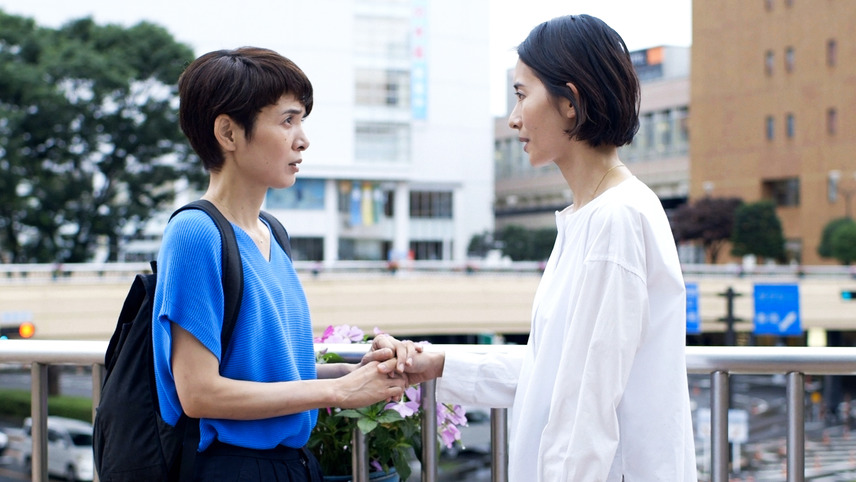
Hamaguchi’s triptych presents three stories about misrecognition as the work of chance. What the film cannot see is that chance is not doing the work. The words are.
Before reading: say the next sentence aloud, without deciding in advance what you feel about it.
Someone you have not thought about in years is standing in front of you, and you do not know yet whether this is the best or the worst thing that has happened to you this decade.
Notice what the sentence did before you interpreted it.
That is the film.
| Director | Ryûsuke Hamaguchi |
|---|---|
| Year | 2021 |
| Runtime | 121 minutes |
| Cast | Kotone Furukawa, Ayumu Nakajima, Hyunri, Katsuki Mori, Fusako Urabe, Aoba Kawai |
| Awards | Silver Bear Grand Jury Prize, Berlin International Film Festival |
| Streaming | Available on major platforms |
The Drive My Car review said that Wheel of Fortune and Fantasy showed Hamaguchi “at his most concentrated, where the language and the silence between people carry the same weight but compressed to breaking point.” That was written as a promise. Arriving now as the subject, the claim needs adjusting at one end: compressed, yes. To breaking point, not quite. The triptych structure — three separate stories, three separate sets of characters, each encounter sealed from the others — releases pressure as much as it builds it. Each story is a controlled detonation. The breaking point requires accumulation, and Hamaguchi has chosen distribution instead. What he gets in exchange is something rarer: three moments where the explosion is small enough to be felt precisely.
Wheel of Fortune and Fantasy consists of three episodes made across a single year, each turning on a scene of unexpected intimacy between people who have misread each other or themselves. In the first, “Magic (or Something Less Assuring),” Meiko discovers mid-taxi-ride that the man her friend is falling for is her own former lover; she goes to confront him and finds the confrontation rerouted by feelings she believed she had finished with. In the second, “Door Wide Open,” a student attempts to trap a professor through a seduction involving his own erotic novel, read aloud; the seduction fails in the direction it was intended and succeeds in a direction no one anticipated. In the third, “Once Again,” set in an alternate Japan where the internet does not exist, two women at a school reunion mistake each other for someone from their past and choose, carefully, to sustain the mistake.
The title promises chance: the wheel spins, people find themselves in positions they did not seek. But watch the actual mechanism of each story. What delivers each character to their moment of unexpected feeling is not the wheel. It is language. In the first story, it is the words Meiko speaks to Kazuaki in his apartment, the sentence she says that opens something she had closed. In the second, it is the passage from the professor’s novel, read aloud by a student who begins performing and stops performing mid-sentence in a way she cannot account for. In the third, it is the letter that the woman reads in the role of the friend she is being mistaken for: a letter from the past that was never sent, now finally arriving.
In every episode, something spoken or read produces a feeling that the speaker did not bring into the room. This is Kafuku’s method from Drive My Car running in reverse: where Kafuku teaches actors to empty themselves so the text can fill them, Hamaguchi’s characters in these three stories begin full — of plans, of expectations, of performed identities — and the text empties them. The words do something the character did not authorize.
The second episode contains the film’s most concentrated scene, and one of the most unusual in recent cinema. The student Nao wants to embarrass the professor Segawa by reading a passage from his novel aloud while he records it, then using the recording as leverage. The passage is explicitly sexual. Nao begins reading with the careful neutrality of someone executing a plan. Then something happens to her voice. The neutrality goes. She is no longer reading. She is inside the words. Segawa watches her. The camera watches both of them. The plan has dissolved and something else is present in the room that neither of them chose and the film does not explain.
Hamaguchi calls these stories about coincidence. They are about the moment when performed language becomes real feeling before the performer can stop it. Chance delivers the occasion. The words do the rest.
What the film cannot quite see is the asymmetry across its three episodes. The first and third are about women finding unexpected feeling in encounters with other women: Meiko with Kazuaki, yes, but more precisely Meiko with herself, Meiko with what she has not finished; and in the third episode, the encounter between Natsuko and Moka, where the mistake they are sustaining is not about men at all but about what each woman needs from the fiction of the other. These two episodes have a spaciousness and a mutual attention that the second episode’s male-female dynamic does not quite match. Segawa in the second episode is moved by the scene, but he is moved in a way that leaves him essentially intact. Nao is not. The words did something to her that they did not do to him in the same measure. Hamaguchi does not notice the imbalance. The film proceeds as though the three episodes carry equal weight. But the weight is not equal: the third episode, “Once Again,” carries more of it than anything else in the film, and what it carries is specifically two women giving each other, through a sustained fiction, the acknowledgment they could not find in the real world.
The film in this archive that creates the sharpest friction is our review of My Night at Maud’s, where the central conversation — sustained, intimate, a single room, a winter night — is presented as a genuine dialectic but is actually one person performing openness while the other does the real philosophical work. The conversation in Rohmer looks like mutual recognition. Hamaguchi’s conversations are mutual recognition, genuinely: in the taxi, in the professor’s office, on the school reunion staircase, both people are changed by what happens. The Rohmer narrator arrives with his conclusion written. Hamaguchi’s characters arrive with conclusions and leave without them. The difference is not optimism. It is the difference between a filmmaker who trusts conversation as a mechanism of confirmation and one who trusts it as a mechanism of surprise.
“Once Again” ends with Natsuko on a street corner, the encounter finished, the fiction released. She has been, for an hour, the person that Moka needed her to be — a school friend who became someone significant, who sent a letter that mattered. Neither woman was that person. The letter was invented between them. The feeling the letter produced was not. Natsuko walks away carrying something she arrived without, which was not on the wheel, and was not chance, and was entirely the work of words spoken in a room to someone willing to receive them.
The wheel turns. The fortune falls where it falls. The fantasy is not that coincidence can remake a life. It is that language, when both people let it, sometimes can.
If this stayed with you, watch these next:
Drive My Car (Hamaguchi, 2021): reviewed here; Hamaguchi’s method expanded to three hours, where the same mechanism — words spoken aloud until the real feeling emerges — is both the film’s subject and its protagonist’s grief, and where the compression of these three episodes becomes the foundation of a much larger architecture.
My Night at Maud’s (Rohmer, 1969): reviewed here; another single-room, single-night conversation between two people who arrive with different levels of openness — but where Rohmer’s narrator is never genuinely surprised by what the conversation finds, and the contrast with Hamaguchi’s characters reveals everything about what each director believes conversation can do.