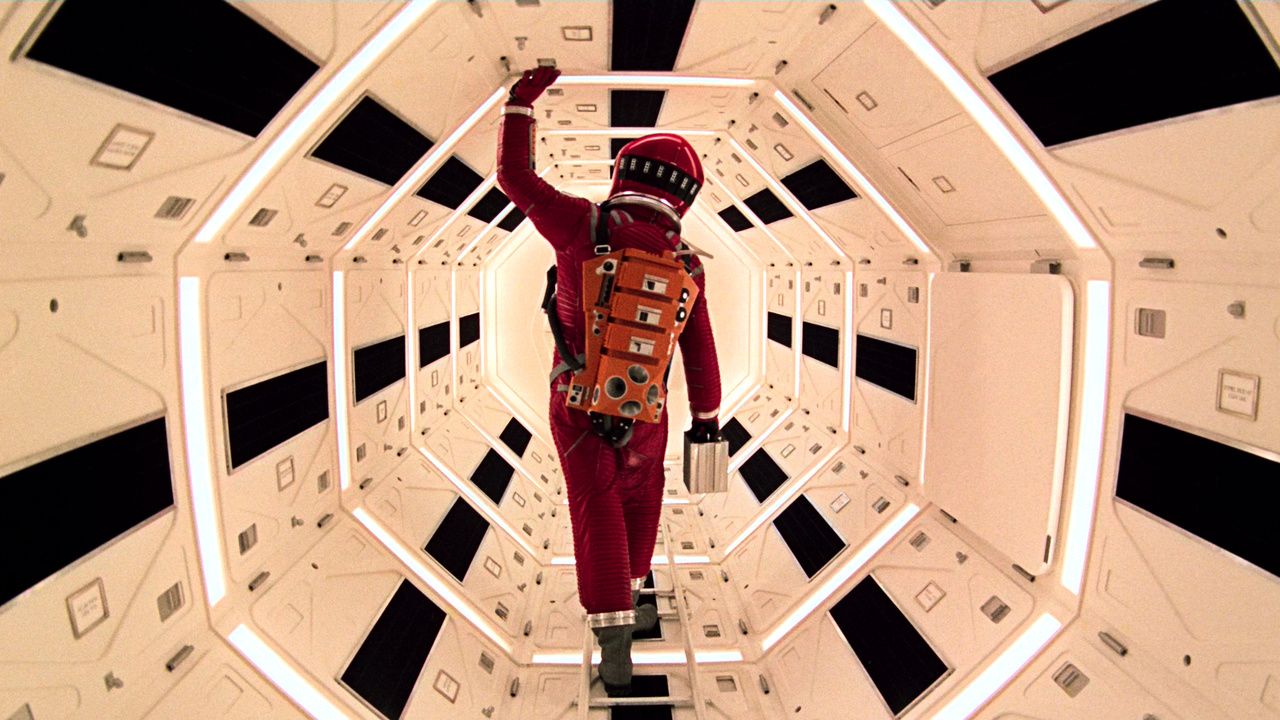
Forget the monolith. Forget HAL. Forget the star-child and the bone thrown into the air and every undergraduate essay about the dawn of man. Forget everything you think this film is about, because everything you think this film is about is a defence mechanism, and the defence mechanism is working, and it has been working for decades, and the proof that it’s working is that you can say “2001” at a dinner party and have a conversation about artificial intelligence and evolution and Cold War paranoia and Nietzsche and leave the party feeling that you’ve engaged with the film and go home and sleep soundly.
You have not engaged with the film. You have engaged with ideas about the film, which is what people do when the film itself is too large to hold.
Here is what the film actually does, underneath the ideas, underneath the interpretations, underneath the frame of reference that turns it into something discussable:
It adjusts your sense of scale. Permanently.
Not metaphorically. I mean your actual, physical, bodily sense of how large things are and where you sit among them. Your proprioception, but for existence. The internal model you carry, without thinking about it, of how much space you occupy in the scheme of things. This model was built when you were young, from the usual materials: your family, your town, your country, the news, the night sky on the rare occasions you looked at it. The model says: you are small but significant. The universe is large but it contains you, and the containing means something.
2001 dismantles this model. Not by arguing with it. By showing you something so large, so indifferent, so patiently and completely uninterested in whether you exist, that the model simply stops working. Like a calculator asked to divide by zero. The screen doesn’t go blank. It goes quiet. And in the quiet, you feel your significance recalibrate, and the new setting is lower than you thought a setting could go, and it does not return to its previous position when the lights come up.
Kubrick achieves this through duration.
Other filmmakers show you space. They give you a shot of a planet, a star field, a ship moving through darkness. The shot lasts three seconds, maybe five. Long enough to register the scale. Short enough to return you to the human story, to the characters, to the drama that assures you that the universe, however vast, is still fundamentally about the people inside it.
Kubrick holds the shot.
He holds it past the point of establishing the scale. Past the point of aesthetic appreciation. Past the point where your mind starts generating interpretations to fill the silence. He holds it until your interpretations run out and you are left with the image itself: a spacecraft moving through nothing, slowly, in silence, for so long that the silence stops being the absence of sound and becomes a presence, a thing with weight, a thing that is pressing against you from a direction that is not up or down or left or right but out, in every direction simultaneously, and the pressing is the universe’s absolute indifference to the fact that you are watching.
You will want to check your phone. This is the defence mechanism. The phone is small, warm, human-scaled, full of people who know your name. Kubrick knew about the phone before the phone existed. He knew that the human response to genuine scale is to reach for something small. He designed the film to outlast the reaching.
There is a waltz in this film. Strauss. “The Blue Danube.” A spacecraft docks with a space station and the docking is choreographed to a waltz written in 1867 Vienna for people in ballrooms who had never imagined leaving the atmosphere, and the effect is not ironic. It is not Kubrick being clever. It is Kubrick showing you, with absolute precision, the thing humans do when confronted with the incomprehensible: we dance. We impose pattern. We take the void and we wallpaper it with civilisation. We float through infinite darkness in a tin can and we play Strauss because Strauss is human and the darkness is not and we need, desperately, to believe that the human thing is the real thing and the darkness is just the backdrop.
The waltz is beautiful. The docking is beautiful. And the beauty is doing exactly what beauty always does in the face of the void: it is lying to you. It is telling you that elegance and the abyss can coexist, that the darkness is navigable, that a sufficiently well-designed spacecraft with sufficiently well-chosen music can make the universe feel like a ballroom.
It can’t. Kubrick plays the waltz and lets you believe it can, and then he takes you to Jupiter, and the waltz stops, and what replaces it has no precedent in your experience.
The stargate sequence.
Seven minutes of light and colour and sound moving through you at a speed and intensity that your visual cortex was not designed to process. This is not a special effect. This is not Kubrick showing you what faster-than-light travel might look like. This is Kubrick doing to your perceptual system what the film has been doing to your sense of scale: overloading it. Pushing it past the point where it can organize input into experience. You are seeing something, and the something is not nothing, but the something has no category, and your mind, which has been categorising every visual input since birth, finds itself in a room with no shelves, and the input keeps arriving, and there’s nowhere to put it.
You will feel nausea. Not everyone. But some of you. Not the nausea of motion sickness but the nausea of a mind encountering something it genuinely cannot process and responding with the body’s oldest signal for “wrong”: the stomach. This is what vertigo actually is. Not Scottie’s fear of heights. The real kind. The kind that comes from looking at something so far outside your frame of reference that the frame cracks.
The room at the end.
Dave Bowman, the last surviving astronaut, finds himself in a white room furnished in 18th-century French style. He sees himself ageing. He sees himself eating dinner. He sees himself dying in a bed. The room is inexplicable. The room has been explained a thousand times by a thousand people who needed the room to be explicable, because an inexplicable room at the end of a two-and-a-half-hour film about the cosmos is intolerable. The room must mean something. It must be a zoo, or a simulation, or a metaphor for death, or the inside of an alien mind, or a waiting room for transcendence.
It might be any of these. It might be none. Kubrick never said. And his not-saying is the room’s actual function, which is to do to your need for meaning what the stargate did to your perception and what the space sequences did to your scale: break it. Gently. By simply providing something that resists it.
You need the room to mean something because you need everything to mean something. That need is the engine of your entire inner life. It is the thing that gets you out of bed, that makes you plan, that makes you tell stories, that makes you read essays about what films can do to you. The need for meaning is the human project. It is the waltz. It is the Strauss playing over the void.
The room does not mean anything. The room is a room. Dave Bowman ages and dies in it and is reborn as something else, and the something else floats above the Earth in a bubble, and the film ends, and you have been given no meaning, and the absence of meaning is not a failure of the film. It is the film’s conclusion. The conclusion is: the universe is not withholding meaning from you. There is no meaning being withheld. There is only the room, and the ageing, and the rebirth, and the floating, and Strauss, and silence, and you, sitting in a chair, wanting an answer you were never going to receive.
Kubrick and Bresson are doing the same thing from opposite ends.
Bresson shows you a donkey that experiences everything and understands nothing. Kubrick shows you a universe that contains everything and explains nothing. Balthazar’s suffering has no narrator. The cosmos has no narrator. Both films leave you alone with the unnarrated, and the aloneness is the same aloneness, whether you’re in a French field with sheep bells or past Jupiter with no sound at all.
But Bresson’s aloneness is warm. It’s close. It’s the aloneness of touching something that can’t touch you back. Kubrick’s is cold. It’s the aloneness of realizing that distance goes on forever in every direction and that “here” is not a location but a temporary opinion.
I should tell you what changes.
After the film, for a while, the sky will be different. Not more beautiful. Just larger. You will look up at night, if you look up at night, and you will feel the distance. Not imagine it. Feel it. The distance will register in your body the way Bresson’s bells registered in your body, as something physical, something that weighs, except this weight pushes outward instead of pressing down.
You will also feel, and this is the stranger effect, a slight absurdity about your daily concerns. Not contempt. Nothing so dramatic. More like the feeling of watching yourself from very far away, from the distance the film taught you to feel, and noticing that the things that organize your life, the meetings, the deadlines, the arguments about who said what, are happening on a speck that is happening in a void that is happening in nothing, and that all of it, every molecule, is a temporary arrangement of matter that will be rearranged, and the rearrangement has no opinion about the arrangement, and the arrangement is you.
This does not make your life feel meaningless. That would be a simpler, easier effect, the nihilist’s shortcut. What it does is stranger: it makes your life feel unlikely. Wildly, absurdly, impossibly unlikely. That you exist at all. That anything exists. That matter organized itself into a person who is sitting in a chair reading about a film about a monolith about nothing, and that this person has a name and a heartbeat and a preference for one kind of tea over another.
The unlikeliness is not depressing. It is, if you let it settle, something closer to wonder. Not the warm wonder of a sunset. The cold wonder of a number so large your mind refuses to hold it. The wonder of looking at your own hand and understanding, not as a thought but as a sensation, that the hand is made of dead stars, and the stars didn’t know, and the hand doesn’t know, and the knowing is yours alone, and it is very small, and it is the only knowing there is.
The monolith is still unexplained. It has been unexplained for over fifty years. People keep explaining it. The explanations keep not being the monolith.
There’s a version of you that needs the monolith to mean something. That version is the one that makes plans and sends emails and tells itself a story about where it’s going and why.
There’s another version that can stand in front of the monolith and feel the hum without naming it. That can look at a black rectangle and not need it to be a door or a mirror or a message or a god. That can let a thing exist without converting it into a meaning.
Kubrick made the film for the second version. The first version keeps writing essays about it.
You’re reading one now.
Whether you’re the first version or the second is something the film won’t tell you. But you’ll know, the next time you look up at night and feel either the need to understand or the willingness to not, which version came home from the theatre.
The sky won’t have changed.
You will have.
Or you won’t. And either way, the monolith is still there, in the dark, humming.
It is not waiting for you. It is not waiting for anyone.
It is just there.