The Ground Rules
On the ground, in Qing dynasty China, no one says what they mean.
Li Mu Bai loves Yu Shu Lien. He has loved her for years. She has loved him for years. Neither of them says so. He circles the declaration. She deflects. They speak in the language of duty, obligation, honor, the memory of her dead fiancé, who was his sworn brother. On the ground, the institution governs every word. Propriety. Hierarchy. Debt. The Wudan code. The social contract. On the ground, the mouth obeys.
Jen Yu is the governor’s daughter. She is betrothed to a man she does not want. She has been secretly trained in martial arts by Jade Fox, a fugitive poisoner who murdered Li Mu Bai’s master. Jen has also lived a second, hidden life: she ran with a bandit in the desert, a man named Lo, and she loved him. On the ground, none of this can exist. Jen is a noblewoman. Her body belongs to the arrangement. Her desires, her skills, her wildness, her love: all of it is contraband.
Jade Fox is a woman who wanted to learn the Wudan martial arts. The Wudan school refused to teach her because she is a woman. She killed the master who slept with her but would not share his knowledge. On the ground, the institution denied her the one thing she wanted, and she became the thing the institution fears most: a woman with power and no allegiance.
These are four people whose mouths are locked. Duty has sealed Li Mu Bai’s. Propriety has sealed Shu Lien’s. Arrangement has sealed Jen’s. Exclusion has sealed Jade Fox’s.
And then they fight. And in the fighting, the bodies lift off the ground. They run across rooftops. They skim the surface of lakes. They sway in the tops of bamboo trees. They fly.
This is the thing most Western audiences understood instinctively but couldn’t quite articulate when Crouching Tiger, Hidden Dragon became a global phenomenon in 2000. The flying was not spectacle. It was language. It was the only language available when every other language had been confiscated by the institution. The body, denied every other avenue of expression, took to the air.
What the Air Permits
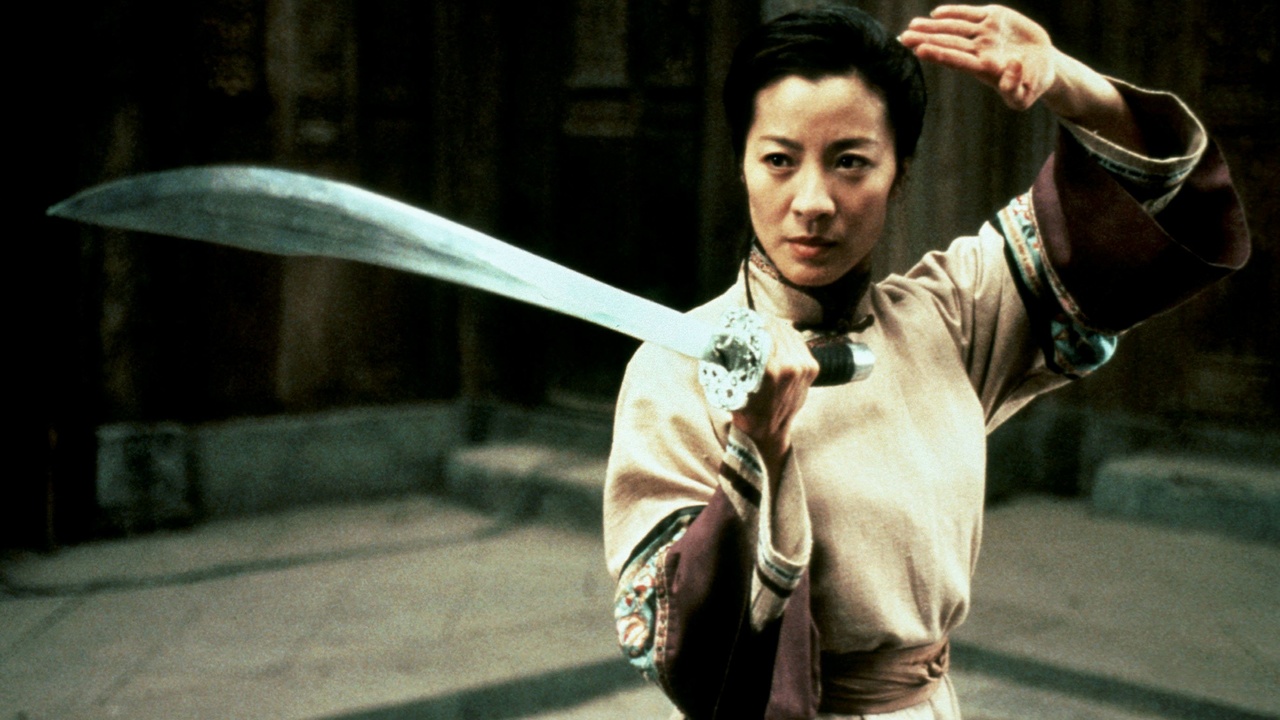
Watch the first fight between Yu Shu Lien and Jen Yu. It is staged as a rooftop chase through a sleeping city. Jen has stolen the Green Destiny, Li Mu Bai’s legendary sword, and Shu Lien pursues her across the rooftops of Beijing.
On the ground, these two women cannot speak to each other honestly. Shu Lien is a warrior, but she has bound herself to propriety. Jen is a noblewoman, but she has bound herself to rebellion. One is free in title but constrained in practice. The other is constrained in title but wild in practice. They are mirrors. And on the ground, the mirror cannot be acknowledged. The social distance between a warrior-courier and a governor’s daughter is too vast.
In the air, the distance disappears. In the air, two bodies are simply two bodies. They speak in strikes and counters, in the geometry of pursuit, in the physics of a leap. And what they say, translated from the body’s language, is something like: I know you. I know what you are. I know what you’re hiding. And I am hiding the same thing.
Ang Lee understood that the wuxia genre’s wire-assisted flight was not a special effect. It was a grammar. Every fight in Crouching Tiger is a conversation that the characters cannot have on the ground. Li Mu Bai and Shu Lien’s few sparring moments carry the tenderness their words deny. Jen and Lo’s desert flashback fights are foreplay, aggression transmuted into desire. Shu Lien’s final confrontation with Jen, where she cycles through weapon after weapon, is a plea: stop running. Let someone in. Each weapon is a different argument. Each parry is a refusal.
The body, in this film, is the only honest organ. The mouth lies or stays silent. The eyes comply. The posture conforms. But the body, given the space of combat, says everything.
This is the connection to Moonlight, the film that opened this cycle. Chiron’s body could only be honest in specific conditions: in the ocean with Juan, on the beach with Kevin, in darkness, in silence. The institution, whether it was the school or the street or the drug trade, demanded a performed body. The real body emerged only in stolen moments.
Crouching Tiger scales this insight to an entire civilization. The institution here is not poverty or racism or homophobia. It is culture itself. The Confucian hierarchy. The patriarchal arrangement. The martial code. These are not presented as villains. Lee has too much respect for the tradition to reduce it. But they are presented as a gravitational field. They pull the body down. They hold it to the earth. And the body, when it lifts, is not escaping the institution. It is saying what the institution will not let it say on the ground.
The Bamboo Forest
The bamboo forest sequence between Li Mu Bai and Jen Yu is the most beautiful fight ever filmed. I say this without qualification. It is also the most articulate.
Two bodies in the treetops. The bamboo sways. Neither combatant can find solid footing. They bend and recover, bend and recover, the trees yielding beneath them, the fight becoming less about strikes and more about balance, about finding a center in a medium that has no center.
Li Mu Bai is trying to recruit Jen. He sees her talent. He wants to train her properly, to bring her into the Wudan lineage, to give her what Jade Fox could not. He is, in the language of the institution, offering her a place.
Jen refuses. Not because the offer is bad. Because the offer comes with the institution attached. Wudan means discipline. It means hierarchy. It means a master above and a student below. And Jen, who has tasted freedom in the desert with Lo, who has felt what it is to live outside every structure, will not submit. Not to her father. Not to her fiancé. Not to Li Mu Bai. Not to anyone.
The bamboo fight is their argument, and neither wins because the bamboo will not let either of them stand firm. The trees bend. The footing shifts. The bodies sway. It is the physical enactment of an irresolvable tension: the institution offers structure, and the structure is real and valuable, but the structure requires submission, and submission is the one thing this body will not give.
In Pan’s Labyrinth, we watched Ofelia disobey from within the structure of the story. Her disobedience was precise and chosen. She followed the faun’s tasks until following meant betraying her brother, and then she refused. Jen’s disobedience is wilder, less controlled, more destructive. Ofelia disobeys the story at one critical juncture. Jen disobeys everything, constantly, and the destruction she causes is part of the cost.
Lee does not take sides. This is what makes Crouching Tiger so much more than an adventure film. Li Mu Bai’s offer is sincere. The Wudan discipline is real. Jen’s refusal is also sincere. Her hunger for freedom is real. And the bamboo bends beneath both of them because neither position can hold the other’s weight.
The Woman Who Was Refused
Jade Fox is the film’s most overlooked character, and she is its key.
She wanted to learn. The Wudan master took her to his bed but would not take her as a student. The knowledge, the physical knowledge, the body’s knowledge, was reserved for men. She killed him. She stole a manual. She taught herself, imperfectly, and she taught Jen.
Jade Fox is what the institution produces when it excludes. She is not a villain in the conventional sense. She is a consequence. The Wudan school denied a woman access to its tradition, and what it got in return was a woman who learned anyway, badly, angrily, and passed on a corrupted version of the knowledge to the next generation.
Lee makes a subtle and devastating point here. Jen is more talented than Jade Fox. Jen surpassed her master. And Jade Fox knows this. Her pupil exceeded her using the same manual she stole, because Jen could read the classical Chinese that Jade Fox could not. The institution locked Jade Fox out twice: once from the school, and once from the written language that encodes the school’s secrets.
The body in flight, in Jade Fox’s case, is a stolen body. She flies, but her flight is imperfect, learned in secret, corrupted by exclusion. She is what happens when the institution says: this body does not belong here. The body finds a way in anyway. And what it learns, it learns wrong, and the wrongness becomes rage.
The Sword Everyone Wants and No One Can Hold
The Green Destiny is the film’s central object, and everyone misreads it.
It is not a MacGuffin. It is not a symbol of power. It is a symbol of what power costs. Li Mu Bai wants to give it up. That is his first act in the film: surrendering the sword to Shu Lien to deliver to a collector. He is tired. He entered meditation and found not peace but “a deep sadness.” The sword, the legendary weapon, the physical emblem of his mastery, has given him nothing he actually wants.
Jen steals it. She wants it because it represents everything she has been denied: agency, skill, the right to be dangerous. In Jen’s hands, the Green Destiny is freedom. It is the body’s argument made physical: I can do what you do. I can do what you told me I couldn’t.
But the sword does not make Jen free. It makes her a fugitive. Every person she fights, every rooftop she crosses, every tavern she demolishes in that astonishing set piece where she defeats an entire room of warriors, brings her closer to the conclusion the film is building toward: you cannot steal freedom. Freedom that is taken by force is just another performance of the institution’s logic. The institution says: power comes from the sword. Jen agrees with the institution. She just wants to hold the sword herself.
Li Mu Bai understood this. That is why he surrendered it. The sword is the institution’s language. Mastery of the sword is mastery of the institution’s grammar. And Li Mu Bai, after a lifetime of mastery, found only sadness, because the institution’s grammar cannot express the one thing he actually wants to say: I love you. I have always loved you. The sword is useless for this.
The Love That Cannot Land
Li Mu Bai and Yu Shu Lien love each other. The film gives us this fact early, plainly, without ambiguity. It is not a question. It is a condition. They love each other the way gravity is a condition: constantly, invisibly, without negotiation.
And they never act on it. Not once. Not in a single scene do they kiss, embrace, or consummate. They orbit each other. They almost touch. The gap between their bodies, when they sit together, when they walk together, when they fight together, is the most charged negative space in cinema.
Why? Because of the dead man. Shu Lien’s fiancé, Li Mu Bai’s sworn brother. He died. The debt survived him. The institution of brotherhood, of betrothal, of honor between warriors, outlived the person it was built around and became a wall between the two people who remained.
This is the institutional gravity the film cannot escape. Not patriarchy alone. Not Confucian hierarchy alone. Something more intimate and more devastating: the unspoken agreement that love must defer to duty, that the body’s desires are subordinate to the social contract, that what you feel matters less than what you owe.
In Portrait of a Lady on Fire, we watched two women create a temporary space outside the institution’s gaze. The painter’s studio. The island. The bounded weeks where looking became loving. But that space was always borrowed. The institution waited outside, and when the time expired, the women returned to it.
Li Mu Bai and Shu Lien never even build the temporary space. They never borrow the time. Their love exists entirely in the gap: in the almost-touch, the interrupted sentence, the fight that says what the conversation cannot. Portrait of a Lady on Fire gave its lovers one scene of mutual gaze. Crouching Tiger gives its lovers a lifetime of averted eyes.
Li Mu Bai dies. Poisoned by Jade Fox. And in his final moments, held by Shu Lien, he says it. He finally says it. He tells her he has always been at Wudan not for the meditation but because of her. He would rather be a ghost drifting by her side than enter heaven without her.
He says it when he is dying. The body, finally, only at the point of its own destruction, says the thing it has spent an entire film refusing to say. And then the body stops.
Shu Lien holds him. The institution won. It won by making the cost of honesty so high that honesty only arrives at the moment of death. The body, which fought and flew and sailed across rooftops, could only be truthful when it was ceasing to exist.
The Last Leap
Jen goes to Wudan Mountain. Lo is there, waiting. The legend says that if you leap from the mountain and your wish is sincere, it will be granted.
Jen leaps.
We see her fall. She does not fly. She drops. The clouds swallow her. Lo watches from the bridge. The film ends.
What is the wish? The film does not say. And the ambiguity is not evasion. It is precision. Because Jen’s leap is the culmination of everything the film has argued.
On the ground, the institution rules. In the air, the body speaks. But speaking is not the same as being heard, and flight is not the same as freedom. Jen fought everyone. She refused every structure. She stole the sword, beat the warriors, ran from her marriage, defied Li Mu Bai, surpassed Jade Fox. And at the end of it, she has Lo and a mountain and a legend about a wish.
She jumps because the jump is the last honest act available. Not a fight. Not a refusal. Not a theft. A surrender. The body, which has done everything it can in the air, now falls. And the fall is the body’s final statement: I have spoken with every muscle and every blow and every leap, and the institution is still there, and Lo is still waiting, and the dead are still dead, and the only language I have left is gravity.
In The Elephant Man, Merrick lay down to sleep like a human being, knowing it would kill him. He chose to stop being displayed. Jen’s leap is the same gesture, translated from the London Hospital to Wudan Mountain, from a man whose body trapped him to a woman whose body was the only free part of her. Both chose the body’s truth over the body’s survival.
Merrick lay down. Jen jumped. Both bodies said: I am done performing. I am done flying. I am done being seen. Watch what happens when I stop.
The Institution Follows You Up
Here is the reading of Crouching Tiger, Hidden Dragon that most admirers resist: flight is not freedom.
The bodies fly. The fights are gorgeous. The rooftop chases and bamboo swaying and lake-skimming are breathtaking. And none of it liberates anyone. Li Mu Bai flies and still cannot say he loves Shu Lien. Jen flies and still cannot escape her betrothal. Jade Fox flies and still cannot learn what was denied her. Shu Lien fights with extraordinary skill and still goes home alone.
The air is not outside the institution. The air is where the institution’s pressure becomes visible. On the ground, the pressure is invisible. It is embedded in every polite sentence, every averted gaze, every unfulfilled duty. In the air, the pressure takes physical form: a sword stroke, a block, a pursuit, a retreat. The fights make the invisible visible. They do not escape it.
This is what separates Crouching Tiger from a hundred lesser martial arts films. The flying is not a fantasy of escape. It is an expression of entrapment. The body goes up because it cannot go forward. The body fights because it cannot speak. The body is most articulate in the air, and the air is still inside the institution’s gravitational field.
In Spirited Away, the bathhouse took Chihiro’s name and gave her a new one, and the entire film was the project of recovering the original. The institution controlled identity by controlling language. Crouching Tiger operates on the same principle but with the body instead of the name. The institution controls the body by controlling where it can go, what it can do, who it can touch. The body in flight is the body temporarily escaping that control. But the escape is temporary. The body always comes down. The ground is always there. And on the ground, the institution waits.
Where This Leads Us
Four films into this cycle, the body has been armor, spectacle, exhibit, and now language. In Moonlight, the body hardened. In The Wrestler, the body performed. In The Elephant Man, the body was displayed. In Crouching Tiger, the body flew because speaking was forbidden.
But we haven’t yet looked at the body that is consumed. Not from the outside. Not by the audience or the institution or the social contract. From the inside. By its own desires.
There is a film about four bodies, each pursuing a different dream: fame, connection, youth, escape. Each dream begins as aspiration and ends as appetite. And each appetite, with methodical, symmetrical, almost musical precision, eats the body alive.
The mother in front of the television. The son in the needle’s grip. The girlfriend on the stage. The friend in the cell. Four bodies. Four dreams. Four destructions.
Requiem for a Dream (2000). Darren Aronofsky’s film about what happens when the dream is not an institution or a performance or a cage. When the dream is a hunger. And the hunger turns the body into fuel.