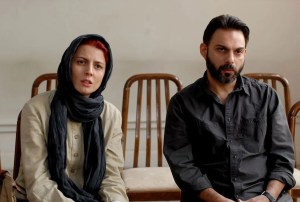
A Separation constructs a moral universe in which every adult lies, and every lie is eventually exposed. Then it ends before the one character who knows the whole truth is allowed to speak.
INTERROGATING JUDGE: Why do you want to leave the country?
SIMIN: I don’t want my daughter raised in these circumstances.
INTERROGATING JUDGE: Did you know Razieh was pregnant when you pushed her out of the apartment?
NADER: I did not know she was pregnant.
INTERROGATING JUDGE: Did Nader cause your miscarriage?
RAZIEH: (after a long silence) I cannot swear to it on the Quran.
INTERROGATING JUDGE: Did you tie the old man to the bed and leave the apartment?
RAZIEH: I had urgent personal business.
INTERROGATING JUDGE: Did you lie in court to protect your father?
TERMEH: (pause) Yes.
INTERROGATING JUDGE: Termeh. Which parent do you choose to live with?
TERMEH:
A Separation (2011) won the Golden Bear in Berlin, the Academy Award for Best Foreign Language Film — the first Iranian film to do so — and holds a near-perfect 99% on Rotten Tomatoes. Roger Ebert, who ranked it the best film of 2011, wrote that it “will become one of those enduring masterpieces watched decades from now.” He was right. Asghar Farhadi’s film is one of the genuinely great works of twenty-first-century cinema: a moral mechanism of such precision that every viewing tightens another screw. It received praise from Steven Spielberg, David Fincher, and Meryl Streep. It was studied in law schools. It has been called a perfect film.
It is also a film that ends before its own question is answered — and the reason it ends there is not artistic ambiguity. It is something more personal and more exposed than that.
| Director | Asghar Farhadi |
|---|---|
| Year | 2011 |
| Runtime | 123 minutes |
| Cast | Leila Hatami, Peyman Moaadi, Shahab Hosseini, Sareh Bayat, Sarina Farhadi |
| Awards | Academy Award Best Foreign Language Film; Golden Bear Berlin; Golden Globe Best Foreign Language Film |
| Streaming | MUBI, Kanopy |
The film opens the way it means to continue: in a courtroom, the married couple Nader and Simin addressing the camera directly as if the camera is the judge. Simin wants to leave Iran with their daughter Termeh. Nader refuses to go. He must care for his father, who has Alzheimer’s and does not recognise him. “But he doesn’t even know you,” Simin says. “No,” Nader replies, “but I know him.” The judge rejects Simin’s petition for divorce. She moves to her parents’ apartment. Nader hires a caregiver, Razieh, a deeply religious woman from a working-class suburb who must keep her employment secret from her husband Hodjat, whose faith forbids her from working in a man’s household. When Nader comes home early one day to find his father tied to the bed and Razieh absent, a confrontation at the door ends with Nader pushing Razieh into the stairwell. She suffers a miscarriage. Whether Nader knew she was pregnant when he pushed her is the question that will determine whether he is guilty of a crime. Every character’s testimony, every partial truth and outright lie, circles this question for the rest of the film.
Farhadi’s method is the slow revelation of what each character has withheld. It is completely reliable. Every concealment in the film is eventually uncovered: Razieh lied about why she left the apartment. Nader lied about knowing she was pregnant. Hodjat lied about his willingness to swear on the Quran. Simin withheld money information that could have changed the case’s shape. The film is an architecture of exposure. Its moral argument is that full truth is never available to any single party — and yet it keeps delivering fragments of it, keeps pulling the curtain back, keeps insisting that what was hidden will be shown.
The film that promised to reveal everything ends before the one person who holds the whole truth is allowed to speak. The last blank in the transcript is not ambiguity. It is a father who could not make his daughter pronounce judgment on him.
Termeh is the film’s moral centre and its most carefully protected character. She is played by Sarina Farhadi — the director’s own daughter. She is the one character who actually holds the complete truth: she overheard Nader on the phone confirming the pregnancy before the confrontation with Razieh, which means she knows her father lied in court. She then lied in court herself to protect him. Then she could not sustain the lie. She has spent the film watching two families and one marriage destroyed while carrying the key fact that could have ended the legal proceedings at any point. Her knowledge, and her silence about it, is the film’s real engine.
Watch how the film handles her. While every adult character is subjected to the interrogating judge’s questions, to cross-examination, to the grinding exposure of the legal apparatus, Termeh is mostly seen watching through doorways and windows. Farhadi’s staging returns to this image repeatedly: Termeh behind glass, Termeh in the gap of a door, Termeh as the figure who observes the adult machinery without being drawn fully into it. She is present at nearly every crisis and almost never centred within the frame of consequence. The film keeps her at the threshold. When she is finally given the frame — when the camera settles on her face and requires her to speak — she tells the truth about her lie. It is the most devastating scene in the film. Her father-character’s case is broken at the moment his daughter breaks under the weight of protecting him.
And then the film asks her to choose.
At its conclusion, the divorce is settled. The parents wait in separate corridors of the family court. Termeh enters the judge’s office to deliver her verdict: which parent will she live with? The film ends on the closed door of that office. The choice stays inside. Every review of A Separation that calls this ending a masterstroke of ambiguity is correct and is also, gently, not looking at who is behind that door. Farhadi’s moral architecture has exposed every adult in the film. He could construct partial guilt for Nader, for Simin, for Razieh, for Hodjat. What he could not do was make his own daughter deliver the verdict on a figure who stands, in the film’s emotional logic, for the father: the man who stayed, who asked too much, who lied about what he knew, who let his child carry the weight of his secret until it broke her. Termeh choosing Simin would be the director’s child choosing against him. Termeh choosing Nader would be the director’s child forgiving him. Either answer is the film’s confession, and the film cannot make it.
The ending is not ambiguous. It is silent in the way that a person is silent when the question is too close.
This connects to the thread running through recent reviews in this sequence about what films built from autobiographical material cannot finally face. In our piece on Cold War, we traced how Pawlikowski’s elliptical structure — the cut to black, the jump of years — was exactly the shape of what a son can know about his parents’ marriage, and how the gaps swallowed Zula’s years without Wiktor. Farhadi’s problem is the reverse: he knows too much, or at least his daughter does, and the gap at the end of A Separation is not an ellipsis but a door held shut. Both films use their formal withholding as protection. What A Separation reveals that Cold War does not is that the protection is not the filmmaker’s — it is the child’s.
The film is still a masterpiece. What the legal mechanism could not adjudicate, Farhadi’s formal instinct handled with absolute precision: end before the verdict, leave the door closed, and let the viewer carry the weight that Termeh has been carrying all film. That is what the film does to us and cannot acknowledge it is doing. We leave the cinema in Termeh’s position — knowing everything except the one answer that would resolve it, and understanding, on some level we can’t quite name, that the resolution was never the point.
If this stayed with you, watch these next:
About Elly (Asghar Farhadi, 2009): Farhadi’s film before A Separation, which deploys the same mechanism of the slowly revealed concealment in an entirely different social register — a group of middle-class friends on a Caspian Sea holiday, an absence that compounds into catastrophe — and which shows how fully formed this moral architecture already was before the world knew his name.
Cold War (Paweł Pawlikowski, 2018): as we argued in the previous review, the film that compresses a love story in cuts to black — each gap erasing years of one character’s experience — and whose formal withholding turns out to be the exact shape of a son’s knowledge of his parents’ marriage; the parallel with Farhadi’s own daughter standing behind the closed door is uncomfortable and precise.
UnspokenCinema publishes every week. No ratings. No rankings. Just what films reveal without meaning to.