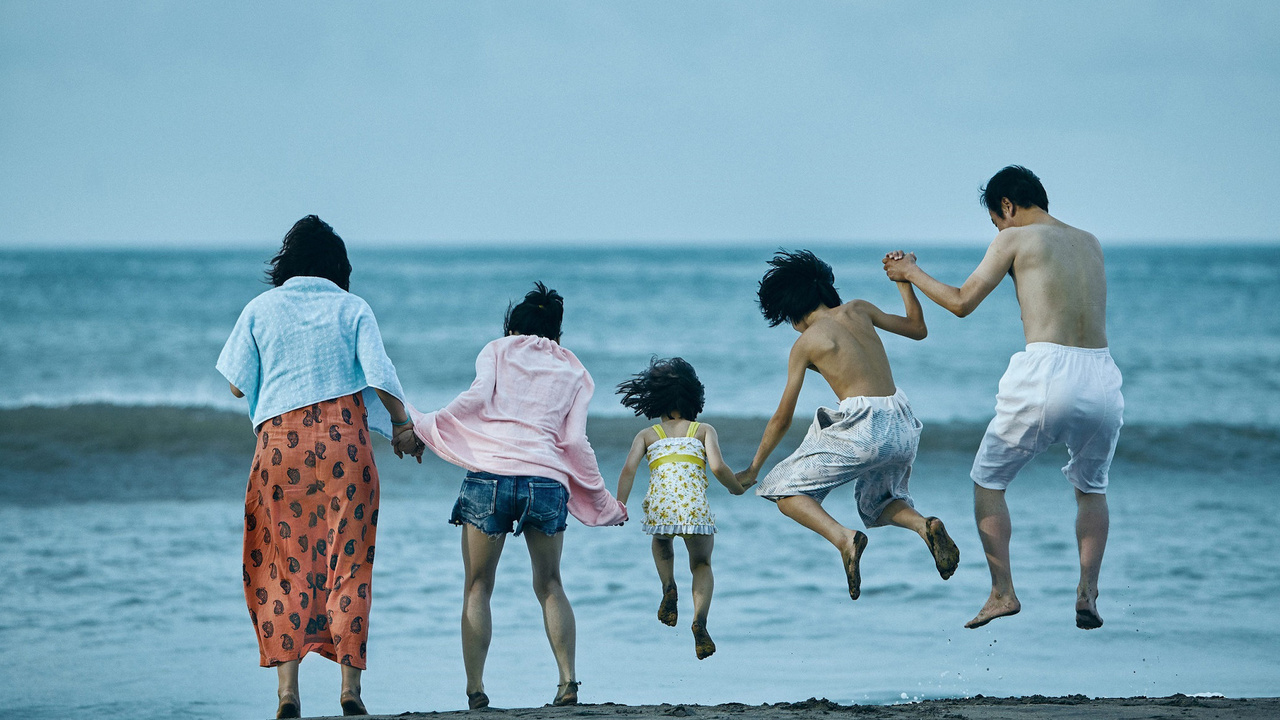
They eat together.
This is the first thing you need to know about the family in Shoplifters, and it is the thing Hirokazu Kore-eda returns to again and again, because it is the foundation of everything he is arguing. They sit around a low table in a house too small for all of them, and they eat. The food is cheap. Instant noodles, croquettes bought on discount, shrimp tempura on good days. They eat with the unselfconscious pleasure of people who know that food is not guaranteed, that this meal exists because someone shoplifted the ingredients or found the money or stretched what was left, and the eating is an act of gratitude performed without the word gratitude ever being spoken.
Osamu. Nobuyo. Hatsue. Aki. Shota. And eventually, Yuri, the little girl they find on a balcony in the cold, the child with bruises on her arms, the one they take home because home is a place where someone should want you, and the people in her legal home did not want her, and the people in this illegal home do.
This is the family. None of them are related by blood. None of them have legal claim to each other. The state does not recognize them. The family registry, that fundamental document of Japanese social identity, contains none of their real connections. To the institution, they are strangers living together, committing fraud, harboring a missing child.
To each other, they are everything.
The House
The house is tiny.
It belongs to Hatsue, the grandmother, or at least she is the one who has lived there longest. It is cluttered, dim, overflowing with the accumulated debris of lives lived at the margins. There is barely room to move. The futons are laid out side by side at night and the family sleeps together, a tangle of bodies, the way families do when there is not enough space to separate and the lack of separation becomes its own form of intimacy.
Kore-eda films this house the way he films everything: with a patience that borders on reverence. He does not aestheticize the poverty. He does not shoot the clutter as picturesque or the cramped spaces as charming. He shoots them as they are: small, worn, insufficient by any material standard, and warm. The house is warm because the people in it have made it warm, through proximity, through meals, through the daily repetition of choosing to be here with each other.
This series has examined many institutional spaces. The Overlook Hotel, vast and haunted. The Park family’s house in Parasite, architecturally perfect and morally poisoned. The Overlook claimed Jack. The Park house sorted people by floor. Noah Cross’s Los Angeles was built on stolen water. The Citadel in Fury Road was a vertical fortress of extraction.
Hatsue’s house claims nothing. It sorts no one. It extracts nothing. It is too small and too poor to function as an institution. It is just a space where people can be together, and the being together is not a means to an end. It is the end.
After forty-four films of institutions that consume, control, rename, and discard, the final space in this series is a room where a family that shouldn’t exist eats noodles on the floor.
Osamu
Lily Franky’s Osamu is the father figure. He is a day laborer when work is available and a shoplifter when it isn’t. He is gentle, funny, a little hapless. He teaches Shota the techniques of stealing from convenience stores with the pride and care of a craftsman passing on his trade.
Osamu is not a good man in any conventional sense. He steals. He lies. He is complicit in hiding Yuri from the authorities. He benefits from Hatsue’s pension in ways that the law would call elder fraud. By every institutional metric, he is a criminal.
And he is the best father in this series.
Not because he is responsible or reliable or capable of providing material security. Because he is present. Because he teaches Shota with patience. Because he carries Yuri on his shoulders. Because he sits at the table and eats and laughs and plays and does the thing that fatherhood, at its most reduced, actually consists of: being there, wanting to be there, choosing to be there again tomorrow.
Think about the fathers this series has encountered. Jack Torrance, whose fatherhood was a performance that concealed a threat. The Godfather’s Vito, whose love was a system of control. Captain Vidal in Pan’s Labyrinth, whose fatherhood was a lineage of violence. Travis Bickle, who cast himself as a father figure to Iris as a justification for murder.
Osamu has no lineage. He has no power. He has no institutional authority. He has only the daily act of showing up, and the act is enough, and the fact that the institution would remove this man from this child’s life because he has no legal claim to her is the film’s quietest and most devastating indictment.
Nobuyo
Sakura Andō’s Nobuyo is the mother, and she carries the film’s moral weight with a stillness that is almost unbearable.
Nobuyo works in a laundry. She is practical, tired, and deeply aware of the precariousness of everything the family has built. She understands, more clearly than Osamu, that what they are doing with Yuri could be called kidnapping, that the house of cards could collapse at any moment, that the warmth they have created exists at the pleasure of a world that has not yet noticed them.
And she keeps choosing it.
There is a scene in which Nobuyo holds Yuri and sees the burns and bruises on the child’s body. She does not call the police. She does not return the child to the parents who burned her. She holds Yuri closer and says, quietly, to herself as much as to anyone: “This is how you hold someone when you love them.”
This is the line that cracks the film open, because it contains the entire argument. The legal parents, the biological parents, the parents the state recognizes, burned their child. The illegal mother, the stranger, the woman with no legal claim, holds the child properly. And the state, when it eventually intervenes, will return the child to the people who burned her, because the state does not measure holding. The state measures documentation.
Nobuyo knows this. She knows the institution will win. She holds the child anyway.
After the interrogation, after the family is discovered and separated, Nobuyo is asked why she took Yuri. The detective suggests she wanted to be a mother. Nobuyo’s face, in the pause before she answers, carries more weight than any monologue in this series.
She did not take Yuri to be a mother. She is already a mother. She became one the moment she held the child correctly. The institution’s refusal to recognize this does not make it less true. It makes the institution less true.
Hatsue
Kirin Kiki’s Hatsue is the grandmother. She is the oldest member of the family, the person whose house they share, the center around which the others orbit.
Hatsue is collecting a pension from her deceased husband. She is also receiving financial support from her ex-husband’s family, who visit occasionally with envelopes of cash, which Hatsue accepts with the serene pragmatism of a woman who has learned that survival is not a moral category.
Hatsue is the family’s founder, though the word “founder” is too institutional. She is the person who let the others in. Osamu and Nobuyo came first. Then Aki, a young woman who may or may not be Hatsue’s granddaughter (the connections are deliberately blurred). Then Shota, a boy found in a car. Then Yuri, found on a balcony.
Hatsue’s house is an open door. Not philosophically. Materially. She has a door, and she opens it, and the people who come through it become family, and the becoming is not conditional on blood or documentation or institutional approval. It is conditional only on the continued choice to stay.
When Hatsue dies, the family buries her in the house. Beneath the floor. They cannot report her death because the death would end the pension, and the pension is one of the few legitimate income streams the family has. They bury the grandmother in the earth beneath the room where they eat, and they continue to live above her, and the act is illegal and tender and logical and the most precise image of what this family is: people who keep their dead close because they cannot afford to let anything go.
The institution would call this desecration. The family calls it home.
Shota
Shota is the boy, and he is the character who breaks the family.
Not intentionally. Not maliciously. Shota breaks the family because he is growing up, and growing up means beginning to see the family the way the world sees it, and the world sees it as a crime.
Osamu taught Shota to shoplift. For years, this was a game, a skill, a form of father-son bonding conducted in convenience store aisles. But Shota has been going to school (enrolled under a false identity, in a system that would remove him if it knew the truth), and school is an institution, and the institution is teaching him different rules. Rules about right and wrong that do not accommodate the family’s survival strategy. Rules that make what Osamu does a crime rather than a craft.
Shota is caught shoplifting. He is caught deliberately. He jumps off a bridge to create a diversion so Yuri can escape, and the fall breaks his leg, and the hospital calls the police, and the police investigate, and the family is discovered.
The child’s growing conscience is what destroys the family. Not the state’s surveillance. Not an enemy’s vengeance. Not institutional malice. A boy’s developing sense that stealing is wrong, a sense cultivated by the very institution (school) that the family enrolled him in to give him a better life.
This is the most painful irony Kore-eda constructs, and it is an irony about institutions and the people who try to live outside them. The family gave Shota school because school is what families give children. And school gave Shota the moral framework that made the family visible to the state. The institution the family trusted with their child became the instrument of their destruction.
You cannot live entirely outside the institution. You send your child to school, and the school teaches the child to see you the way the institution sees you. And the child, in the act of becoming a person, becomes the person who ends what you built.
The Interrogation
The family is arrested. They are separated. They are interrogated individually.
Kore-eda films the interrogations with the same patience he films the meals, and the parallel is deliberate. The table where the family ate is replaced by the table where the family is dismantled. The detectives ask questions designed to categorize: who is related to whom, who has legal claim, who is a parent and who is a stranger.
The detectives are not cruel. They are professional. They are doing their jobs, which is to sort people into the categories the institution recognizes: family and non-family, parent and non-parent, victim and perpetrator. The categories are not malicious. They are the mechanism by which the state organizes human life, and the mechanism requires that every person be legible within the system.
This family is not legible.
They are not related. They have no documentation. Their names are not their real names. The child they took was reported missing. The grandmother they buried was reported alive. Every fact the detectives uncover makes the family less real in institutional terms, and every fact the audience has witnessed over the previous two hours makes the family more real in human terms, and the gap between institutional reality and human reality is the space where the film lives and where it breaks your heart.
The detective asks Nobuyo: “What did the children call you?”
Nobuyo pauses.
They didn’t call her anything. They didn’t call her Mom. The name was never spoken. The role was performed daily, in the holding and the feeding and the choosing, but the word was never used, because the word is the institution’s word, and the institution did not grant it, and the family existed in the space before the word, in the space where the act is enough.
The detective does not understand this. The detective cannot understand this. The detective’s job requires the word. Without the word, there is no category. Without the category, there is no recognition. Without recognition, there is no family.
The institution needs the name. The family had the thing the name refers to. And the thing without the name is invisible to the institution, and the institution’s blindness is what separates the children from the people who loved them.
What Holds
This is the final film in Cycle Three, and it is the final film because it answers the question the cycle has been asking across forty-four films.
The question was: what holds?
When the story collapses (Mulholland Drive). When the hero narrative turns poisonous (Taxi Driver). When the institution provides the script (The Shining). When the investigation changes nothing (Chinatown). When meaning itself becomes obsolete (No Country). When outrage becomes content (Network). When the story is a trap (Oldboy). When the narrative resists (Pan’s Labyrinth). When the listener is transformed (The Lives of Others). When the gaze becomes mutual (Portrait of a Lady on Fire). When the unlived life haunts the lived one (Past Lives). When no story is reliable (Rashomon). When the genre knows it’s a genre (Scream). When art and warmth go to war (The Banshees of Inisherin).
What holds?
Kore-eda’s answer is the table.
Not the story told at the table. Not the meaning made at the table. Not the institution that sanctions the table. The table itself. The act of sitting down together and eating. The daily, unremarkable, uncelebrated act of being in the same room with people you chose and who chose you, eating food you found or stole or stretched, in a house too small for all of you, with no legal claim on each other and no institutional recognition and no guarantee that tomorrow will not take it all away.
The table holds.
It holds because it is not a narrative. It is not a performance. It is not a story anyone is telling about themselves. It is the thing that exists before and beneath all stories: the human need to be in the company of other humans, to share food, to share warmth, to share the space between waking and sleeping.
Every institution this series has examined has offered a version of this. The Overlook offered Jack belonging. Hollywood offered Diane recognition. The military offered Travis a mission. The bathhouse offered Chihiro a place. But every institutional offer came with a price: your name, your body, your freedom, your self.
The table in Hatsue’s house offers nothing except itself. It promises no legacy. It bestows no name. It demands no performance. It is just a surface where food is placed and where people sit, and the sitting is the thing, and the thing is enough.
The Last Image
The final scene of Shoplifters.
Yuri, returned to her biological parents, the parents who burned her, stands on the balcony where the family first found her. She is alone. She is playing with a marble. She looks out over the railing, into the distance, the way a child looks when they are waiting for someone who is not coming.
Kore-eda holds the shot.
Yuri is back in the institution. She is back in the family the state recognizes, the family with the documentation, the family with the legal claim. She is back where she started: on the balcony, in the cold, with bruises that will not be investigated because the people who made them are the people the system says are responsible for her.
The family that held her correctly is gone. Osamu is in prison. Nobuyo is in prison. Shota is in a facility. Aki is alone. Hatsue is dead beneath the floor of a house that has been emptied.
The warmth is gone. The table is cleared.
And Yuri is on the balcony, looking out, waiting.
Kore-eda does not tell you what she is waiting for. He does not tell you whether she remembers the house, the noodles, the shoulder rides, the way Nobuyo held her. He does not resolve. He holds the shot and he lets you sit with the image of a child on a balcony in the cold, returned to the institution that hurt her, separated from the people who loved her, because the institution could not see what you, the audience, spent two hours seeing.
The family was real. The institution says it wasn’t. And the child is on the balcony.
This is the last image of Cycle Three, and it is the last image because it contains everything the cycle has been arguing, compressed into a single shot: that institutions sort people into categories that do not correspond to human reality. That the state’s definition of family is a legal fiction that sometimes aligns with love and sometimes does not. That the people who hold you correctly may have no right to hold you. That the people who have every right may burn you. That the table where you were fed and the floor where the dead were kept and the room where you slept in a tangle of bodies that were not yours by blood but were yours by choice was the realest thing you ever had.
And it is gone.
And you are on the balcony.
And you are looking out.