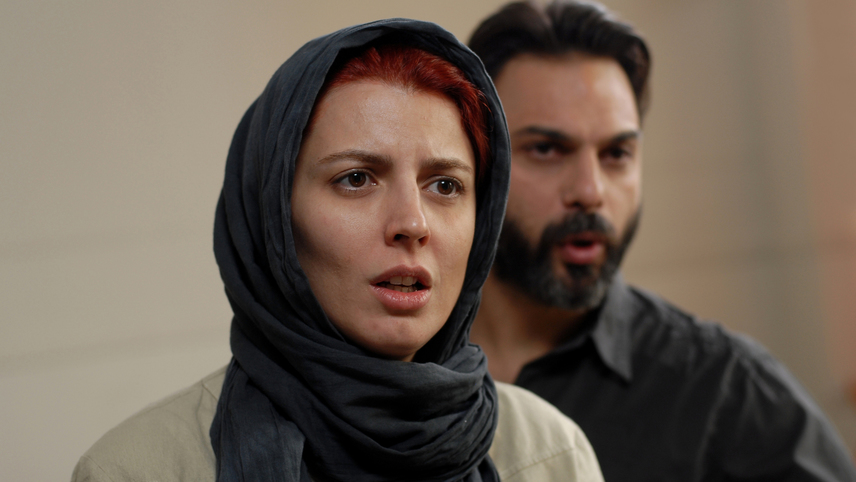
There is a film that will break your trust in being right.
Not wrong. Being wrong is easy. Being wrong has a shape, a fix, a direction. You apologize. You adjust. You learn. Being wrong is a problem with a solution, and problems with solutions are, in the grand scheme of things, a comfort.
Being right is the thing A Separation will make you afraid of. Being right and watching everything fall apart anyway. Being right and causing damage that your rightness cannot repair. Being right the way two walls are right when they meet at a corner: both perfectly vertical, both exactly where they should be, and between them, nothing. A corner. A trap. A place no one can live.
A married couple, Nader and Simin, are in a courtroom. Simin wants to leave Iran. She has secured a visa. She wants to take their daughter, Termeh, and build a life elsewhere. Nader will not go. His father has Alzheimer’s. The old man cannot be left, cannot be moved, cannot be explained to. Nader will not abandon his father. Simin will not abandon her daughter’s future.
They are both right.
This is the first thing the film does to you: it removes the exit. In every conflict you’ve ever watched on screen, there is a side. You may not choose it immediately, but the film gives you enough information, enough framing, enough music, to know where your sympathy belongs. Farhadi gives you nothing. He places the camera at the exact midpoint between two people who love each other and love their daughter and are about to destroy their family because they have different definitions of what love requires them to do. And both definitions are correct.
You will spend the first twenty minutes waiting for one of them to be wrong. You will spend the rest of the film realizing that the wrongness you’re waiting for is something you invented to make conflict survivable, and that Farhadi has no intention of providing it.
The separation of the title is not a divorce. It is not even primarily about the marriage. It is about what happens when two moral positions, each internally flawless, each motivated by genuine love, collide. The film takes this collision and feeds it into the machinery of daily life: a hired caretaker, an accident, a lie, a miscarriage, a courtroom, a child standing between two parents trying to hold the last thing together.
Each of these events produces a new conflict, and each new conflict has the same structure as the first: two people, both right, both trapped by their rightness. The caretaker, Razieh, is right to feel wronged. Nader is right to feel accused. Razieh’s husband, Houjat, is right to be furious. The judge is right to demand clarity in a situation that has none. And at every turn, the rightness of each person tightens the knot rather than loosening it, because rightness, it turns out, is not a tool for resolution. It is a tool for escalation.
You know this. You have lived this. Not in a courtroom, probably, but in a kitchen, or a family WhatsApp group, or a conversation that started about dishes and ended somewhere nobody intended. You have been in the argument where both sides are correct and the correctness is the problem, where being right gives you exactly enough moral fuel to keep going and not enough moral clarity to stop.
A Separation is going to make you relive every one of those arguments. Not the content. The structure. The feeling of standing on solid ground and watching the ground on the other side be equally solid and understanding, slowly, that the space between two right people is where the most damage is done.
I want to talk about the child.
Termeh, the daughter, is eleven. She is watching her parents come apart. She is not collateral damage. She is the damage. She is the space between the two walls. And Farhadi, who is merciless in the way that only deeply compassionate filmmakers are merciless, makes you watch her navigate the impossible geography of a home where both parents are right and the rightness is destroying the only thing she needs, which is for them to be in the same room without the room becoming a courtroom.
There is a scene where Termeh does her homework while her parents argue in the next room. She does not cry. She does not slam her door. She sits at her desk and works on a maths problem and you will understand, in that moment, that she is already learning the lesson the film is teaching you: that the world is full of problems with correct answers, and that the correct answers do not help, and that the homework is a place to hide from the problems that don’t have solutions.
If you are a parent, this scene will cost you something. If you are a child of parents who loved you and could not stay together and were both right about why, this scene will cost you more.
Here is the thing A Separation does that no other film in this series does: it makes you distrust your own moral instincts.
Every other film here works on your emotions. They make you feel restraint, guilt, grief, desire, longing. They access parts of you that are pre-rational, that exist below argument. A Separation works on your reason. It attacks the part of you that believes that if you can figure out who is right, you can figure out what to do. It shows you a situation where figuring out who is right is trivially easy (everyone is right) and figuring out what to do is impossible.
This will follow you into your next disagreement. Not as a memory of the film, but as a hesitation. A half-second pause before you deploy your best argument. Because the film has shown you what your best argument looks like from the other side: equally valid, equally principled, equally destructive. And in that half-second pause, you will feel something you rarely feel in the middle of a conflict: doubt. Not about your position. About whether your position is relevant.
That doubt is the most useful thing any film in this series will give you. It is also the most uncomfortable, because doubt in the middle of a righteous argument feels like betrayal. Like weakness. Like losing. Farhadi knows this. He built the whole film around it.
In Tokyo Story, Ozu showed you a family dissolving through the gentle, blameless force of time and distance. No one was at fault. The children were simply busy. The parents were simply old. The dissolution was frictionless and total.
A Separation is the version with friction. Everyone is at fault. Everyone is also blameless. The family dissolves not through drift but through collision, through the violent contact of people who care too much and in incompatible directions. Where Ozu’s damage was silent, Farhadi’s is loud and legal and involves courtrooms and depositions and a hired caretaker’s miscarriage and a lie told to protect a daughter that ends up being the thing that hurts her most.
Both films arrive at the same place: a family that no longer exists in the form it once took. But where Tokyo Story made you feel the weight of what you neglected, A Separation makes you feel the weight of what you fought for. And the second weight is heavier, because it has your effort in it. Your conviction. Your certainty that you were doing the right thing.
You were. That’s the problem.
There is a lie at the centre of this film. Nader tells it. I won’t say what it is, because the moment you hear it is the moment the film pivots from a domestic drama to something closer to a moral thriller. But I will say this about the lie: you will understand why he tells it. You will understand that he tells it to protect something real. And you will watch the lie metastasize, infecting every relationship it touches, not because lies are inherently destructive but because this particular lie is told in a situation where the truth is also destructive, and there is no third option, and the absence of a third option is the entire point.
You have told this lie. Maybe not this specific one. But you have been in the situation where the truth causes harm and the lie causes harm and you have to choose not between right and wrong but between two different shapes of damage. And you chose. And the shape you chose grew. And you could not undo it without choosing the other shape, which had also been growing in the dark.
Farhadi does not forgive Nader. He does not condemn him. He does something worse: he makes you see that in Nader’s place, with Nader’s obligations and Nader’s love and Nader’s fear, you would have told the same lie. And that knowledge, the knowledge that you too would choose damage over damage, is what the film deposits in you and does not take back.
A warning.
Do not watch this film with someone you are currently in a disagreement with. The film will not help you resolve the disagreement. It will make you both feel heard, which sounds helpful and is actually catastrophic, because feeling heard while remaining in disagreement is the loneliest possible outcome. You will sit on the same couch, having both felt understood by the film, and you will realize that understanding is not the same as resolution, and that you can see each other perfectly and still not be able to stay in the same room.
Do not watch it if you are recently separated and have been telling yourself a story about whose fault it was. The film will not correct your story. It will simply add a second story, equally true, running alongside yours, and the two stories will never intersect, and you will have to carry both.
Watch it if you are ready to feel the particular vertigo of a world where being a good person is not enough. Where loving your child is not enough. Where telling the truth is not enough and telling a lie is not enough and the gap between enough and not enough is where a family falls apart.
The film ends with a choice. I won’t tell you the choice, but I will tell you who has to make it.
Termeh. The eleven-year-old.
The camera holds on a hallway. The parents sit on opposite sides, separated by a glass partition. Termeh has made her decision. The camera does not show you what it is. The film cuts to black.
You will sit in that cut for a very long time. Not because you need to know what Termeh chose, but because the film has spent two hours showing you that there is no right choice, that every option available to this child is a form of loss, and that the world that produced this choice is not broken or corrupt or villainous but simply, mercilessly, structured in a way that makes some losses inevitable.
You will think about this glass partition. About the hallway. About the two chairs on opposite sides. You will realize you’ve sat in that hallway. Maybe as the child. Maybe as one of the parents. Maybe as both, at different points in your life, which is the cruelest possibility of all.
The glass is still there. Clear as justice. Cold as being right.