Salieri was never chosen. That was his tragedy.
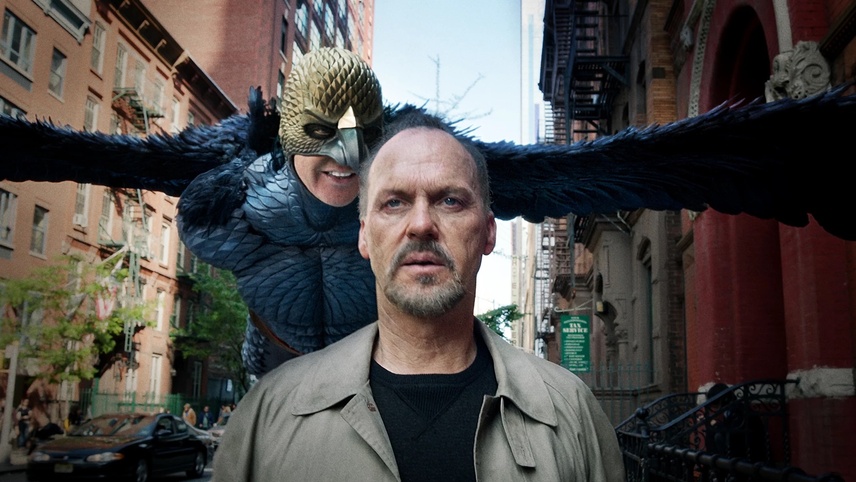
Riggan Thomson was chosen. He was chosen spectacularly. He was loved by millions, paid by studios, recognized on the street, worshipped in the dark of a thousand multiplexes. He wore a cape and flew across screens and the world said: you matter.
Then the world stopped saying it.
And Riggan discovered something that Salieri, for all his suffering, was at least spared. Salieri never had to learn what it feels like to have mattered and then to stop. Salieri raged against absence. Riggan rages against something worse.
The memory of presence.
The Voice
There is a voice in Riggan Thomson’s head.
It sounds like him. It sounds like a better version of him. It sounds like the version of him that was famous, that was powerful, that filled seats and sold posters and had the world’s attention without having to beg for it. The voice calls itself Birdman.
“You are a god,” it says.
“You could be doing a sequel right now,” it says.
“You’re better than this,” it says, meaning: you were more profitable than this.
Most readings of the film treat the Birdman voice as Riggan’s dark side. His ego. His shadow self. The temptation pulling him away from serious art and back toward the comfortable, lucrative, hollow world of franchise filmmaking.
This reading is incomplete.
The Birdman voice is not Riggan’s dark side. It is his survival instinct. It is the part of his brain that remembers how to be relevant, how to be loved, how to walk into a room and have the room rearrange itself around him. It is the neural pathway of fame, still firing, still remembering, long after the stimulus has been withdrawn.
And the voice is not wrong. That’s the uncomfortable part. When Birdman tells Riggan he’s wasting his time on a Broadway play that nobody will care about, Birdman is, by every commercial metric, correct. When Birdman says the world wants spectacle, not Raymond Carver, Birdman is reading the market accurately. When Birdman says Riggan is fooling himself, Birdman is voicing the suspicion that Riggan himself cannot silence.
The voice is not the villain. The voice is the truth that Riggan is building an entire Broadway production to disprove.
The Play Nobody Asked For
Riggan Thomson is adapting Raymond Carver’s “What We Talk About When We Talk About Love” for the Broadway stage. He is directing it. He is starring in it. He has mortgaged his house to finance it. He is betting everything, his money, his reputation, his sanity, on the proposition that he is more than a man in a bird costume.
And nobody asked him to.
This is the detail that gets lost in discussions of Birdman as a film about art versus commerce. Riggan’s Broadway play is not a response to demand. No one is clamoring for a Carver adaptation starring the guy from Birdman 1, 2, and 3. No audience is waiting. No critic is hoping. The production is an act of pure, unilateral self-assertion. Riggan is staging his own relevance, directing his own comeback, writing himself into a story that the world has not requested.
And the film is sympathetic to this. Deeply sympathetic. Because the need to matter is not pathological. It is not vanity. It is the human animal’s refusal to accept that its time has passed. And Iñárritu, who understands ego from the inside (you don’t make a film that looks like a single unbroken take without a considerable ego of your own), films Riggan’s desperation with a tenderness that coexists, without contradiction, with merciless clarity about its absurdity.
Riggan is ridiculous. Riggan is heroic. The film holds both of these truths simultaneously and never resolves them, because resolving them would require choosing between compassion and honesty, and Birdman refuses to choose.
The Single Shot and Its Meaning
The film appears to be shot in one continuous take.
It isn’t, of course. The “single take” is assembled from long, carefully choreographed shots stitched together through hidden cuts. Walls. Doorways. Moments of darkness. Emmanuel Lubezki’s camera moves through the St. James Theatre like a restless ghost, following characters through corridors and dressing rooms and onto the stage and back again, never pausing, never cutting, never allowing the audience a moment of visual rest.
This is not a gimmick. It is an argument.
Because the single take means there is no escape. There is no cut to a different scene. No reaction shot to break the tension. No montage to compress time. Riggan is trapped in continuous present tense, and so are we. We are inside his experience of the world, which is an experience of relentless, unbroken forward motion in which every crisis bleeds into the next crisis and there is never a moment to step outside and assess.
This is how anxiety feels. This is the phenomenology of a man who cannot stop. Who is always performing, always reacting, always in the middle of something that started before he arrived and will continue after he leaves. The unbroken shot doesn’t just immerse you in Riggan’s world. It replicates his condition. You cannot cut away from his life because he cannot cut away from his life.
The camera moves and the drums pound (Antonio Sanchez’s jazz score is a nervous system set to music) and the walls close in and the next scene starts before the last one finished and somewhere, underneath the craft and the virtuosity and the dazzling technical achievement, a man is suffocating.
Mike Shiner, or: The Authenticity Trap
Edward Norton plays Mike Shiner as the most insufferable kind of genius: the kind who knows he’s a genius and uses the knowledge as both weapon and shield.
Mike is a “real” actor. Method. Committed. Dangerously talented. He can barely walk onto a stage without the air becoming more interesting. He drinks real gin during a scene that calls for gin. He attempts real sex during a scene that calls for simulated intimacy. He rejects artifice. He insists on truth. He is, by every standard the theater holds sacred, the genuine article.
He is also a complete disaster as a human being.
Off stage, Mike is impotent. Literally. He can only achieve arousal in the context of performance. Off stage, he is manipulative, petulant, self-absorbed. He starts a relationship with Riggan’s daughter, Sam, not out of genuine interest but because she is there and he needs an audience even in his private life. His “authenticity” is a one-way valve. It flows onto the stage and does not flow back.
The film is doing something crucial with Mike that most readings overlook.
Mike Shiner is what Riggan wants to be. He is the “serious” actor. The artist. The man who is taken seriously by critics, respected by peers, valued for his craft rather than his box office. Riggan looks at Mike and sees everything he’s chasing: artistic credibility, fearlessness, the respect of people who read the New York Times and have opinions about Carver.
But the film shows you, quietly and persistently, that Mike’s authenticity is its own performance. Mike isn’t “real” on stage. He is performing realness. He has found a mode of behavior (intensity, boundary-violation, emotional nakedness) that reads as authentic in a theatrical context, and he deploys it with the same strategic precision that Riggan once deployed his superhero persona. Mike’s method is not truth. It is a style of truth. A brand of truth. And the difference between that and Birdman’s cape is smaller than either man would like to admit.
The theater is full of people performing authenticity. Hollywood is full of people performing spectacle. And Riggan, standing between the two, realizes slowly that there might not be a third option.
Sam
Emma Stone delivers three minutes of dialogue that contain more truth than the rest of the film combined.
Sam is Riggan’s daughter. She is an addict in recovery. She is working as Riggan’s assistant, a role that allows her to be close enough to resent him while being too close to escape. She is furious and fragile and smart enough to see through every performance in the building, including her father’s.
She tells Riggan: “You don’t matter.”
She says it flatly, without cruelty, almost with relief, as if she’s been holding it for years. She tells him his play won’t change anything. That Broadway doesn’t matter the way it used to. That the world has moved on. That he is fighting for relevance in a medium that is itself increasingly irrelevant. That his desperation is visible and pathetic and, worst of all, ordinary.
“You’re doing this because you’re scared to death, like the rest of us, that you don’t matter,” she says. “And you know what? You’re right. You don’t.”
The speech is devastating because it is true. And because Sam loves him. And because love and truth, in this film, are not allies. They are opposing forces. Love wants to protect. Truth wants to demolish. And Sam, standing in the corridor of a Broadway theater, delivers both at once.
Riggan absorbs the blow. He does not change. He cannot change. Because changing would mean accepting that the thing he used to be is the only thing he will ever be, and accepting that is a kind of death, and he is not ready to die.
Not yet.
The Critic
Tabitha Dickinson sits at a bar. She tells Riggan she will destroy his play. She hasn’t seen it yet. She will destroy it because he is a Hollywood actor doing Broadway, and his presence contaminates the space. He doesn’t deserve to be here. He hasn’t earned it.
This scene enrages audiences. It is supposed to. Tabitha is arrogant, dismissive, gatekeeping. She represents everything that’s wrong with critical culture: the prejudgment, the snobbery, the refusal to engage with work on its own terms.
But the film is more honest than its audience about what this scene is actually doing.
Because Riggan’s response to Tabitha reveals something he doesn’t want revealed. He doesn’t argue for his play’s quality. He doesn’t defend his artistic choices. He attacks her authority. He says she doesn’t create anything. He says her labels (“good,” “bad,” “mediocre”) are meaningless. He says she hides behind adjectives.
And he’s right about some of this. But he’s also doing exactly what Tabitha accused him of: responding to criticism not with art but with celebrity. With the entitlement of a man who believes his fame should exempt him from scrutiny. Riggan doesn’t want Tabitha’s approval because Tabitha’s judgment is valuable. He wants her approval because her approval is the one thing his money and fame cannot buy, and the inability to buy it is intolerable.
Riggan wants artistic legitimacy. But he wants it given, not earned. He wants the critical establishment to recognize him the way Hollywood recognized him: immediately, enthusiastically, without requiring him to prove anything beyond his willingness to show up.
This is the Birdman instinct, alive and well beneath the Carver dialogue. The expectation that the world should rearrange itself around him. The belief that mattering is a permanent condition, not a daily negotiation.
The Carver Parallel Nobody Mentions
“What We Talk About When We Talk About Love.”
Riggan chose this material. The film never explains why, beyond a vague backstory about Carver meaning something to him. But the choice is not random, and the film trusts you to notice.
Carver’s story is about four people sitting around a kitchen table, drinking gin, trying to articulate what love is. They fail. They talk around it. They tell stories that circle the subject without landing on it. They perform the vocabulary of love without accessing the experience. The story ends with the four of them sitting in the dark, silent, unable to say the thing they came to say.
This is Riggan’s condition, staged and restaged eight times a week.
He is a man who cannot express love. Not to Sam. Not to his ex-wife. Not to his girlfriend. Not to himself. He can perform love on stage (he performs it every night, in Carver’s words) but cannot locate it in his own life. He can say the lines but cannot feel the feeling. He is, like Carver’s characters, a man sitting in the dark, surrounded by people, unable to make contact.
The play is not Riggan’s redemption. The play is his diagnosis. And the fact that he chose it himself, that he recognized his own condition in Carver’s prose without being able to apply the recognition to his own behavior, is the film’s quietest and most devastating irony.
The Gun
On opening night, Riggan replaces the prop gun with a real one.
He performs the final scene. His character is supposed to shoot himself. Riggan raises the gun, turns it toward his own face, and fires.
He survives. He blows off his nose. He is rushed to the hospital. And the reviews are ecstatic. The critics call his performance “super-realism.” They call it brave. They call it the most daring piece of theater they’ve ever seen. Tabitha Dickinson, the critic who promised to destroy him, writes a rave.
The gun scene is where every thread in the film converges.
Andrew Neiman bled for his art and the audience cheered. Nina Sayers danced until she died and the audience applauded. Riggan Thomson shoots himself in the face and the critics give him a standing ovation. In each case, the destruction of the performer is repackaged as the triumph of the performance. The body is consumed. The art is celebrated. The audience moves on.
But Birdman adds a layer that the other films don’t.
Riggan’s self-destruction is immediately, seamlessly absorbed into the narrative of his comeback. His suicide attempt becomes a career move. His genuine crisis becomes content. The most real thing he has ever done on stage (trying to die) is received as the most impressive acting choice he has ever made. The critics cannot tell the difference between performance and breakdown. Or perhaps they can, and they don’t care, because the breakdown makes better copy.
The system doesn’t distinguish between art and self-destruction because, for the system, there is no difference. Both produce content. Both fill seats. Both generate reviews. The man behind the performance is incidental. He always was.
The Window
Riggan is in the hospital. His nose is bandaged. His play is a hit. Sam brings him flowers. She shows him his social media. He is trending. He is, for the first time in years, relevant again.
He goes to the bathroom. He looks at himself in the mirror. He removes the bandage. Underneath, his face is reconstructed, almost birdlike. He looks at it. He looks out the window.
He opens the window. He climbs out.
Sam returns to the empty room. She goes to the window. She looks down. Nothing. She looks up. She smiles.
The screen goes black.
Did Riggan fly? Did Riggan jump? Is Sam smiling because her father has achieved transcendence or because she is in shock? Is this a superhero ending or a suicide ending? Is there a difference?
The film does not answer. And the refusal to answer is the answer.
Because for Riggan Thomson, transcendence and self-destruction have been the same thing since the first frame. His art is self-annihilation. His comeback is a suicide attempt. His relevance is purchased with blood. Every act of creative assertion in the film is also an act of self-harm, and the distinction between flying and falling is determined entirely by who’s watching and what story they need to tell.
Sam looks up and smiles. She sees what she needs to see. The audience sees what it needs to see. And Riggan, wherever he is, has finally achieved the thing he wanted.
He is no longer in the frame. He is no longer performing. He is no longer the man who used to be Birdman.
He is gone.
And gone, in this film, might be the only freedom available.
The Mirror That Runs Through Everything
Amadeus asked: what does it feel like to not be chosen? Birdman asks the inverse: what does it feel like to have been chosen and then unchosen? To have had the world’s attention and then lost it? To know, with absolute certainty, that your best was behind you, and that the best wasn’t even the right kind of best?
Salieri could never produce Mozart’s music. Riggan produced Birdman. He produced something massive and beloved and culturally dominant. And it didn’t count. Not in the rooms he wanted it to count in. Not with the people whose approval he craved. He was chosen by the wrong audience for the wrong reasons, and the choosing, which should have been a gift, became a prison.
Arthur Fleck was invisible and wanted to be seen. Riggan was hyper-visible and wanted to be seen differently. Both discovered the same thing: that being seen is not the same as being known. That the audience’s gaze, whether it arrives as worship or contempt, is always, at some level, a form of consumption. You are taken in. You are processed. You are discussed. And then the gaze moves on.
Nina died for one perfect performance. Riggan nearly died for one honest one. The difference is that Nina’s institution demanded perfection and got it. Riggan’s institution didn’t demand anything from him at all. It simply forgot he existed. And the forgetting was worse than any demand, because you can fight a demand. You can push against it. You can bleed for it.
You cannot fight indifference. You can only perform louder, and louder, and louder, until the performance consumes the performer and the audience, if they’re still watching, calls it art.
Where This Leads Us
Riggan couldn’t stop being the thing he used to be. The Birdman voice followed him through corridors, through dressing rooms, through the impossible continuous present of his anxiety. He couldn’t outrun his own irrelevance.
But what if irrelevance isn’t the enemy? What if the real trap isn’t being forgotten by the world but being remembered by it? What if the most famous, most beloved, most culturally dominant story of the century is also the most suffocating? What if a filmmaker builds a universe so complete, so profitable, so perfectly engineered for audience satisfaction, that it becomes the only story anyone wants to hear, and every other story starts to sound like silence?
What if the franchise is the Birdman voice, and it’s not talking to one man anymore? What if it’s talking to all of us?