Whiplash made you a promise.
It said: if you bleed enough, if you sacrifice enough, if you endure enough, you will become great. The promise was wrapped in abuse and soaked in sweat, but it was still a promise. Suffer and be rewarded. Pay the price and collect the prize. The equation balances.
Amadeus burns that promise to the ground.
It says: you can do everything right. You can devote your life. You can practice until your hands bleed and pray until your knees bruise and follow every rule the universe sets down. And it won’t matter. Because greatness is not earned. Greatness arrives like weather. It lands where it lands. It has no respect for effort, no interest in fairness, and no obligation to reward the deserving.
And the person it lands on might be an obscene, giggling, foul-mouthed child who has done nothing, nothing at all, to deserve it.
This is not a film about music. This is a film about the worst thing God ever did to a good man. And the good man’s name is not Mozart.
Salieri
Antonio Salieri is old. He is in an asylum. He has just tried to cut his own throat. A young priest comes to hear his confession, and what follows is one of the great monologues in cinema, not because of what it reveals about Mozart but because of what it reveals about the man telling the story.
F. Murray Abraham plays Salieri with a precision that should be studied in every acting school on earth. Not for its intensity, though it is intense. For its specificity. Salieri is not a raving madman. He is not a scenery-chewing villain. He is a man of genuine intelligence, genuine sensitivity, and genuine devotion who has been handed a piece of knowledge so devastating that it has taken him decades to metabolize, and he still hasn’t finished.
The knowledge is simple.
He is not great. He will never be great. And the reason is not that he didn’t work hard enough. The reason is that God said no.
Most films about artistic ambition locate the obstacle in effort. Try harder. Practice more. Find the right teacher. Overcome the right trauma. The obstacle is always within reach, always actionable, always something the protagonist can theoretically overcome through will and sacrifice.
Amadeus removes the obstacle from human reach entirely. Salieri’s obstacle is not effort. It is ontology. He was not made to be great. He was made to be good. Good enough to understand greatness when he hears it. Not good enough to produce it.
This is a specific kind of cruelty. And the film takes two and a half hours to show you exactly how that cruelty unfolds inside a human being.
The Deal
Salieri, as a boy, made a deal with God.
He tells the priest this directly. He knelt in church and he prayed: make me a great composer. I will give you everything. My chastity. My devotion. My obedience. I will serve you through music. I will use the talent you give me to glorify your name. Just give me the talent. Please. Give me the talent.
And for a while, it seemed like God accepted.
Salieri rose. He became court composer to Emperor Joseph II. He was respected. He was performed. He was, by every external measure, a success. He lived a life of discipline and devotion. He kept his end of the bargain.
Then Mozart walked into the room.
And Salieri heard, for the first time, what God had been saving for someone else.
The Cruelest Gift
Here is the detail that makes Amadeus not just a great film but a devastating one.
Salieri can hear it.
He is not a hack. He is not a fraud. He is not a man of limited perception who simply doesn’t understand Mozart’s genius. He understands it completely. He understands it better, the film argues, than anyone else in Vienna. Better than the Emperor, who counts the notes. Better than the court, who wants pleasant entertainment. Better, perhaps, than Mozart himself, who produces genius the way a bird produces song: naturally, effortlessly, without full comprehension of what it is.
Salieri is the one who knows.
He holds Mozart’s original manuscripts and his hands tremble. He describes the music to the priest and his voice cracks. He hears the Serenade for Winds and stands in the doorway and the world stops. Abraham plays these moments with a rapture so total that it looks, from the outside, like love. And maybe it is love. But it is love alloyed with something molten and unbearable. Because Salieri doesn’t just hear beauty. He hears the distance between that beauty and anything he will ever be capable of creating.
He has the ears of a genius and the hands of a craftsman.
He can perceive the mountaintop. He cannot reach it. And he will spend every day of his life knowing exactly how far away it is.
This is the gift God gave Salieri. Not talent. Perception. The ability to recognize perfection while being permanently excluded from producing it. Salieri’s tragedy is not that he can’t hear Mozart. It’s that he can.
Mozart as Weapon
Tom Hulce’s Mozart is one of the most controversial performances in film history, and the controversy is itself revealing.
Mozart, in Amadeus, is a giggling, screeching, fart-joke-telling man-child. He laughs in high, hysterical bursts. He chases his wife around furniture. He drinks too much. He talks about his bowels. He is, in almost every social interaction, insufferable.
He is also, when he sits at a keyboard, the voice of God.
The disjunction is the point. It is, in fact, the entire theological argument of the film.
Because Salieri’s complaint is not merely “Why him and not me?” Salieri’s complaint is: “Why him? Why THIS vessel? I offered you devotion. I offered you discipline. I offered you a life organized entirely around your glory. And you chose THIS. This obscene, undisciplined, graceless creature. You poured infinity into a vessel that mocks you with every breath it takes.”
This is not jealousy. This is theodicy. This is the problem of evil, relocated from the realm of suffering to the realm of talent. If God exists, and God distributes genius, then God’s choices reveal God’s character. And God’s choice of Mozart over Salieri reveals a God who is either indifferent to devotion, amused by suffering, or actively cruel.
Salieri considers all three options and settles on the third. God is cruel. God is mocking him. Mozart is not a fellow artist. Mozart is the instrument of God’s contempt.
The film never confirms or denies this. Milos Forman, who fled communist Czechoslovakia and understood something about the arbitrary distribution of punishment and reward, films Salieri’s theological crisis with a respect that never quite tips into agreement. The camera watches Salieri rage at a crucifix. It watches him weep at Mozart’s music. It watches him plot and scheme and destroy. And it never tells you whether he is right about God or simply mad.
The ambiguity is the film’s greatest act of compassion. Because if Salieri is wrong, he is a jealous man who destroyed a genius. But if Salieri is right, even partially, even metaphorically, then his rage is the most rational response imaginable to an irrational universe.
What Salieri Does With His Pain
Salieri doesn’t simply resent Mozart. He studies him. He collects his work. He attends every performance. He sits in the audience and listens with a concentration that borders on devotional. He is, in some sense, Mozart’s greatest audience.
And then he decides to kill him.
Not quickly. Not violently. Slowly. Through exhaustion, through exploitation, through the gradual weaponization of Mozart’s own desperation.
Salieri commissions a Requiem Mass. He does it anonymously, through a masked messenger, letting Mozart believe the commission comes from a mysterious patron. Mozart, broke and sick and drowning in debt, takes the commission. He works on the Requiem obsessively. He pours what remains of his health into it. And Salieri watches. Salieri waits. Because the Requiem is not a commission. It is a trap. Salieri plans to claim it as his own after Mozart dies, to stand before the world and conduct Mozart’s final work under his own name.
To steal from God what God would not give him.
The plan is monstrous. It is also, in the film’s hands, heartbreaking. Because Salieri doesn’t want fame. Not really. He wants proof. He wants to stand in front of an audience and hear them respond to genius and know, just once, that the genius is associated with his name. Even if it’s a lie. Even if he stole it. Even if the price is a man’s life.
He wants to feel what it feels like to be chosen.
The connection to Tom Ripley is almost unbearable. Tom killed to inhabit another man’s life because his own life had no value in the world he wanted to enter. Salieri kills to inhabit another man’s music because his own music, despite everything he gave, was not enough. Both men commit murder not out of cruelty but out of a hunger so deep it has become indistinguishable from need.
Constanze
Elizabeth Berridge plays Constanze Mozart as a woman caught between two men who are both, in different ways, using her husband.
There is a scene that doesn’t get discussed enough.
Constanze goes to Salieri. She brings Mozart’s manuscripts. She is desperate. Mozart needs a court appointment. Salieri has influence. She brings the pages as evidence of her husband’s genius, hoping they will persuade.
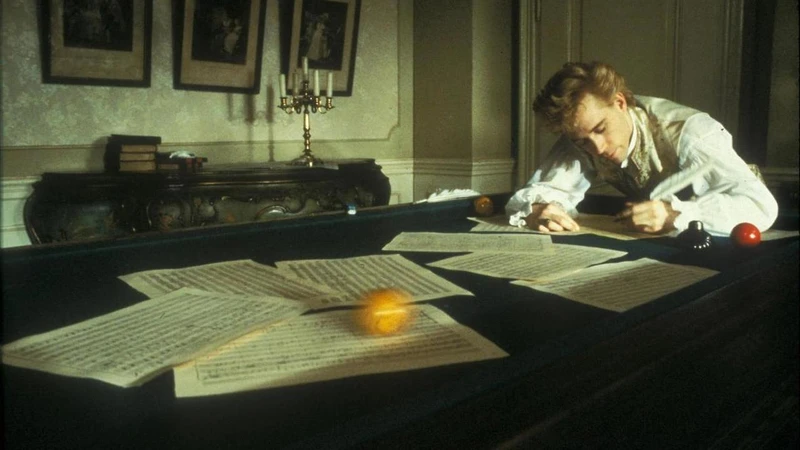
Salieri looks at the manuscripts. And what he sees destroys him. No corrections. No revisions. No crossed-out passages. The music arrived on the page fully formed, as if Mozart were simply transcribing something he could already hear. As if the composition had already happened, somewhere, and the writing was just the recording.
This is the moment that breaks Salieri. Not the music itself. The effortlessness. The evidence that what costs Salieri everything costs Mozart nothing. That genius, for Mozart, is not a summit to be climbed but a language to be spoken. As natural as breathing. As involuntary as a heartbeat.
But the scene doesn’t end there. Salieri, destroyed and furious, tells Constanze he can help. He implies a price. She understands. She returns. She undresses.
And Salieri sends her away.
This scene is about power. Salieri holds, for one moment, the one piece of leverage he has over Mozart’s world. He could take something from Mozart. He could violate the one space Mozart holds sacred. And he chooses the cruelty of refusal over the cruelty of exploitation. He rejects Constanze not because he’s moral but because taking her would be too small. It would reduce his war with God to a squalid transaction. Salieri wants to defeat God, not Mozart’s wife.
The woman is incidental. Her body, her humiliation, her desperate offering of herself, is a footnote in a cosmic argument between a man and his maker.
The film sees this. It sees the cruelty of it. But it does not linger long enough to let Constanze’s experience become its own subject. She recedes. The men and their war continue. And the woman who stripped bare in a room full of power and was discarded remains one of the most quietly devastating figures in the film.
The Requiem
The sequence where Salieri transcribes the Requiem from Mozart’s deathbed dictation is the most extraordinary scene in the film, and possibly the most extraordinary scene Milos Forman ever directed.
Mozart lies in bed, dying. Salieri sits beside him with manuscript paper. Mozart dictates. He hears the entire orchestra in his head. He speaks the parts. Salieri writes them down. And for this one scene, these few minutes, the war between them dissolves.
They are collaborators.
Salieri is, finally, inside the music. Not as its creator, but as its vessel. He is the hands that transcribe what the mind produces. He is the instrument, the tool, the mechanism through which Mozart’s genius reaches the page. And Abraham plays this scene with a strange, luminous calm. The jealousy is still there. The rage is still there. But underneath them, for the first time, there is something else. Something that might be peace. Or might be surrender.
Because Salieri has been given, in this final hour, the thing he wanted all along. Not genius. Proximity to genius. The chance to serve the music he loves, even if serving it means serving the man he hates, even if the service comes too late, even if the page he’s writing on will eventually bear a dead man’s name.
Mozart dies. The Requiem is unfinished. Salieri’s plan to claim it collapses. And what remains is not triumph or defeat but something more difficult. What remains is the knowledge that Salieri’s closest moment to grace came not through his own work but through his willingness to be useful to someone else’s.
The Patron Saint of Mediocrities
The final scene.
Salieri is wheeled through the asylum. He passes the other patients. The broken, the forgotten, the ordinary. And he blesses them. He raises his hands like a priest and he says: “Mediocrities everywhere, I absolve you. I absolve you. I absolve you all.”
This is read, almost universally, as tragic irony. The mad old man, the failed composer, the deluded murderer, performing one last bitter pantomime of grandeur. The patron saint of nobodies. The punchline of his own joke.
But what if it isn’t ironic?
What if Salieri, in this moment, has arrived at something true? What if the absolution is genuine? What if, after a lifetime of raging against the unfairness of talent, he has finally accepted the thing the universe was trying to tell him?
You are not special. You were never going to be special. The deal you made with God was one-sided. The devotion was real but the promise was imagined. And the millions of people who work hard and follow the rules and give everything they have and are still, at the end of it all, ordinary: those people are not failures. They are the majority. They are the human race. And they deserve a saint.
Whiplash told you suffering produces greatness. Amadeus tells you the truth. Suffering produces suffering. Greatness produces itself.
Fletcher would have destroyed Salieri. He would have thrown chairs and screamed obscenities and pushed and pushed, and Salieri would have bled into his compositions and practiced until dawn, and at the end of it, the music would still have been merely good. Because Fletcher’s method only works if the talent is already there. And the talent is not a reward for effort. It is a weather system. It lands where it lands.
Andrew Neiman might be talented enough to survive Fletcher’s method. He might be the rare one. But the film that follows Whiplash, the film that answers its central lie, is Amadeus. Because Amadeus asks: what about everyone else? What about the ones who bled and prayed and still weren’t chosen?
What about the Salieris?
What about us?
Why It Devastates
Amadeus devastates because Salieri is not a villain. He is a mirror.
Most of us are not Mozart. Most of us are not Andrew Neiman, the rare survivor of the excellence machine. Most of us are Salieri. We work hard. We follow the rules. We do our best. And our best is good. Not great. Good. And the world is full of good work done by good people, and almost none of it will be remembered, and the unfairness of this is so enormous, so foundational, so woven into the fabric of existence, that we have built entire mythologies to deny it.
We tell ourselves effort matters. We tell ourselves practice makes perfect. We tell ourselves that talent is just hard work in disguise, that genius is ninety-nine percent perspiration, that the cream rises to the top.
Amadeus sits across from us, like Salieri sits across from the priest, and says: you know that’s not true. You’ve always known. You’ve seen the person who makes it look easy. You’ve seen the work that arrives fully formed. You’ve heard the music that you could never write, no matter how many hours you spent, no matter how much you sacrificed, no matter how sincere your prayers.
And the film says: that’s okay. That is the human condition. It is not a failure. It is not a punishment. It is simply what it is.
But the okay-ness doesn’t arrive easily. It doesn’t arrive without a lifetime of rage and grief and the slow, grinding acceptance that the universe does not owe you anything, not even a reason.
Mozart’s music plays over the final credits. It is perfect. It is effortless. It is the sound of something that was never earned and never deserved and simply is.
And Salieri, somewhere in his asylum, can still hear it.
That’s the cruelest part. He can always hear it.
Where This Leads Us
Salieri raged against a God who gave genius to the wrong person. He spent his life in the shadow of a man who didn’t earn the light.
But what if the genius knows? What if the person standing in the light understands, with a clarity the world never credits them with, that the light is a cage? That being chosen is not a privilege but a sentence? That the gift everyone envies is also the thing that makes ordinary life, ordinary love, ordinary peace, impossible?
What if genius is not something you have but something that has you? And what if the having is closer to possession than ownership, and the possessed cannot put it down, cannot rest, cannot stop, even as the world applauds and the body fails and the person inside the music slowly disappears?
What if Salieri’s curse was hearing the music he couldn’t make, but Mozart’s curse was worse: making the music he couldn’t stop?