Four Curtains
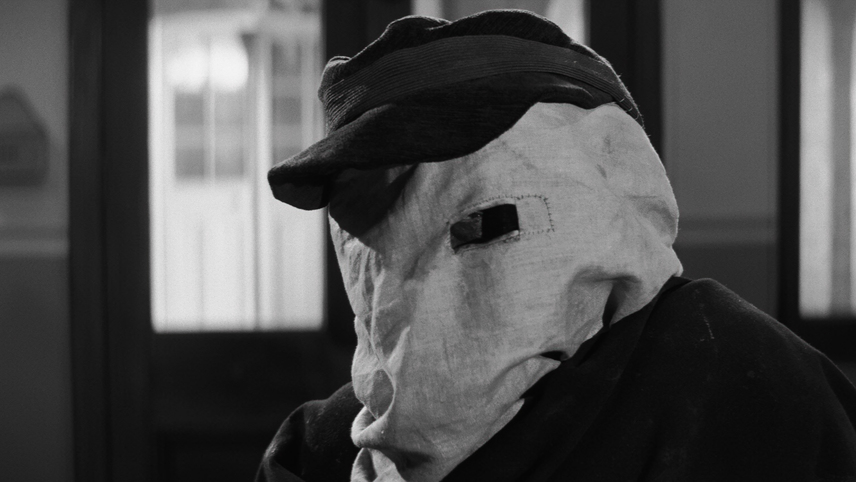
Every space John Merrick enters has an audience.
This is the fact the film buries beneath its compassion, beneath John Hurt’s extraordinary performance, beneath the black-and-white beauty of Freddie Francis’s cinematography, beneath the tears the film so expertly produces. Strip all of that away and what remains is a structural observation so simple it’s almost invisible: the curtain is pulled back in the freak show, and Merrick is displayed. Then Merrick is “rescued.” And the curtain is pulled back again. And again. And again.
Different rooms. Different curtains. Same body on display.
The freak show. The medical lecture hall. The hospital room with its parade of aristocratic visitors. The theater, where Merrick sits in a box and the entire house turns to applaud him, and the applause is indistinguishable from the gasps in the carnival tent because both require the same thing: a body that is extraordinary, a crowd that looks, and a person inside who is reduced, again and again, to what happens when the curtain opens.
The Elephant Man is routinely described as a film about cruelty and compassion. About the inhumanity of the Victorian freak show and the humanity of the doctor who saves a man from it. This reading is not wrong. It is just shallow enough to let the audience off the hook.
The deeper reading, the one the film makes available in every frame but never insists upon, is this: the compassion is real, and the display is also real, and they are not opposites. They are the same system. Frederick Treves does not rescue John Merrick from being a spectacle. He upgrades the venue.
The First Curtain: The Show
Bytes runs a freak show in the slums of Victorian London. He keeps Merrick in a dark room, behind a curtain. Customers pay. The curtain opens. They gasp, scream, recoil. The curtain closes. That is the transaction.
Lynch films Bytes as precisely what he is: a brute, a bully, a man who treats a human being as inventory. There is no ambiguity here. Bytes is cruel. He beats Merrick. He calls him a thing. He sells access to a body that cannot refuse.
But Lynch does something else, something quieter and more disturbing. He delays Merrick’s reveal. For the first portion of the film, we don’t see Merrick’s face. We see the reactions. The gasps. The tears. The hand over the mouth. We see what the audience sees, which is to say, we see the performance of spectatorship before we see its object.
This is not suspense for its own sake. Lynch is training you. He is teaching you how to watch. And what he is teaching you is that the audience’s reaction is the point. Not the body. The audience. The freak show does not exist to display Merrick. It exists to produce a reaction in the people watching. Merrick’s body is the stimulus. The crowd’s horror is the product. Bytes is not selling a body. He is selling an experience, the experience of being shocked, appalled, moved, and then walking away.
When Treves first sees Merrick in the show, he weeps. His tears are genuine. His horror is genuine. His compassion is genuine. And he is also a customer. He paid to see the body behind the curtain. He watched the curtain open. He had his experience. The only difference between Treves and the other customers is what he did next.
The Second Curtain: The Lecture
What Treves did next was bring Merrick to the London Hospital and present him to a room full of doctors.
Watch this scene carefully. Treves stands at a podium. Merrick stands beside him, partially undressed. Treves describes the deformities in clinical language. The doctors observe. They take notes. They lean forward. They are fascinated.
The vocabulary has changed. “Freak” has become “patient.” “Spectacle” has become “case study.” “Horror” has become “clinical interest.” The curtain has become a lecture hall. The pennies have become professional prestige. But the structure is identical. A body is displayed. An audience watches. A mediator controls the terms of the display.
Lynch frames the lecture hall scene to echo the freak show, and the echo is not subtle. Same geometry. Body in the center. Audience in a semicircle. Authority figure narrating. The only difference is the lighting, which is cleaner, more respectable, more institutional. The London Hospital is a nicer room than Bytes’s tent. The doctors are better dressed than the carnival crowd. The body on display is the same body.
This is where the film meets Network. Howard Beale’s breakdown was broadcast to millions because the institution discovered that human suffering is a product. The network didn’t create Beale’s anguish. It monetized it. Treves doesn’t create Merrick’s condition. He monetizes it, not for money (he is sincere, he is kind, he genuinely cares) but for something more insidious: for the moral prestige of being the man who cared.
This is not cynicism. The film does not suggest Treves is a fraud. Treves’s compassion is real. His concern for Merrick is real. The nights he lies awake wondering whether he is any better than Bytes are real. The film’s argument is not that kindness is fake. Its argument is that kindness does not, by itself, dismantle the structure. You can rescue a man from the freak show and put him in a hospital and treat him with tenderness and genuine care, and he is still a body on display. The system survived the change of management.
The Third Curtain: The Drawing Room
Word spreads. London society learns that a remarkable creature is living at the hospital. They visit. The aristocracy comes to Merrick’s room with gifts, conversation, photographs of themselves for his collection. They sit with him. They talk about the theater. They treat him like a person.
And he is, once again, the show.
The social visits are the film’s most complex scenes because they operate on three levels simultaneously. On the surface, they are acts of kindness. These people are acknowledging Merrick’s humanity. They are treating him as a peer, a friend, a person worthy of their time. On the second level, they are acts of social performance. Visiting Merrick is fashionable. It signals virtue. It demonstrates that one is compassionate, progressive, enlightened. The aristocrats visit Merrick the way a certain kind of person in any era performs proximity to suffering.
On the third level, and this is the one Lynch trusts the audience to find on their own, the visits are another exhibition. Merrick’s room has become a salon. The stream of visitors is a queue. The body is still the attraction. The only thing that has changed is the emotional register: the audience no longer gasps in horror. It gasps in compassion. Both gasps require the same body. Both gasps require the same curtain.
There is a devastating scene where Merrick receives a visit from a famous actress, Mrs. Kendal, played by Anne Bancroft. She is warm. She is kind. She reads Romeo and Juliet with him. Merrick, who has memorized the balcony scene, recites Romeo’s lines. It is beautiful. Mrs. Kendal is visibly moved. She kisses him on the cheek.
And then she leaves. And Merrick is alone in his room with the cathedral model and the photographs and the small, specific silence of a person who has just been visited.
The kiss is real. The warmth is real. And the visit had a beginning and an end, an arrival and a departure, and when it’s over, Merrick is still in the room, and the room is still in the hospital, and the hospital is still a place where his body is the reason he lives here and not somewhere else.
The Man Inside the Display
Here is what Lynch does that almost no other director would attempt: he insists, quietly and relentlessly, on Merrick’s interiority.
Merrick builds a model of St. Philip’s Cathedral, visible from his window. He works on it carefully, patiently, with hands that the film has shown us are severely deformed. The model is beautiful. It is precise. It is an act of sustained attention and craft.
Lynch holds on this. He lets you watch Merrick work. He does not narrate the symbolism. He does not cut to a reaction shot of Treves looking moved. He just shows a man building something, and the building is the argument.
Because the model is the one thing in the film that is not a display. No one asked for it. No one is watching. It is not for Bytes or Treves or the aristocrats or the medical profession. It is Merrick’s private act of creation, and it is the proof, the only proof the film needs, that there is a person inside the body that everyone keeps looking at.
The cathedral model does what Merrick’s famous declaration cannot. “I am not an animal. I am a human being.” That line is the film’s most iconic moment, and it is extraordinary, but it is also, structurally, a performance. Merrick shouts it to a crowd that has cornered him in a train station. He is, once again, on display, and his declaration of humanity is addressed to an audience. It requires witnesses.
The cathedral model requires no witnesses. It is proof of self that exists whether or not anyone sees it. In Moonlight, we watched a body that could only be honest when no one was watching, on a beach, in the dark, in the water. Merrick’s cathedral is the same gesture. The self exists most fully when the curtain is closed.
The Doctor’s Doubt
To his credit, Treves knows.
There is a scene late in the film where Treves lies in bed beside his wife and asks the question out loud. Am I a good man, or am I just another showman? Have I helped this man, or have I simply moved him from one exhibition to a more respectable one?
Anthony Hopkins plays this scene with devastating restraint. The doubt is genuine. It is the doubt of a person who has done a good thing and suspects, in his bones, that the good thing is built on the same foundation as the terrible thing it replaced. Bytes put Merrick behind a curtain and charged a penny. Treves put Merrick behind a hospital door and charged nothing, and the institution still runs on the same fuel: a body that people want to see.
This doubt is what separates The Elephant Man from the sentimental film it could have been. A lesser film would present Treves as the hero and Bytes as the villain and let the audience feel good about being on the right side. Lynch refuses this. He insists that Treves and Bytes exist on a continuum, not as equals but as participants in the same economy. The economy of the displayed body.
In The Silence of the Lambs, we watched Clarice and Lecter negotiate across the bars of a cage. Lecter was displayed, confined, observed. But Lecter controlled the transaction. He chose what to reveal. He weaponized the gaze. The power in that film ran in both directions.
Merrick has no such power. He cannot weaponize the gaze because the gaze is never reciprocal. People look at Merrick. They do not look with him. Even Treves, who comes closest to genuine mutuality, cannot fully escape the dynamic. He is the doctor. Merrick is the patient. The relationship is defined by the curtain between them, however gently it is drawn.
The Nocturnal Raid
There is a sequence in the film that functions as a horror scene, and it is the most revealing sequence Lynch ever directed about the nature of spectatorship.
Bytes, or perhaps the night porter acting on his own, brings people into the hospital at night to see Merrick. Drunks, curiosity seekers, people from the street. They crowd into his room. They pull back his blankets. They make him stand. They touch his body. They force him to look in a mirror.
It is a freak show. It is Bytes’s operation, reconstituted inside the institution that was supposed to protect Merrick from exactly this. The hospital’s walls, its rules, its prestige, all of it failed. The curtain was pulled back again, and the audience returned, because the audience always returns.
Lynch films this sequence as pure nightmare. The faces of the intruders are distorted, leering, lit from below. The scene is operatic in its cruelty. And its function in the film is not simply to show that bad people exist. Its function is to demonstrate that the institution, however well-intentioned, cannot seal Merrick away from the fundamental dynamic that defines his life. The body attracts an audience. The audience will find the body. The hospital can manage the terms of display, but it cannot eliminate display itself.
The morning after, Treves finds Merrick traumatized, and the hospital’s governor considers whether Merrick should be sent away. Not because Merrick did anything wrong. Because his presence attracts attention, and the attention has become unmanageable. The institution’s concern is not for Merrick. It is for the institution.
This is where the film connects to Shoplifters, which ended Cycle Three with the argument that the institution cannot see the family inside the family. The welfare system, the courts, the police: they see documents, categories, violations. They do not see the table where people eat together.
The London Hospital cannot see Merrick. It sees a case, a cause, a curiosity, a problem of institutional management. Merrick the person, the man who builds cathedrals and memorizes Shakespeare and wants, more than anything, to be ordinary, is invisible to the institution in the same way that Shoplifters’ family was invisible to the state. The institution has eyes only for the category. The person inside the category is on their own.
The Cathedral and the Sleep
Merrick finishes the cathedral model. He signs it. He places it on his bedside table.
Then he removes the pillows that he sleeps propped against, because his head is too heavy to lie flat. He lies down. He sleeps like a normal person.
And he dies.
This ending is sometimes read as accidental, sometimes as suicide. Lynch does not clarify. But the film has been preparing for this moment since the first frame, and what it means is not ambiguous at all.
Merrick chooses to sleep like a human being. He knows what this will cost. He has been told. He has slept propped up for his entire life because the alternative is suffocation. And on this night, after finishing the cathedral, after signing his name to it, after creating the one thing in his life that was not a display, he lies down.
The cathedral is complete. The name is signed. The private act of creation is finished. And the body, the body that has been displayed and exhibited and observed and pitied and celebrated and prodded and carried through the streets and applauded in theaters, this body is finally, completely, his.
He lies down with it. He takes it back. He does the one thing with his body that no audience has ever seen him do: he sleeps flat. Like a person. And the sleep is the end.
Lynch gives us a final image: stars, space, Merrick’s mother’s voice. “Nothing will die.” The film transcends the body at the last moment, moving into a space where the flesh and its deformities and the audiences and the curtains are gone, and what remains is something Lynch can only gesture toward. A self that was always there. A self the curtain could never fully reveal because every time the curtain opened, what the audience saw was not the self but the body, and the self, quiet, patient, building its cathedral, was somewhere else entirely.
The Audience That Never Left
Here is the most uncomfortable thing about The Elephant Man.
You are the audience.
You have been the audience for two hours. You have looked at John Merrick’s body through every curtain the film provides. You have gasped at the reveal (Lynch delayed it to maximize your reaction, just as Bytes did). You have wept at the kindness (the film engineered your tears, just as Mrs. Kendal’s visit was engineered by the social calendar). You have been moved, horrified, uplifted.
And you have not, at any point, stopped watching.
In The Wrestler, the audience’s complicity was built into the premise. Randy needed you to watch. Your gaze sustained him. Without the audience, The Ram died. The Elephant Man inverts this completely. Merrick does not need you to watch. Merrick would prefer, desperately, that you stop watching. And you don’t. You can’t. The film won’t let you, because the film is a curtain too, and it opens onto a body, and you are here because you wanted to see.
This is not an accusation. It is an observation. The economy of the displayed body requires a viewer. The viewer can be cruel (Bytes), professional (Treves), fashionable (the aristocrats), or compassionate (you, in the theater, watching this film). The emotional register changes. The structure doesn’t.
The only person in the film who escapes the structure is Merrick himself, and he escapes it the only way the film allows: by closing his eyes.
Where This Leads Us
Three films into this cycle, the body has been armor, spectacle, and exhibit. In Moonlight, the body hardened to survive. In The Wrestler, the body performed until it broke. In The Elephant Man, the body was displayed without consent, and every institution, cruel or kind, kept the curtain open.
But there is a kind of body we haven’t examined yet. A body that is not armored, not performed, not displayed. A body in flight.
There is a film about two women whose bodies defy gravity. They fight on rooftops and treetops, suspended above the world, and the flight is not fantasy. It is the body’s argument against every institution that says: you will stay on the ground. You will be still. You will be contained.
One of these women has spent her life obeying the institution. The other has spent her life running from it. And in the space between them, in the bamboo forest and above the rooftops of Qing dynasty China, the body speaks a language that no institution can translate.
Crouching Tiger, Hidden Dragon (2000). Ang Lee’s meditation on what the body knows that the institution forbids it to say. After three films about bodies trapped, a film about the body that flies.