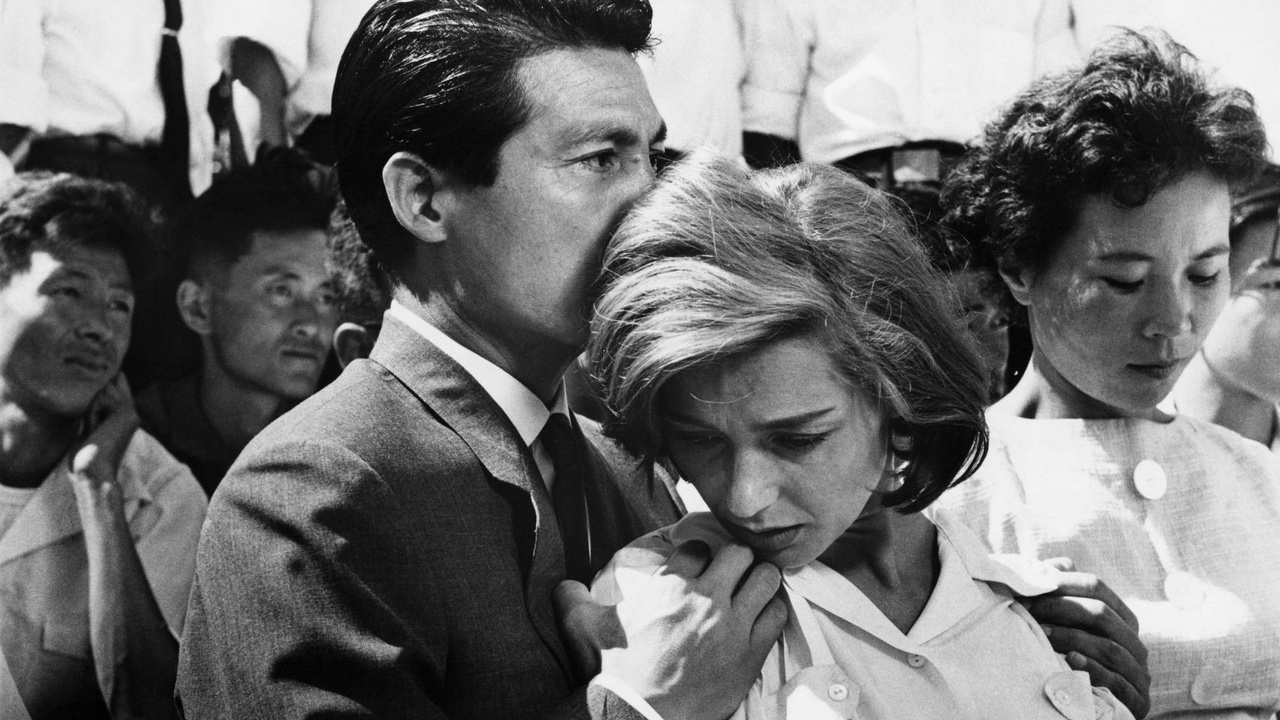
She says: You saw nothing in Hiroshima. Nothing.
He says: I saw everything. Everything.
They are both right. They are both lying. And the entire film lives in the space between those two positions, a space that is also a bed, also a city, also a wound that will not stop being new.
Alain Resnais made Hiroshima Mon Amour in 1959, fourteen years after the bomb. It is not a film about Hiroshima. It is not a film about love. It is a film about what happens when a body that carries one catastrophe lies down next to a body that carries another, and the two bodies try, through skin and language and repetition, to make the other person’s destruction real. They fail. The film is the shape of that failure.
You need to understand what the opening does before you can understand anything else.
Two bodies, intertwined. Skin against skin. The skin is covered in ash, or sweat, or something that makes it shimmer, and for a moment you cannot tell whether you are watching lovers or victims. The image oscillates. Desire and destruction occupy the same frame, and Resnais holds them there, refusing to let one resolve into the other. Then the ash is gone. The skin is clean. The bodies are in a hotel room in Hiroshima, and they are alive, and they are talking, and the words they use are the words of the opening argument:
You saw nothing.
I saw everything.
Over these words, Resnais cuts to footage of the aftermath. The hospital. The burns. The hair falling out. The museum. The reconstructions. The photographs that no one should have to look at and everyone should have to look at. She has visited all of it. She has walked through the museum. She has looked at the photographs. She has seen the evidence. And the film tells her — through his voice, through the structure of the scene, through the rhythm of contradiction — that seeing the evidence is not the same as seeing.
This is the problem the film will not solve because it cannot be solved. Experience is not transferable. You can visit the museum. You can stand in the peace park. You can read the testimony. You can weep. And you will still have seen nothing, because seeing, in the sense that matters, requires having been there, and having been there is a condition of the body, not the eyes.
She is a French actress. She has come to Hiroshima to act in a film about peace. He is a Japanese architect. They meet. They sleep together. They will separate. The affair lasts two days. That is the entire plot, and it matters almost nothing compared to what the affair excavates.
Because she has a story she has never told anyone. During the war, in Nevers, she loved a German soldier. He was shot during the liberation. She held him as he died. She went mad. Her head was shaved. She was locked in a cellar. She emerged, eventually, and went to Paris, and the night she arrived in Paris was the night Hiroshima was destroyed.
Two catastrophes on the same night. One private, one the size of a city. And the film places them not in parallel but in superimposition. Nevers is not compared to Hiroshima. It is not equated with Hiroshima. The film is more precise than that and more dangerous. It says: the body does not rank its wounds. The body that lost a lover in Nevers and the body that lost a city in Hiroshima carry their losses at the same depth, not because the losses are equivalent but because the body has only one depth. Everything goes to the same place. Everything is held in the same tissue.
This is what makes the film unbearable to certain viewers and essential to others. If you believe that historical catastrophe exists on a different plane from personal grief, the film will offend you. If you believe that the body is the site where all experience converges — where history and desire and memory and loss are stored in the same flesh — then the film will feel like the truest thing you have ever watched.
Marguerite Duras wrote the screenplay, and the language she gives these two people is unlike anything in cinema before or since.
It is not dialogue. It is not monologue. It is incantation. The sentences repeat. They circle. They return to the same words the way a hand returns to a bruise: not to heal it but to confirm that it is still there. “Tu me tues. Tu me fais du bien.” You are killing me. You are good for me. The same mouth, the same breath, the same sentence that holds both destruction and tenderness without resolving the contradiction.
Duras understood something about language that most screenwriters do not. Language does not communicate experience. Language orbits experience. It circles the thing that happened, getting closer and closer, and never arriving, and the never-arriving is not a failure of language but its nature. The opening argument — you saw nothing, I saw everything — is not resolved because it cannot be resolved. It can only be repeated, in different rooms, at different hours, with different amounts of light on the skin.
In The Mirror, Tarkovsky treated language as something that surfaced from beneath consciousness, fragments of poetry and memory drifting upward through the image like sediment disturbed by a hand. Resnais does something related but more adversarial. His language does not drift. It insists. It pushes against the image. The woman describes Nevers while the camera shows Hiroshima. The man describes Hiroshima while the camera shows her face. Word and image are in constant, productive disagreement, and the disagreement is the point. You cannot say what happened. You cannot show what happened. You can only place the saying and the showing next to each other and let the gap between them do the work.
The German soldier dies slowly. She holds him. His blood is on her hands. She lies on top of him on the ground, on the quay in Nevers, and the duration of his dying is the duration of her undoing.
She tells this story to the Japanese man in a café. She tells it slowly, as if the telling might finish the event, might bring it to a close that the event itself never reached. And as she speaks, something happens that the film has been building toward for an hour: the Japanese man becomes the German soldier. Not metaphorically. Not in her imagination. In her body. She looks at him and she sees the other man. She speaks to him and she is speaking to the other man. The past and the present collapse into the same gesture, the same reaching, the same hand on the same face that is two faces.
This is what time does in the body. It does not pass. It layers. The Japanese man is not a replacement for the German soldier. He is an accumulation. He is the German soldier plus fourteen years plus Hiroshima plus the hotel room plus the sweat on the skin. The body does not sequence its experiences. It stacks them. And in the stacking, the body produces something that looks like confusion but is actually precision: the precise experience of being a person for whom past and present are not separate rooms but the same room seen at different hours.
There is a walk through the city at night. She walks. He follows. She turns. He is there. She walks again. The streets are wet. The neon reflects. The city of Hiroshima, rebuilt, modern, electric, alive, surrounds them, and it is simultaneously the most present city in cinema and the most haunted.
Because the city, too, carries its wound in its body. Hiroshima rebuilt itself. The buildings are new. The streets are clean. The tram runs. But the rebuilding is itself a form of memory. Every new building is built on the absence of the building that was there before. Every street that functions normally functions normally on top of a street that was, for a moment in August 1945, the surface of the sun. The city is a scar that has been paved over, and Resnais films it at night because at night the neon makes everything shimmer, and the shimmer recalls the opening sequence, the ash on the skin, the bodies that could not be distinguished from the light that killed them.
She walks through this city the way Szpilman walked through the ruins of Warsaw in The Pianist — except that her ruins are invisible. Szpilman’s rubble was literal, external, undeniable. Hiroshima’s rubble has been cleaned up, replaced, covered with concrete and commerce. The wound is deeper for being hidden. You cannot point to it. You cannot photograph it. You can only walk through the city at night and feel, in the wetness of the street and the reflection of neon on skin, that something happened here that the city’s surface has agreed to forget but its body has not.
The film ends without resolution. She will leave. He will stay. The affair will become a memory, and the memory will become another layer in the body’s accumulation, and the accumulation will continue until the body stops.
In the last scene, she calls him Hiroshima. He calls her Nevers. They have become each other’s catastrophe. Not each other’s lover, not each other’s comfort, not each other’s healing. Each other’s city. Each other’s site of destruction. Each other’s place where something happened that cannot be communicated and cannot be forgotten and cannot be held by language and cannot be released by the body.
“Hi-ro-shi-ma. C’est ton nom.”
She names him. He names her. And in the naming, something is accomplished that the film has been circling for ninety minutes. Not understanding. Not empathy. Not the transfer of experience from one body to another. Something smaller and stranger: the acknowledgment that the transfer is impossible, and that the impossibility is itself a form of intimacy. To know that you cannot know what someone carries. To stay with them anyway. To press your body against theirs and feel, in the warmth of the skin, both the closeness and the distance. Both the everything and the nothing.
You saw nothing in Hiroshima.
Everything.
The film ends, and you sit with it, and you realize that what it has done to you is not teachable. It has not given you information about Hiroshima or Nevers or the nature of trauma or the limits of empathy. It has given you an experience of those limits. You have felt them in your chest, in the rhythm of the language, in the oscillation of the image. You have been pressed against a catastrophe you cannot enter, held there by desire and repetition, and the pressing itself has left a mark.
Not knowledge. A mark.
That is what this film can do to you.