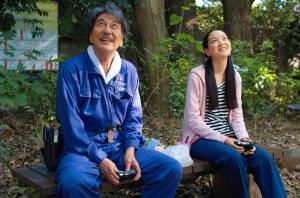
Perfect Days is a film about a man who has achieved perfect presence. The question it never asks is what he is being so perfectly present against.
Let me tell you what this film does before I tell you what it does not know it is doing, because the first part matters enormously and it would be dishonest to skip it.
Perfect Days (2023) is one of the most quietly beautiful films made in a long time. Wim Wenders, the German director of Paris, Texas and Wings of Desire, was invited to Tokyo to make a short promotional piece about a series of architecturally extraordinary public toilets built throughout the Shibuya district. He made a feature film instead. He gave it a man called Hirayama, played by Kōji Yakusho, who won Best Actor at Cannes, and who may give the finest largely wordless performance in recent cinema. And he made a film that, for the better part of two hours, asks you to do nothing except pay attention alongside a man who has learned to pay attention with his entire body.
This is harder than it sounds and rarer than it should be.
| Director | Wim Wenders |
|---|---|
| Year | 2023 |
| Runtime | 124 minutes |
| Cast | Kōji Yakusho, Tokio Emoto, Arisa Nakano, Miyako Tanaka |
| Award | Best Actor (Yakusho), Cannes 2023; Ecumenical Jury Prize, Cannes 2023 |
| Streaming | Criterion Channel, MUBI |
Hirayama’s days have a rhythm so precise it feels choreographed. He wakes before the alarm, folds his bedding, washes his face, tends to the small plants on his balcony. He selects a cassette from a wooden box and slides it into the player in his van. He drives to the toilets. He cleans them with the focus of someone who has decided that the quality of their attention to small things will be the measure of their life. He eats the same lunch in the same park beneath the same trees, photographing the light as it falls through leaves — komorebi, the Japanese word for exactly that dapple of sun and shadow, which exists only at that moment, which cannot be stored, only noticed. In the evenings he reads, drinks a small beer, sleeps, and dreams in black and white. Then he does it again.
The film is in love with this life. And it should be. There is real beauty here, a real argument being made for the kind of presence that most people spend their lives fleeing into distraction to avoid. Wenders means every frame of it, and Yakusho inhabits it with a warmth that never tips into sentimentality.
But here is the thing the film has chosen not to tell you, and chooses not to tell you so carefully that the choice itself becomes the most interesting thing in it.
Hirayama has a past. The film knows this. It shows you the evidence: a niece who arrives unannounced, clearly from another world entirely, sleeping in his van and eating at his regular bar as if the simplicity of his life is something she has been told about and come to see for herself. Then her mother arrives in a car expensive enough to mean something, and the conversation between them, brief and careful and carrying enormous weight, tells you that Hirayama walked away from that world, from money, from status, from whatever it was that world required of him. He chose the toilets. He chose the cassette tapes. He chose this.
Wenders, who revealed in interviews that he conceived of Hirayama as a former wealthy businessman who contemplated suicide before a shaft of sunlight through leaves sent him in a different direction, decided not to put any of this in the film. It exists as negative space. You feel the shape of it without ever being shown what it is. This is a legitimate artistic choice, and for the most part it is the right one. But it means that the film’s celebration of presence and simplicity is built on a foundation the film refuses to examine. Hirayama’s contentment is not innocent. It is a decision. Something specific was left behind. And the rituals that fill his days, the exquisite, repeated, perfected rituals, are not only an expression of joy. They are also what you do when you have decided, with great precision, not to think about the other thing.
Every object Hirayama loves is one that cannot reach back into his attention. The cassette tapes he plays each morning cannot update themselves, cannot send him notifications, cannot ask more of him than he gives. The analog camera requires him to wait, to develop, to discover later what he saw. The paperback novels are inert until he opens them. The komorebi, the light through the leaves, exists only in the moment of looking and then is gone. He has constructed a life of one-way devotion. He attends to things, and they receive his attention and ask for nothing further.
The film presents this as spiritual mastery. It might also be the most elegant possible design for a life in which certain thoughts cannot be allowed to arrive. The beautiful wall is still a wall.
“A man who has found peace is not the same as a man who has found a place where the noise cannot reach him. Perfect Days is too in love with Hirayama to ask which one it is looking at.”
The comparison that earns its place here is not the obvious one. Paterson (Jim Jarmusch, 2016) is close in spirit and is frequently cited alongside this film, and correctly, because both follow quietly contented men moving through their days finding beauty in small things. But in Paterson, we go inside. The bus driver writes poems, and Jarmusch shows them to us. We are not watching from outside a contented man. We are inside the contentment, reading the actual words it produces. There is no distance.
The more illuminating comparison is Tokyo Story (Yasujiro Ozu, 1953), which Wenders invokes deliberately: Hirayama is a name shared with an Ozu character, the film is shot in a 4:3 ratio in Ozu’s city sixty years after his last film, the whole formal inheritance is worn openly. But Ozu’s characters are embedded in life to the point of suffocation. They cannot retreat. The aging parents of Tokyo Story must bear the full weight of their children’s indifference, in real time, with nowhere to go. Hirayama is an Ozu character who has opted out of the very story Ozu would have told him. He saw what was coming and quietly declined. Ozu would have followed him into it. Wenders follows him into the park instead, and watches him photograph the light.
The film ends on Hirayama’s face. He is driving, and Nina Simone is singing, and something moves across him that is not simply happiness: grief and joy and something unnameable all at once. Yakusho holds it for a long, astonishing time, and then the film cuts to black. It is one of the great final images in recent cinema. It is also the only moment in the film where the interior the story has spent two hours protecting from view comes briefly, partially, to the surface.
You never find out what it is.
This is the film’s final, most honest gesture: acknowledging, in its last thirty seconds, that there is something it has not shown you, without telling you what it is. Perfect Days is a film about presence that keeps its own central figure at a beautiful, deliberate remove. The man who has learned to be fully present with the world is the one person in the film the audience is never fully present with.
Perhaps that is exactly right. Perhaps a man who has made himself a wall of beautiful things is not someone whose interior the film is entitled to enter. Perhaps the final shot of that face is Wenders saying: this is as far as we go. What is behind it is his.
If so, it is one of the most generous acts of restraint in recent cinema. And also, quietly, an act of not knowing.
If this stayed with you, watch these next:
Paterson (Jim Jarmusch, 2016): the nearest companion piece, about a man who finds poetry in the ordinary, and the film that shows you what it looks like when a director chooses to go inside rather than stay out.
Tokyo Story (Yasujiro Ozu, 1953): the film Wenders is in conversation with throughout, and the one that reveals, by contrast, what Hirayama has chosen not to have.
UnspokenCinema publishes every week. No ratings. No rankings. Just what films reveal without meaning to.