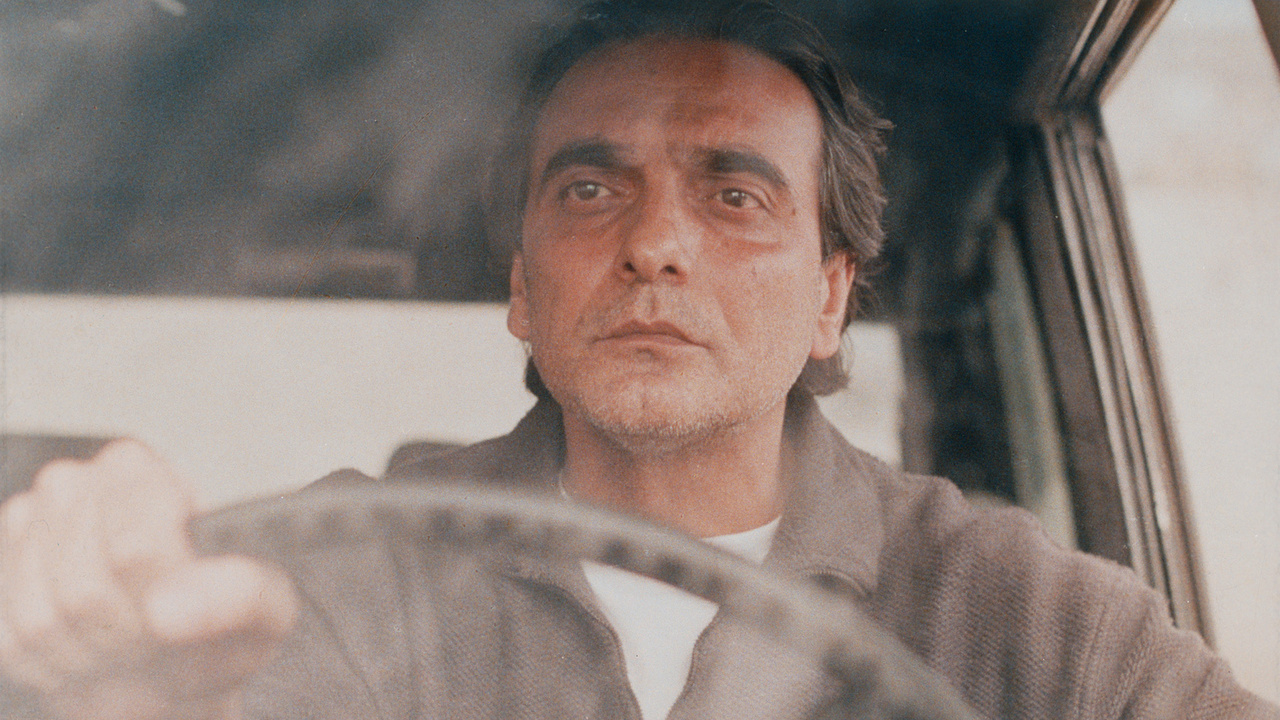
There is a film that will not save your life. I want to be clear about that from the beginning, because the premise will make you think it’s trying to, and it isn’t.
A man drives around the outskirts of Tehran looking for someone willing to bury him after he kills himself. That’s the film. A car. A city’s edge. A series of passengers. A question asked again and again: will you do this for me?
This is not a film about why life is worth living. It does not contain a speech that will change your mind. It does not build toward a revelation. It does not offer you a reason. What it offers you is something so much smaller than a reason that you might miss it entirely, and the missing is part of the design, and the smallness is the point.
Mr. Badii is middle-aged, well-dressed, polite. He drives a Range Rover through the dry, beige hills outside Tehran, and the landscape is so monotone, so indifferent, so completely unconcerned with whether he lives or dies, that you begin to feel what he feels: the world’s absolute neutrality toward your existence. Not cruelty. Not hostility. Neutrality. The hills will be there tomorrow whether you are or not. The construction workers will keep digging. The dust will keep settling.
This neutrality is the first thing the film does to you. It is not dramatic. It is not painful. It is simply accurate. And the accuracy settles into you the way the dust settles on Mr. Badii’s windshield: slowly, without event, until you realize your vision has changed and you can’t say when it happened.
Most films about suicide are urgent. They use music and close-ups and the pressure of ticking clocks to make you feel that something must be done, that the person must be stopped, that life is precious and fragile and worth fighting for. Kiarostami does none of this. He lets Mr. Badii drive. He lets the conversations happen at the speed of conversations. He lets the passengers say what they say: a young soldier who is too frightened to respond, a seminarian who offers religious objections, an old taxidermist who offers something else entirely.
The film is not in a hurry because Mr. Badii is not in a hurry. He has made his decision. He is not asking to be talked out of it. He is asking for a practical favour. And this practicality, this calm attention to logistics in the face of the largest possible decision, is what makes the film so disorienting. You want him to be desperate. You want the film to treat his situation as an emergency. It doesn’t. It treats it as a drive. And you sit in the passenger seat and watch the hills go by and you realize, with a discomfort that has no dramatic equivalent, that this is what it actually looks like. Not the version from movies. The real version. The quiet, logistical, afternoon version, where a man has made a decision and the world has not rearranged itself to stop him.
Then there is Mr. Bagheri.
He is the third passenger. An old man, a taxidermist at a natural history museum. He needs a ride. Mr. Badii offers one, and in exchange, eventually, asks his question. Mr. Bagheri listens. He does not panic. He does not argue. He does not quote scripture or invoke family or deliver the monologue you’ve been waiting for.
He tells a story.
He says that years ago, he went out early one morning to hang himself from a mulberry tree. He had a rope. He had a plan. He climbed the tree. And while he was up there, preparing to die, his hand touched a mulberry. He ate it. Then he ate another. Then he noticed the sunrise. Then he felt the texture of the bark under his fingers. Then some schoolchildren walked by below him, on their way to class, and he called down to them to come shake the tree so the mulberries would fall, and they did, and they laughed, and he filled his pockets.
He came down from the tree. He went home. He brought the mulberries to his wife.
That’s the story.
I need to tell you what this story does, because it will not do the thing you expect.
It does not convince Mr. Badii. The film does not show you a man being saved by an anecdote. Mr. Badii listens. He drives. The conversation moves to other things. The mulberry story sits in the car like a passenger that neither of them looks at directly.
But the story does something to you. Not to Mr. Badii. To you. And what it does is not inspirational and not redemptive and not any of the things a story about choosing life is supposed to be. What it does is this: it makes you aware of taste. Not as a metaphor. As a physical fact. You become aware, sitting in a chair watching a film, that you have a mouth, and the mouth can taste things, and you have been tasting things your entire life without once considering that the tasting is, by itself, an answer to a question you didn’t know you were asking.
The cherry. The mulberry. The fruit whose sweetness is not a reason to live but is, in the moment of tasting, indistinguishable from one. Kiarostami is not arguing that life is sweet. He is not arguing at all. He is pointing at something so small and so constant that you stopped noticing it decades ago: the fact that your senses are still working. That the world is still arriving at your body through your tongue and your skin and your eyes. And that this arriving, this ceaseless, uninvited, unjustified arriving, is not a reason to live but is the thing that living actually consists of, underneath all the reasons.
There is something this film does that I have not encountered in any other.
It makes you pay attention to texture. Not the film’s texture. The world’s. After watching Taste of Cherry, you will notice, for a day or two, the feel of things. The warmth of a cup. The grain of a table. The weight of a blanket. The specific quality of the air at a particular hour. You will notice these things the way you notice them after a fever breaks: with the startled gratitude of a body that has remembered what it can do.
This is not a grand awakening. It is not a transformation. It lasts two days, maybe three, and then the noticing fades and you are back inside the ordinary anaesthesia of a functioning life. But for those two or three days, the world will feel closer. Not more beautiful, not more meaningful. Closer. As if the distance between you and the surface of things has been reduced by a millimetre, and the millimetre makes a difference you can’t articulate but can feel, and the feeling is neither happy nor sad but simply: present.
Kiarostami thought that was enough. The entire film is built on the premise that it’s enough.
After Come and See, you might expect this essay to rebuild what that film tore down. It doesn’t. It can’t. What Come and See removed was the insulation between you and a particular kind of knowledge, and no film, no cherry, no sunrise can put that insulation back.
But Taste of Cherry is not trying to insulate you. It is doing something more modest and, in its own quiet way, more radical. It is asking whether you need insulation in the first place. Whether the exposed, unprotected, fully arriving version of you, the one that Come and See left behind, might be the version that can taste a mulberry and feel it mean something. Not something grand. Not something that redeems suffering or justifies existence. Something the size of a fruit. Something the size of a sunrise. Something so small it can fit in your pocket.
Ikiru‘s Watanabe found his answer in a playground. He built something. He left a mark. His answer to mortality was action, and the action was noble, and the nobility was real, and his colleagues forgot it by the next morning. The answer was large. The forgetting was also large.
Mr. Bagheri found his answer in a mulberry. He built nothing. He left no mark. He put a fruit in his mouth and came down from the tree and brought the rest home in his pockets. The answer was small. Too small, you might think, to hold the weight of the question.
But the question is also small. That’s what the film knows and what we keep getting wrong. The question is not “why should I go on living?” The question is: “Am I willing to taste another cherry?” And the question is asked not once, heroically, on a swing in the snow, but every morning, invisibly, in the ordinary act of putting one thing in your mouth and registering that it has a flavour.
You have been answering this question every day without knowing it. Every cup of tea. Every meal you made without thinking about why you were making it. Every breath that arrived at your body uninvited and was accepted without deliberation. You have been saying yes. The film is simply showing you what your yes looks like from the outside: a man driving through beige hills, still here, still driving, not because he has a reason but because the hills are there and the car is moving and his hands are on the wheel.
A warning, though this one is gentler than the others.
Do not watch this film if you need it to argue with you. If you are in a place where you need to hear reasons, strong reasons, logically organized and passionately delivered, for why your life has value, this film will not provide them. Not because it disagrees. Because it thinks the question is shaped wrong, and it will not engage with a question it considers misshapen, and if you are asking that question in earnest, the film’s refusal to answer it may feel like abandonment.
If you are in that place, talk to a person. A real person, with a voice, in a room. Not a film. Not this essay. A person.
But if you are in a different place, a quieter place, a place where the decision has not been made but the weight of making it has been felt, where you are not in crisis but are simply tired, simply unconvinced, simply aware that the machinery of continuing requires a fuel you can no longer name, then watch this film. Watch it alone. Watch it in the afternoon, when the light is the same colour as the hills outside Tehran. And when Mr. Bagheri tells his story, pay attention to your mouth.
You will feel something. It will not be hope. It will be smaller and more honest than hope. It will be the sensation of a body that is still here, still tasting, still receiving the world through its surfaces. And that sensation, which is not a reason and not a purpose and not a meaning, is the only thing the film offers you. It is also, Kiarostami quietly insists, the only thing you need.
The film ends with a scene that has confused and angered people for decades, and I want to tell you what it does.
The screen goes dark. Mr. Badii has lain down in his grave. Rain falls. You believe the film is ending in death, in silence, in the unanswered question.
Then the image changes. Handheld video footage. Grainy, bright, overexposed. Soldiers walking on a hillside. A film crew. Kiarostami himself, smoking. The actor who plays Mr. Badii, standing, alive, stretching his legs. Louis Armstrong’s trumpet plays over the footage, warm and scratchy and completely out of place.
This is Kiarostami pulling the frame back. Not to show you the making of the film. To show you the world that exists outside the film. The world where the actor is alive and the hills are green and someone is playing a trumpet and the question that consumed you for ninety minutes is revealed to be what it always was: a construction. A story. A thing made by human hands in a world that is still, stubbornly, going on.
The trumpet is a cherry. The footage is a cherry. The film looks at you and says: you are sitting in a chair. You are alive. You have been watching a man decide whether to die, and you have been breathing the whole time, and the breathing was involuntary, and the involuntary breath is the answer, and it has been the answer since before you pressed play.
Come down from the tree.
Your pockets are empty. The mulberries are right there.
One response to “Taste of Cherry (1997) — Dir. Abbas Kiarostami”
Interesting piece you’ve got. But I dare say that the taxidermist’s words moved the main character more than you gave them credit for.
Why would he rush back and tell the taxidermist to remember to throw rocks and do other things to try waking him up?