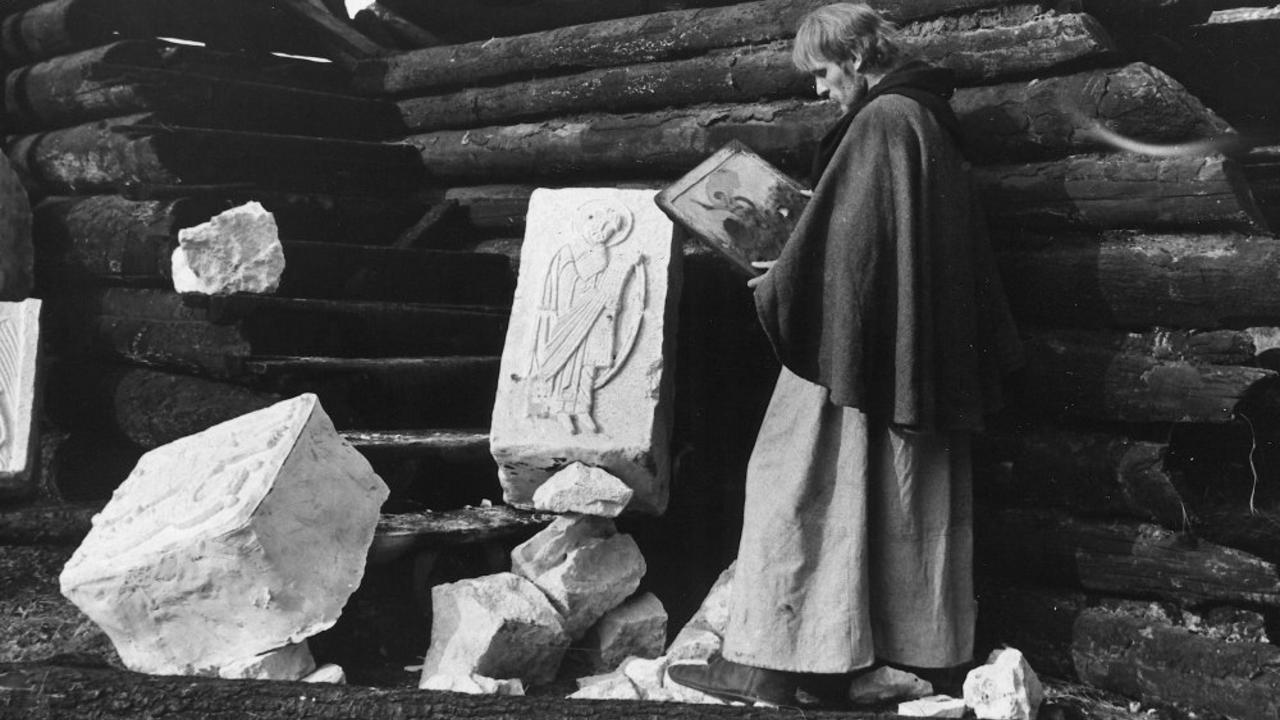
There is a film that will make you ashamed of every excuse you’ve ever made for not doing your work.
Not embarrassed. Not mildly guilty. Ashamed. The specific, load-bearing shame of a person who has been given the ability to make something and has spent years explaining, to themselves and others, why the conditions aren’t right. The world is too cruel. The audience won’t understand. The market doesn’t want it. The timing is wrong. I need to wait until I’m ready. I need to wait until things are better. I need to wait until the noise stops.
Andrei Rublev takes place in fifteenth-century Russia, during a period of such sustained, monotonous brutality that the word “brutal” loses its meaning within the first hour. Mongol raids. Feudal cruelty. Famine. Blinding. Burning. The systematic destruction of everything beautiful by people who are not evil but are simply operating inside a system that treats beauty as an irrelevance and human life as a material.
In this world, a monk paints icons. He paints them with such tenderness, such impossible attention to the human face, that the paintings survive six hundred years and are still, today, among the most beautiful objects ever made by a human hand.
The film is about how. Not how technically. How morally. How a person continues to make beautiful things in a world that is actively, energetically, and without apology, ugly.
You will watch this and you will feel your excuses become very, very small.
Andrei Rublev is a monk, a wanderer, an artist who speaks little and watches everything. Tarkovsky follows him through decades of medieval Russian life, structured not as a narrative but as a series of episodes, each one a chapter in a country’s slow education in suffering. “The Jester.” “The Passion According to Andrei.” “The Raid.” “The Bell.” Each episode shows Rublev witnessing something: cruelty, faith, betrayal, creation, destruction. And each episode changes him, though the changes are not dramatic. They are geological. You see them the way you see erosion. Slowly. Over distances that require patience to cross.
Rublev does not fight. He does not preach. For a significant portion of the film, he does not even paint. After witnessing a particularly devastating act of violence, he takes a vow of silence and stops making art entirely. He sits. He waits. He carries the weight of what he has seen and cannot justify the act of creation in a world that specializes in destruction.
This is the crisis the film is built around, and it is not a medieval crisis. It is yours. If you have ever made anything, if you have ever written a sentence or composed a melody or built a thing with your hands or your mind, you have had the moment where the world’s indifference or hostility to what you make became so loud that making felt like a delusion. A vanity. A small person arranging flowers on the deck of a ship that is, quite obviously, sinking.
Rublev stops painting. You have stopped too. Maybe not formally. Maybe you still go through the motions. But there was a day when the making shifted from necessity to performance, and you know the day, and you have been performing ever since, and the performance is exhausting, and the exhaustion is what you call burnout, and the burnout is not a condition. It is a question. The question is: why make something beautiful in a world that will destroy it?
Tarkovsky spent three and a half hours building this question. He will answer it in the last forty minutes. And the answer will involve a boy, a pit of clay, and a bell.
The boy’s name is Boriska. He appears in the final chapter of the film, and he is not a painter. He is the son of a bell-maker who has died, and he claims to know the secret of casting bells. He is probably lying. He is almost certainly lying. He is a teenager who has watched his father work and is now telling the Grand Prince’s men that he can do what his father did, because the alternative is irrelevance, and irrelevance, for Boriska, is a kind of death.
They give him the commission. He digs the pit. He mixes the clay. He directs grown men with the authority of someone who has no idea whether what he’s doing will work but has committed to the doing so completely that doubt has become a luxury he cannot afford. The entire sequence takes nearly forty minutes of screen time and Tarkovsky films it with the attention of a man watching a birth: every detail, every setback, every moment where the project threatens to collapse, every moment where Boriska’s faith in his own ability is tested against the indifference of physics and weather and the men who are beginning to suspect that this boy is making it up as he goes.
He is making it up as he goes. That is the point.
The bell is cast. It is raised. The moment arrives: the clapper swings. And the bell rings.
It rings.
You will feel this in your body. Not because the sound is beautiful, though it is. Because of what the sound represents, which is the most terrifying and most necessary thing any maker ever faces: the moment where the work is tested against reality. The moment where you stop planning and preparing and researching and outlining and show the thing to the world and the world either rings or doesn’t and you cannot control which.
Boriska collapses. He falls into the mud and weeps. Not from joy. From the release of a terror so total that it could only be held together by forward motion, by the refusal to stop and examine whether what he was doing was possible. He made it up. He didn’t know the secret. His father never told him. He bluffed his way into the commission and then he did the work, and the work was honest even if the claim was not, and the bell rang because the honesty of the labour was stronger than the dishonesty of the premise.
This is Tarkovsky’s answer. Not to the question of whether art matters. To the question of how you make art when you don’t know if it matters. The answer is: you don’t know. You make it up. You dig the pit and mix the clay and direct the men and commit to the doing with such totality that the question of whether it matters becomes irrelevant, because the doing has consumed you, and inside the doing there is no room for the question, and the bell either rings or it doesn’t, and you will not know until the clapper swings.
Rublev watches the boy collapse. He has been silent for years. He has not painted. He has carried the weight of a world that burns churches and blinds craftsmen and salts the earth where beautiful things were planted. He has had every reason to stay silent and no reason to begin again.
He walks to Boriska. He kneels beside him in the mud. And he speaks. The first words he has said in years.
He tells the boy they will work together. He, Rublev, will paint. The boy will cast bells. They will make things. In this world. This one. The one that burns and blinds and destroys. This one, because it is the only one, and the making is not a response to the destruction. It is not a protest or a defiance or a consolation. It is simply the other thing that humans do. Alongside the destroying, there is the making. And neither one cancels the other. And neither one justifies the other. And doing one in the presence of the other is not heroism. It is just the full exercise of what it means to be a human being in a world that contains both capacities.
This is not an inspirational message. It is something harder and more durable than inspiration. It is permission. Permission to make things in a world that doesn’t deserve them. Permission to care about beauty in the presence of ugliness. Permission to paint an icon while the village burns, not because the icon will stop the fire but because the icon and the fire are both true, and refusing to paint because of the fire is just another way of letting the fire win, and the fire does not need your help.
Then Tarkovsky does something that I have never recovered from.
The film has been in black and white for three and a half hours. The medieval world, the mud, the violence, the snow, the faces, all rendered in the grey, muted palette of a world that has not earned colour.
And then, in the final minutes, the camera moves to the icons. Rublev’s actual paintings. And they are in colour. Full, saturated, blazing colour. Gold and blue and red and the specific, heartbreaking tenderness of faces painted by a man who looked at the worst the world had to offer and responded by painting the most gentle, most compassionate, most human faces he could imagine.
You will not be prepared for this. The colour will hit you like sound after silence. After three and a half hours of grey, the blue of a robe will feel like a physical event. And you will understand, in the way that only the body understands, what Rublev was doing. He was not ignoring the world’s cruelty. He was not transcending it. He was answering it. With colour. With tenderness. With faces that look at you across six centuries with an expression that is neither happy nor sad but simply, completely, present.
The icons survive. The world that tried to destroy them does not. The princes are forgotten. The armies are dust. The raids are footnotes. And the faces remain. Blue and gold and looking at you. Still looking.
Come and See showed you the destroying. The full, unwatchable, unredeemable scope of what human beings do to each other. Andrei Rublev does not argue with Come and See. It does not soften it. It simply places the other thing beside it. The making. The icon next to the fire. And it asks you to hold both. Not to choose. Not to reconcile. To hold.
Taste of Cherry offered you a mulberry. A small, sensory, immediate reason to stay. Andrei Rublev offers you something different. Not a reason to stay. A reason to work. And the reason is not a reason at all. It is a boy in a pit of mud, weeping, because the bell rang, and he didn’t know it would, and he did it anyway.
A warning.
Do not watch this film if you are waiting to begin. If you are in the planning stage, the preparation stage, the “I’ll start when I’m ready” stage, this film will not be patient with you. It will not shame you directly. It will simply show you a boy who was not ready and began anyway, and a monk who had every reason to stop and didn’t stay stopped, and the distance between their courage and your caution will be measured in the silence after the bell rings, and the silence will be long, and you will sit in it.
Do not watch it if you need to believe that the world will value what you make. The world in this film does not value what Rublev makes. It burns it, steals it, forgets it. The world six hundred years later values it, but Rublev doesn’t know that, and the film does not offer him that consolation, and it will not offer it to you.
Watch it if you are ready to begin without knowing whether the bell will ring. Watch it if you are ready to dig the pit and mix the clay and commit to the work with the full knowledge that the secret was never passed down, that you are making it up, that every maker who ever lived was making it up, and that the making-it-up is not a flaw in the process. It is the process.
The last image of the film is rain falling on horses in a field. After the icons, after the colour, after six centuries of looking, Tarkovsky returns you to the world. The grey, wet, ordinary world. Horses standing in rain. No music. No message. Just the world, still there, still raining, still containing both the capacity to burn a church and the capacity to paint one.
You will leave the film and the world will look the same. The same streets, the same light, the same Tuesday. But somewhere in you, in the place where the excuses lived, there will be a different weight. Not inspiration. Not motivation. Something colder and more useful. The knowledge that a boy who didn’t know the secret cast a bell that rang, and a monk who had stopped painting started again, and neither of them waited for the world to deserve it.
The pit is there. The clay is there. The world is still burning, still building, still both.
Your hands are free.